Company Insight
Sponsored by Applied Virtual Simulation
The Technology Behind the Australian Army’s Unified Virtual Battlespace
The mining sector is notorious for being slow when it comes to embracing new technology.
Main image credit:
The Australian Army’s approach to simulation training is undergoing a major evolution—one that could set the standard for military forces around the world. At the centre of this transformation is the Common Simulation Software (CSS) developed by Applied Virtual Simulation (AVS) as part of the Army’s LS CORE Tranche 1 program.
Developed using the Australian Generic Simulation Architecture (GSimA), CSS is designed to serve as the unifying backbone for simulation-based training across all corps. The system has already undergone a rigorous testing and acceptance process and will shortly be rolled out across the Army’s Land Simulation Network.
We spoke with Paul Rogers, Director of Business Development at AVS, about what this means for the future of Army training, how CSS is already reshaping operational readiness, and why open-architecture simulation may be one of the most consequential shifts in Defence capability development this decade.
With diesel vehicles accounting for 30% to 50% of greenhouse emissions at a mine site, replacing them with a battery-electric fleet is a sure way to drastically reduce overall CO2 emissions, but how else can mines benefit from this technology?
Leading underground manufacturers Normet believe the answer lies with SmartDrive. This architecture for battery electric vehicles (BEV) was developed in collaboration with customers, building on feedback, predicting future trends, and assessing the limitations of diesel engines, and comes with a wealth of benefits for operators.
Can you tell us a bit about CSS and how it differs from simulations currently used?
The difference between the CSS and most common simulation systems or simulators is they're often built on proprietary software for the vendors of those machines or that software. The ability for other simulation systems and other software to connect into it is often an expensive process, if not sometimes impossible, to connect the two, whether it's software or hardware. CSS is built on the Australian Generic Simulation Architecture, which allows anyone to plug in their simulators or simulation systems into one federated system.
What kind of scale are we looking at with CSS, how many soldiers can you have active in one arena at any time?
It's an open-ended question depending on the network where you are and what you're doing, but to have a squadron of helicopters, a squadron of tanks, three or four PMTTs, you're talking about many soldiers on the simulators at the same time, and lets not forget the staff officers ‘on the CSS’ who are doing constructive simulation at the same time.

In early June 2019, mining companies avoided increases to royalties by agreeing to provide A$70m to a A$100m infrastructure fund.
Frank Smith, Founder and CEO of TowHaul
CSS opens a lot of options in terms of the type of operations and military training they can now perform through their simulation system. What do you anticipate as to what their training and operative capabilities are going to be with this software now?
During recent testing we had 30 soldiers in Darwin operating the simulation system, and you had soldiers in Canberra operating the system simultaneously. So, what we're already demonstrating is the defence network can use it for real time training at multiple sites. This is Army's future endeavour; you want to be able to get into those tank simulation systems in Townsville, the Protected Mobility Tactical Training (PMTT) systems in Brisbane and Darwin, whilst you've got some helicopter simulators at Oakey, and you're all on at the same time rehearsing for a Talisman Sabre. You're actually rehearsing scenarios over and over in the simulator, all talking to each other on the same map at the same time. They could be virtually flying over Shoalwater Bay from Townsville or Darwin or Adelaide, rehearsing with the tanks who are driving through that same terrain in Shoalwater Bay, and no one has left their home base.
No army in the world has this yet. We're at the leading edge of technology here.
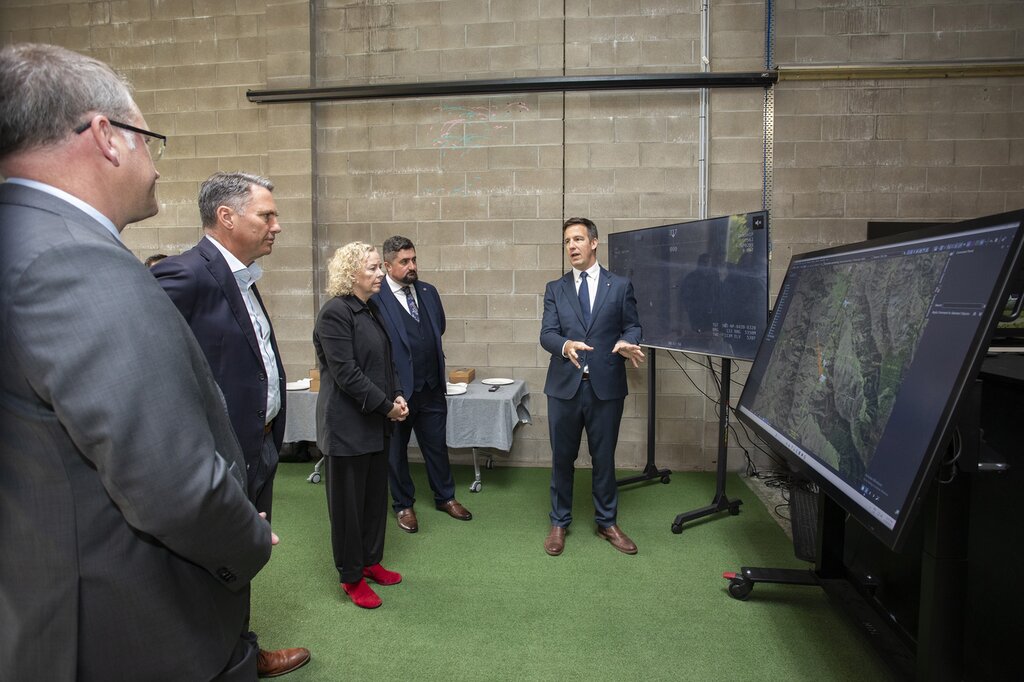
Richard Marles, Deputy Prime Minister of Australia and Minister for Defence, being shown the full integration of multiple simulators and simulation feeds into the CSS.
Phillip Day. Credit: Scotgold Resources
What has the Army’s response been so far, having had CSS integrated for a while now?
From what we’re seeing, Army has been clear in its messaging that CSS is here to stay and that it’s important that when the simulation industry is proposing a simulation solution, that it can integrate with CSS.
The new Abrams tank simulators that have been just delivered to Townsville, they all have CSS in them, as do the new Redback IFVs. The Universal Motion Simulator systems at Puckapunyal all have the same software in them. So, Army is already moving towards getting all these simulation systems onto the CSS.
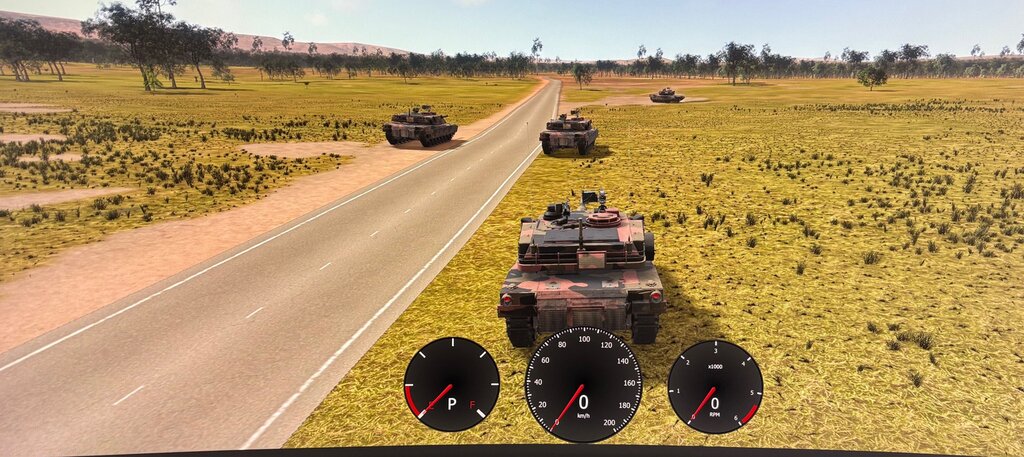
Richard Marles, Deputy Prime Minister of Australia and Minister for Defence, being shown the full integration of multiple simulators and simulation feeds into the CSS.
How do the costs of CSS compare to current systems? Being a holistic system, you’re not really comparing apples to apples, but how do costs compare in terms of what the military is going to be able to achieve?
I think there's several aspects to that. If you talk just about the software and the simulation itself, what you gain is significant efficiencies in the fact that a vendor can no longer bring their own proprietary simulator to the army. It must integrate with this system. So, what you do is you break down those commercial barriers where companies can charge a lot of money for their particular simulator for their particular style of software that won't integrate with anything else.
When I look at it as a previous Army Commanding Officer, it’s the saving of costs to run my vehicles - I can now do multiple domain vehicle activities and operations exercises in simulation that we've never been able to do. It's in the fact that I don't need to fly my Apache for four hours a day at $40,000 dollars an hour, or whatever the cost is, to get to Townsville to then go to the field to operate with tanks. It’s in taking soldiers away from families and homes less. We're never going to stop exercising because I know as well as anyone else, you need the real thing, but with these simulation systems linked to the CSS, you can rehearse and rehearse without expensive ammunition usage, fuel usage, and putting kilometres on vehicles and hours on helicopters. If you've got world leading simulators connected to a CSS that can now operate anywhere on the planet, that's where I think value is going to be absolutely phenomenal, almost unquantifiable.
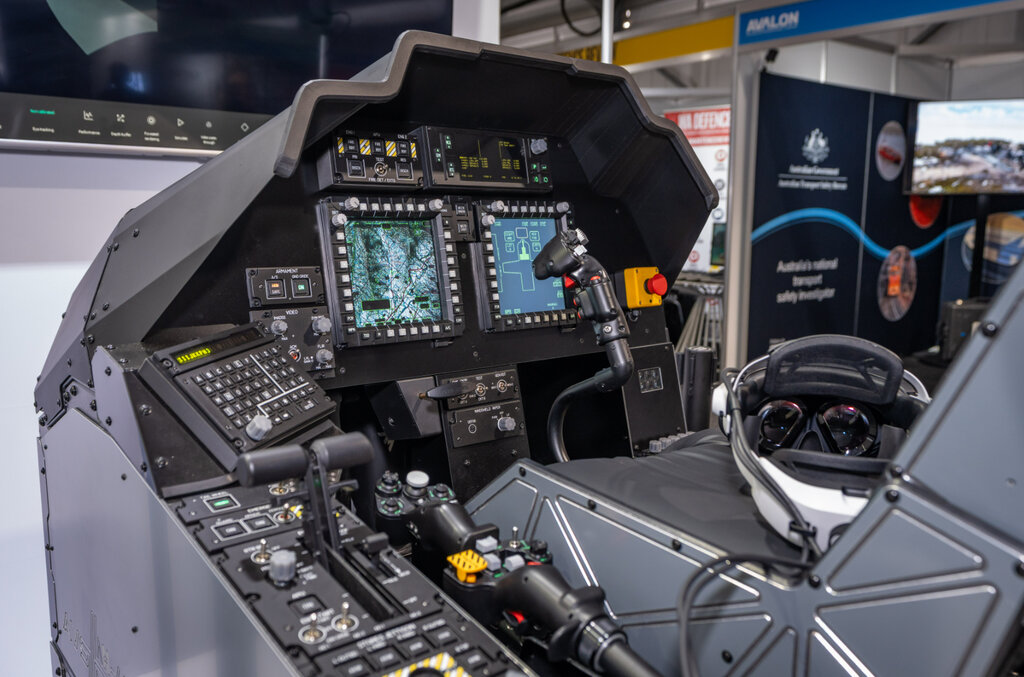
Apache Tactical Trainer Capability Demonstrator: The mixed-reality Apache simulator bridges the gap between high- and low-fidelity training. Developed with MultiSim and powered by the Varjo XR-4 Focal, it enables affordable, networked tactical training with a fully operational medium-fidelity cockpit.
It appears that CSS is really going to be a turning point in how Australian military trains. What are your aspirations for global deployment?
There are absolutely aspirations. We are looking at multiple overseas markets, and we are operational in the United Kingdom with AVS UK now established. We've had success selling our UAV first person training systems - Obriy, to multiple NATO countries- so we are absolutely in the international market.
A lot of other countries are now starting to ask questions about the CSS. Once we formally get accepted and announced by the Australian Army, we will see what other opportunities we can take.
Contact information
Applied Virtual Simulation Pty Ltd
Email: info@appliedvirtual.net
Web: www.appliedvirtual.net

- Biffa internal savings data, average saving (January - August 2023)
- Nisbets internal savings data, average saving (January – September 2023)
- Compliance365 internal data, average savings
- HEINEKEN UK data, Calculations based on SmartDispense® active accounts each year since 2015 with 10 lines
- Independent test results based on subterranean and ground floor pub cellars of varying sizes
- Independent test results based on subterranean and ground floor pub cellars of varying sizes
