Feature
Test subject: Pentagon cuts into ODOT&E
A drive for fiscal efficiency in the Pentagon has found its way into military testing and evaluation. Jen Kirby reports.
Main image: The far-reaching Pentagon audit is having a profound impact. Credit: Ivan Cholakov / Shutterstock
Feature
Taking stock: Europe’s rearmament quest
Europe greases the wheels of ammunition production through innovation and coordination – but is it enough? John Hill reports.
A hypersonic sled travelling at 6,400ft per second during a US test. Credit: US DoD
In 1983, the United States Congress created the Office of the Director of Operational Test and Evaluation (ODOT&E), an independent agency to monitor weapons testing at the Pentagon.
Lawmakers were responding to troubling reports that the US military was deploying systems without adequately evaluating them in combat-like situations – for example, missile tests against dummy targets rather than something to simulate a Soviet jet.
A bipartisan group believed these failures bloated the defence budget while undermining America’s military. ''Too often, the attitude is, 'Buy it now, Band-Aid it later,’” Willliam V. Roth Jr., a Republican senator from Delaware, said ahead of a 1983 hearing. Defence officials and contractors resisted the oversight, arguing it would add an unnecessary layer of bureaucracy, though they lost that battle.
But ODOT&E’s future role in weapons oversight is in doubt after the Pentagon ordered a “strategic and deliberate reorganisation” of the agency and dramatically slashed its staff and budget.
On 27 May, Secretary of Defense Pete Hegseth issued a memo saying that “a comprehensive internal review has identified redundant, nonessential, non-statutory functions within ODOT&E that do not support operational agility or resource efficiency, affecting our ability to rapidly and effectively deploy the best systems to the warfighter.”
Hegseth did not go into specifics on the review, and a US defence official referred to the 27 May memo when Global Defence Technology asked about its conclusions, but the order effectively calls for a more than 70 percent reduction of ODOT&E’s employees down to 30 civilian and 15 military staff. The memo also ended all contractor personnel support, though the ODOT&E could submit contractor requests for review after a 60-day "acclimation period.” (A US defence official said ODOT&E is working on this update.)
Hegseth said this reorganisation will save $300m per year and reflects the Department’s commitment to “continued reform and reducing bureaucracy.” About $350m was appropriated to ODOT&E in fiscal year 2025, according to Pentagon budget documents.
ODOT&E’s reorganisation looks more like a gutting, and it is happening as the Pentagon is fielding new and expensive advanced programmes and as US military is pushing to integrate artificial intelligence into its operations.
Former ODOT&E and defence officials agree the weapons testing process needs reform. Some see promise in the ODOT&E shakeup because so many layers of testing already exist. Others fear a premature push toward automation and a dramatic loss of institutional expertise that will recreate the conditions ODOT&E was established 40 years ago to prevent: wasteful spending on weapons that will fail America’s warfighters.
“I just don't know how you're going to protect the taxpayer,” said Robert F. Behler, who served as the director of Operational Test & Evaluation from 2017 to 2021 during the first Trump administration.
“Most importantly, it's the individual that's at the tip of the spear. The individual is taking these weapon systems into combat. That's who I work for.”
ODOT&E wasn’t perfect. Is this “reorganisation” the remedy?
The Golden Dome is President Donald Trump’s (at least) $175bn plan to deploy a space-based missile defence capability. Its price tag alone makes it a candidate for ODOT&E review. Its purpose – to shield the country from missiles, including with interceptors launched from satellites – means the US and its allies need to be completely certain the whole thing works.
But ODOT&E’s decision to put Golden Dome on its oversight list may have spurred the Pentagon to scrutinize the office, according to reporting from Defense News. The Pentagon did not return a request for comment by Global Defence Technology.
At a June Congressional hearing, Senator Mark Kelly, a Democrat from Arizona, asked Hegseth whether the Golden Dome prompted ODOT&E reorganisation.
“The concerns were not specific to Golden Dome, sir,” Hegseth responded. “It was years and years of delays unnecessarily based on redundancies in the decision-making process that the services, COCOMs [Combatant Commands] and the Joint Staff, together with [Office of the Secretary of Defence], identified as log jam.”

The idea is to make the testing as realistic as possible.
Douglas Schmidt, former director of OT&E
Hegseth’s comments represent a long-standing tension between ODOT&E and parts of the Pentagon.
Testing happens at every stage of a weapon’s lifecycle, and all branches of the armed services undertake operational testing. ODOT&E approves and oversees operational weapons tests for certain major acquisitions, and it analyses those results to determine the effectiveness, survivability, suitability, and the lethality of American arms.
“The idea is to make the testing as realistic as possible so that the warfighters who are going to put themselves in harm’s way have confidence the systems work as intended in the actual environment they're going to be used,” said Douglas Schmidt, the dean of William & Mary's School of Computing, Data Sciences & Physics who served as the director of OT&E from April 2024 to January 2025.
The ODOT&E essentially grades the armed services on their operational-test homework, but it does not have the power to kill programmes. It delivers its findings to Pentagon leadership, and critically, to Congress. But bad marks can be hard to ignore, and this can create friction with military leaders, who want to get marquee weapons out the door, and see ODOT&E as delaying platforms by being too risk-averse and coming in too late and taking too long to issue its reports.
Congress understood the potential conflicts when those building and fielding the weapons are also evaluating them, which is why they wanted an independent auditor. “You don't want the students to grade their own papers,” Schmidt said.
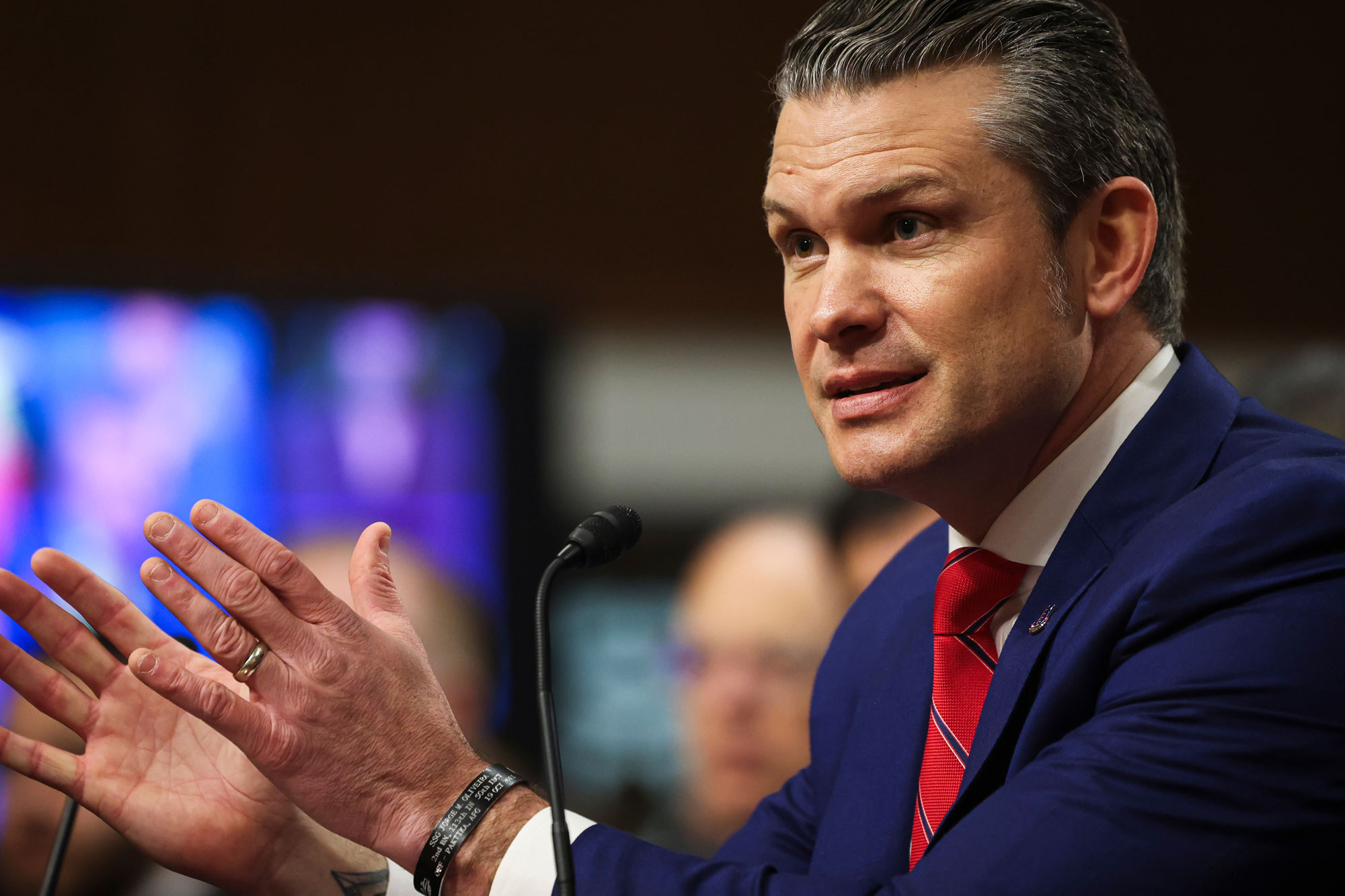
Secretary of Defense Pete Hegseth wants to cut fiscal waste. Credit: Joshua Sukoff / Shutterstock
But even before Hegseth’s memo, both supporters and critics of ODOT&E felt it needed to become more responsive to a rapidly evolving technological and threat environment. "When I was in the Pentagon, I was advocating to say, 'we've got to figure out how to streamline the layers of testing because our adversary will get their systems out far faster than we can, because it's a process we have defined,” said Heidi Shyu, a former Under Secretary of Defence for Research and Engineering from 2021 to 2025.
Shyu said instead of a “grade your homework” mentality, ODOT&E should be about helping with the homework. Former ODOT&E officials also saw a need for more integrated or continuous testing, making contractor, developmental – ensuring weapons met their specs – and operational testing happen more fluidly by passing data from one phase to another, with the goal of saving time and money and getting weapons to warfighters quickly.
Digital twins and automation
Today’s software-intensive platforms demand this, as they constantly require updating. “The operational test community needed to start thinking about weapon systems that were going to change over time as a natural consequence of complex weapons systems,” said Nickolas Guertin, director of OT&E from 2021 to 2023.
The answer to fixing those problems is not getting rid of most of the people.
Missy Cummings, former US Navy fighter pilot
Guertin said ODOT&E understood it needed to get involved earlier in the production cycle. “The office was on the march to be more responsive, more competent, and more effective,” Guertin said.
That also means leveraging tools like automation and artificial intelligence to do more effective testing at scale. Dr. Amy Henninger, Trump’s pick to lead the ODOT&E, said at her Senate confirmation hearing in July that she would “press for speed, automation, and digital testing everywhere where I possibly can, caution wherever necessary, and clarity always.”
Henninger also testified she would seek to surge beyond manpower, looking at “automation, more automated teaming, more digital methods, digital modeling to speed and facilitate our test and evaluation processes.”
Testing officials share those goals, but caution the technology is not yet at a place to replace human expertise. “That's a message that people really need to understand, because it's very convenient to think, ‘Oh, well, we'll just replace all these people with digital twins, and then we can do simulations – but it turns out that the amount of money it takes to get those simulations to the point that are realistic probably costs more than all the people that we just fired,” Schmidt said.

The US military operates highly complex systems, such as the V-22 Osprey. Credit: US Army
All of this requires deep expertise and institutional knowledge. As OTOD&E looks to be more responsive, staff reductions, including outside contractors and researchers, is undermining the critical technical capabilities necessary to make and stress-test the advanced weapons America wants to deploy.
“The answer to fixing those problems is not getting rid of most of the people,” said Missy Cummings, one of the US Navy’s first female fighter pilots and an expert in autonomous systems at George Mason University. “If you get rid of most of the people, it really communicates to industry that they can cut corners – and they will.”
“That kind of decoupling is a lot more complicated than people would want to implement, and it's also a really expensive affair because it's not about just stopping the acquisition of new weapons. It's also about what you do with all of the training, the infrastructure, the planning for all of these contracts that are meant to last.”
Any breakup will also be painful for the US firms, which rely on partners to co-invest in research and systems development. The development and construction of F-35s is a project among allies, with components manufactured outside the US, including in Denmark and the United Kingdom.
“I think Lockheed Martin – as would the different subcontractors – would be very upset if there was any instability in the projected purchases of the F-35 from other countries,” said Bert Chapman, a professor at Purdue University and author of Global Defense Procurement and the F-35 Joint Strike Fighter.

Caption. Credit:
Phillip Day. Credit: Scotgold Resources
Total annual production
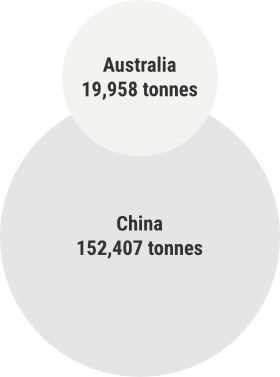
Australia could be one of the main beneficiaries of this dramatic increase in demand, where private companies and local governments alike are eager to expand the country’s nascent rare earths production. In 2021, Australia produced the fourth-most rare earths in the world. It’s total annual production of 19,958 tonnes remains significantly less than the mammoth 152,407 tonnes produced by China, but a dramatic improvement over the 1,995 tonnes produced domestically in 2011.
The dominance of China in the rare earths space has also encouraged other countries, notably the US, to look further afield for rare earth deposits to diversify their supply of the increasingly vital minerals. With the US eager to ringfence rare earth production within its allies as part of the Inflation Reduction Act, including potentially allowing the Department of Defense to invest in Australian rare earths, there could be an unexpected windfall for Australian rare earths producers.
