Feature
Autonomous AFVs: stuck in neutral
Drones have caused mounting AFV losses on the ground, but also prompted questions about the design, purpose, and strategy of a timeless platform. John Hill reports.
Main image: British troops and vehicles deployed on exercise in Estonia. UK MoD/Crown copyright
Cover Story
Eye in the sky
As the first line of threat detection, airborne early warning is a must-have capability for the world’s militaries. Gordon Arthur reports.
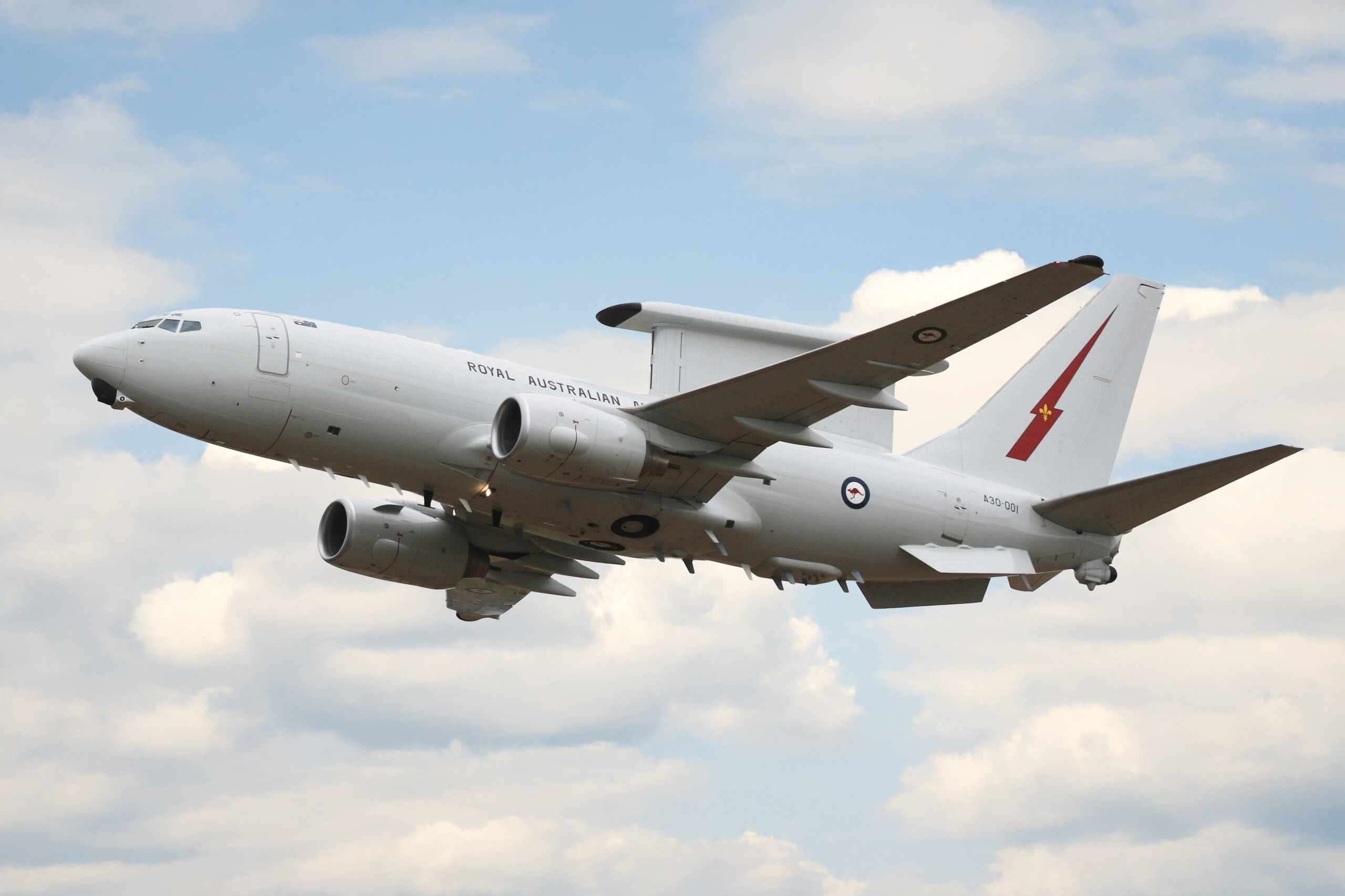
Australia was the first country to adopt the E-7A Wedgetail. Credit: Gordon Arthur
It comes as no surprise that tension with Russia amid the war in Ukraine is driving European and Nato countries to improve their land mobility capabilities with new platforms able to counter the heavily armoured and mechanised formations of the Russian Army.
Likewise, industry is proving responsive to the new requirements for armoured fighting vehicles (AFVs) in a battlespace saturated with evasive, manoeuvrable, and uncrewed aerial systems.
New and various AFV designs were displayed at the DSEI 2025 exhibition in London in September, with a particular focus on counter-drone technologies. But in speaking to various leading voices across industry and academia, Global Defence Technology discerned an incisive debate proceeding within the land vehicle market around autonomy and automation.
The AFV market is being shaped by this emerging threat landscape, and it is through this lens that AFVs must first be examined.
The DroneGun Mk4 is a handheld countermeasure against uncrewed aerial systems. Credit: DroneShield
Overhead threat
Recently, it was found that around 80% of casaulties in the Russia-Ukraine war are caused by drones. There is clearly a need to counter uncrewed aerial systems (C-UAS) and top-attack tactics, prompting industry to respond in kind with crucial changes in AFV design, purpose, and strategy.
“We’re seeing… legacy platforms that are very reliable, mixed in with [capabilities that are] more technologically advanced,” described John Borton, managing director for weapon systems, BAE Systems UK, during a panel discussion with American and Swedish colleagues on the continued relevance and utility of the AFV during DSEI 2025.
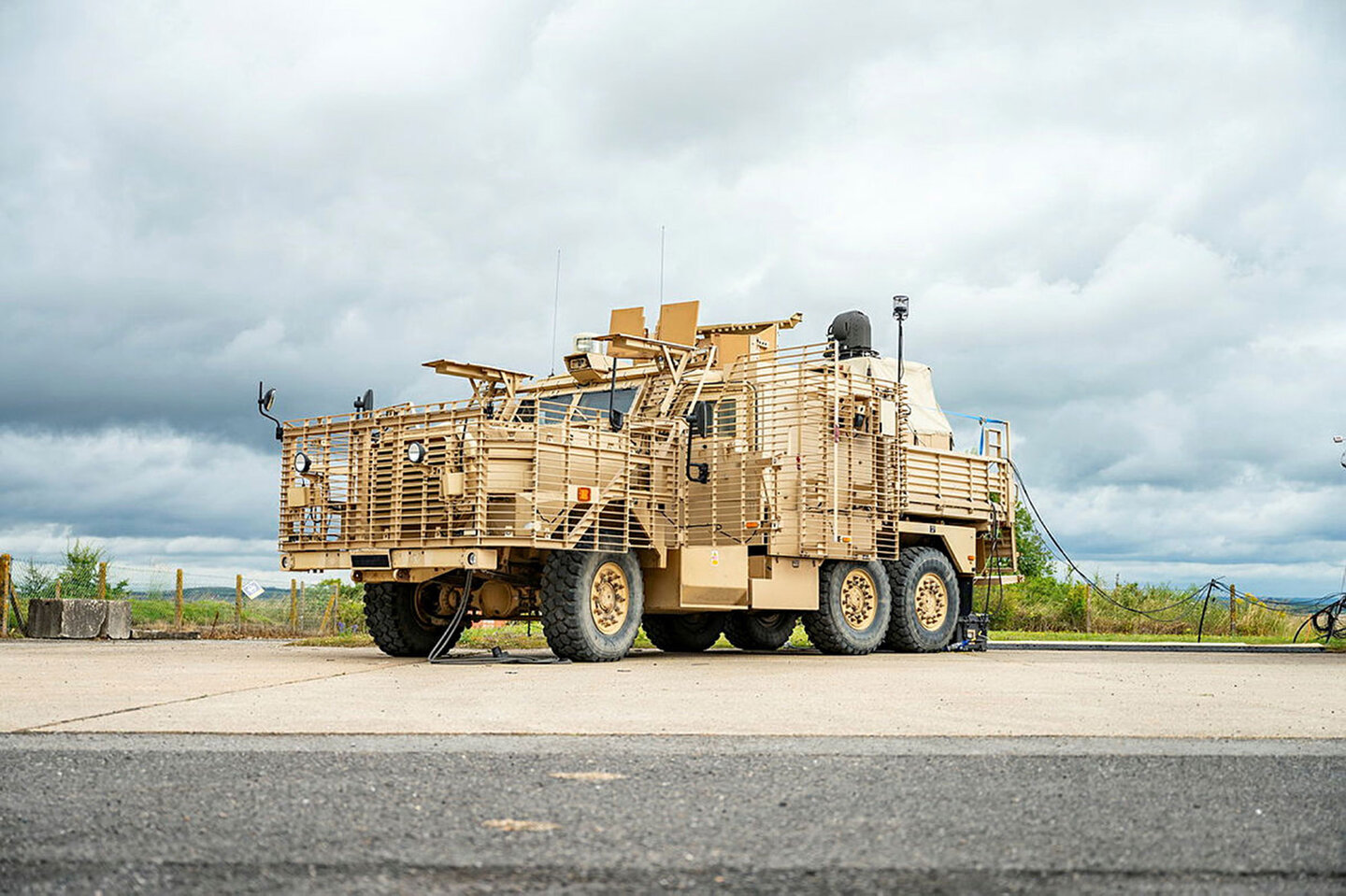
British Army test 15-kilowatt laser weapon on Wolfhound. Credit: UK MoD/Crown copyright
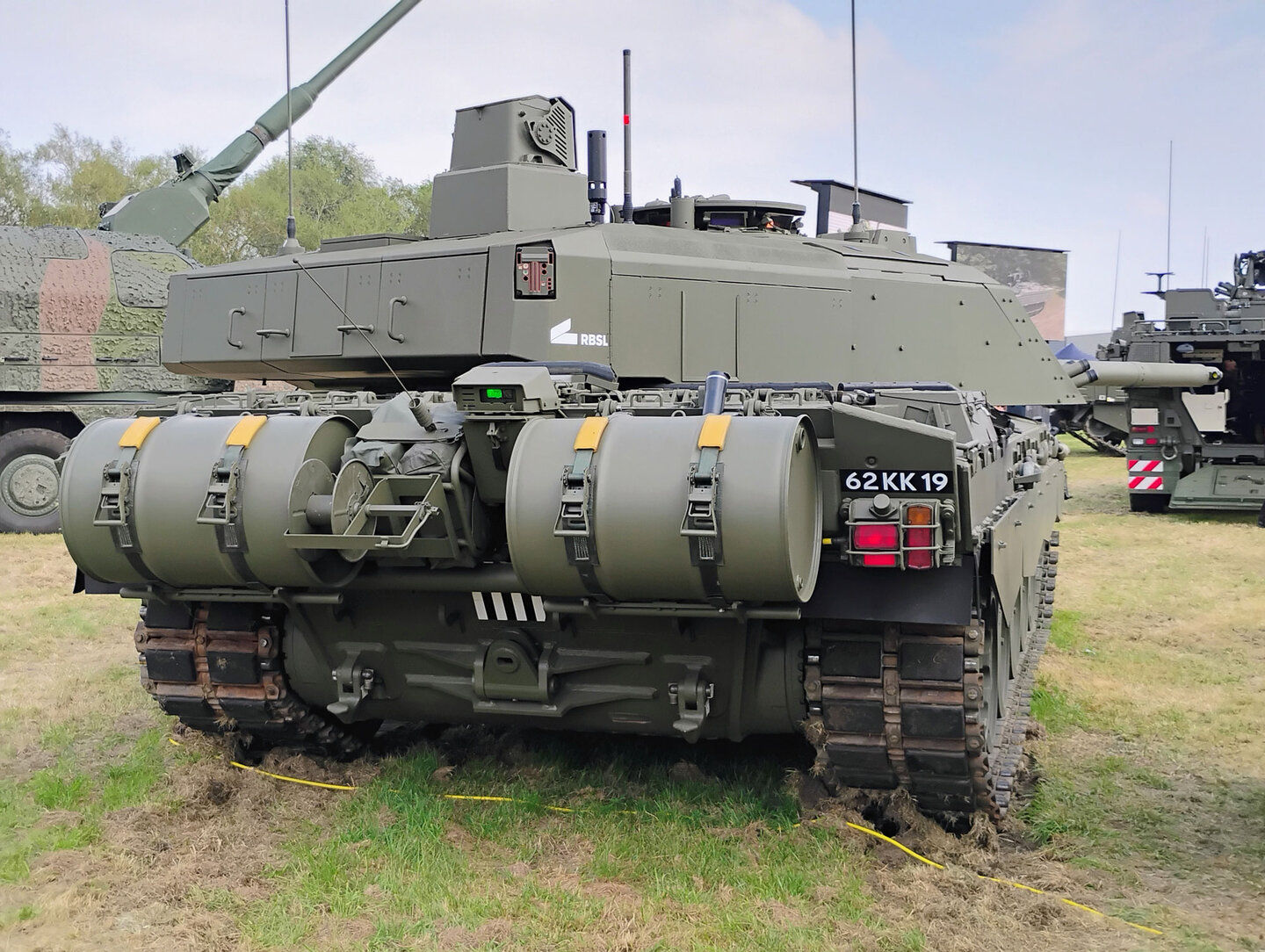
The UK Armed Forces, for example, have tested a number of directed energy weapon (DEW) systems. One concept saw the British Army mount a 15 kilowatt laser on a 6x6 Wolfhound armoured vehicle in September last year. The weapon system reportedly neutralised targets at distances reaching more than one kilometre.
Likewise, the service trialed a radio frequency DEW system that downed a drone swarm of 100 small airborne vehicles at a range of one kilometre and at a cost of 10 pence (13 cents) per shot. Anything that transmits over the electromagnetic spectrum, such as drone signals, are at risk to non-kinetic effects; there will be a sustained development of these denial capabilities.
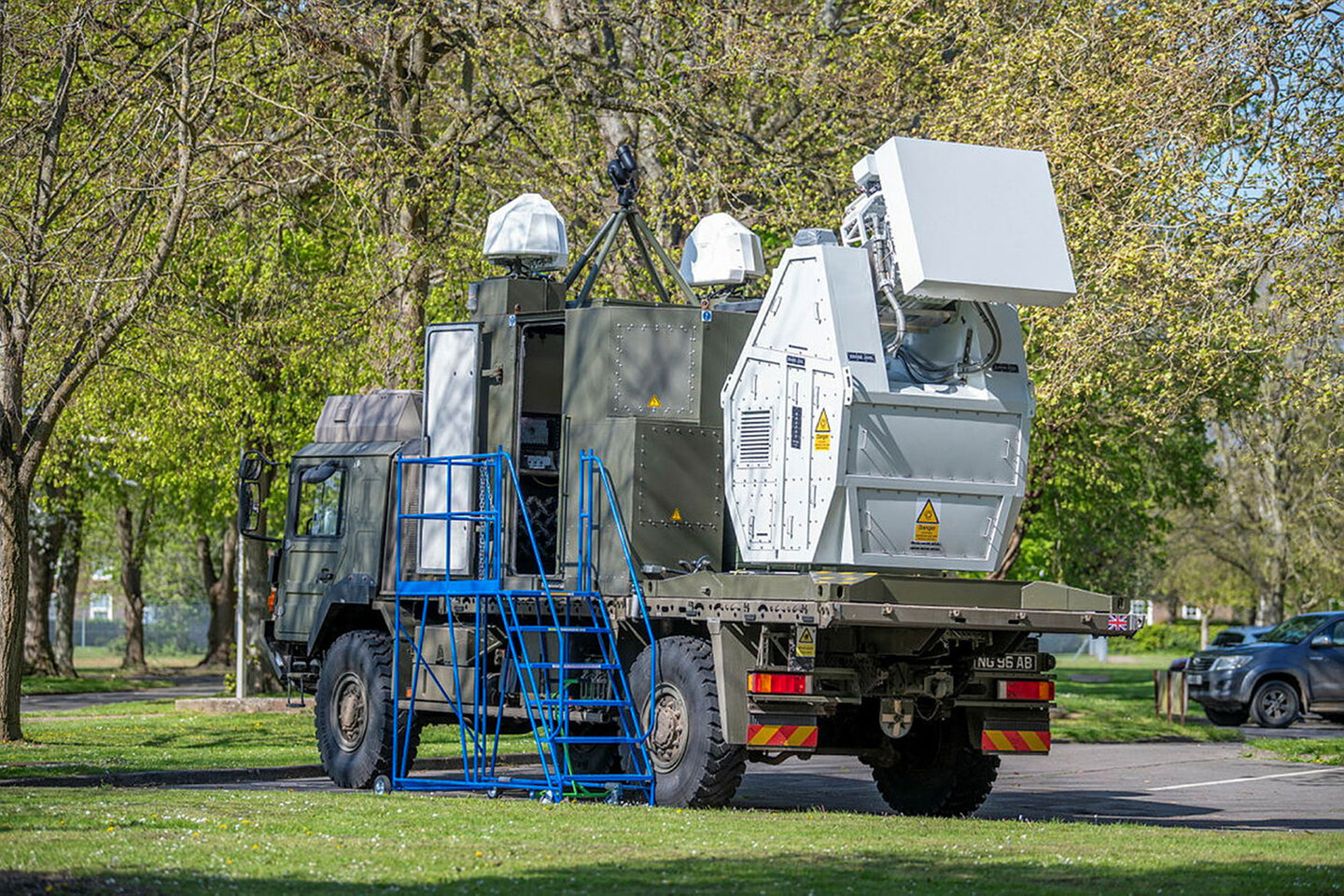
Radio Frequency Directed Energy Weapon developed by Dstl and Thales. Credit: UK MoD/Crown copyright
Remarkably, instead of deploying this mix of legacy vehicles mounted with C-UAS capabilities, Russian ground operations have reverted to motorcycles and all-terrain vehicles, even horses according to The Telegraph, to evade UAS with mobility, speed, and expendability.
According to commentary from the Royal United Services Institute, these vehicles are used for assault but also for logistics, medical evacuation, reconnaissance, and electronic warfare support, particularly in terrain where heavy armour is ineffective or too easily targeted. The Ukrainian military, too, has embraced the concept.
Other protective measures include the use of slat armour. In February 2025, during the IDEX exhibition in Abu Dhabi, Rosoboronexport, Russia’s defence export agency, presented the T-90MS main battle tank.
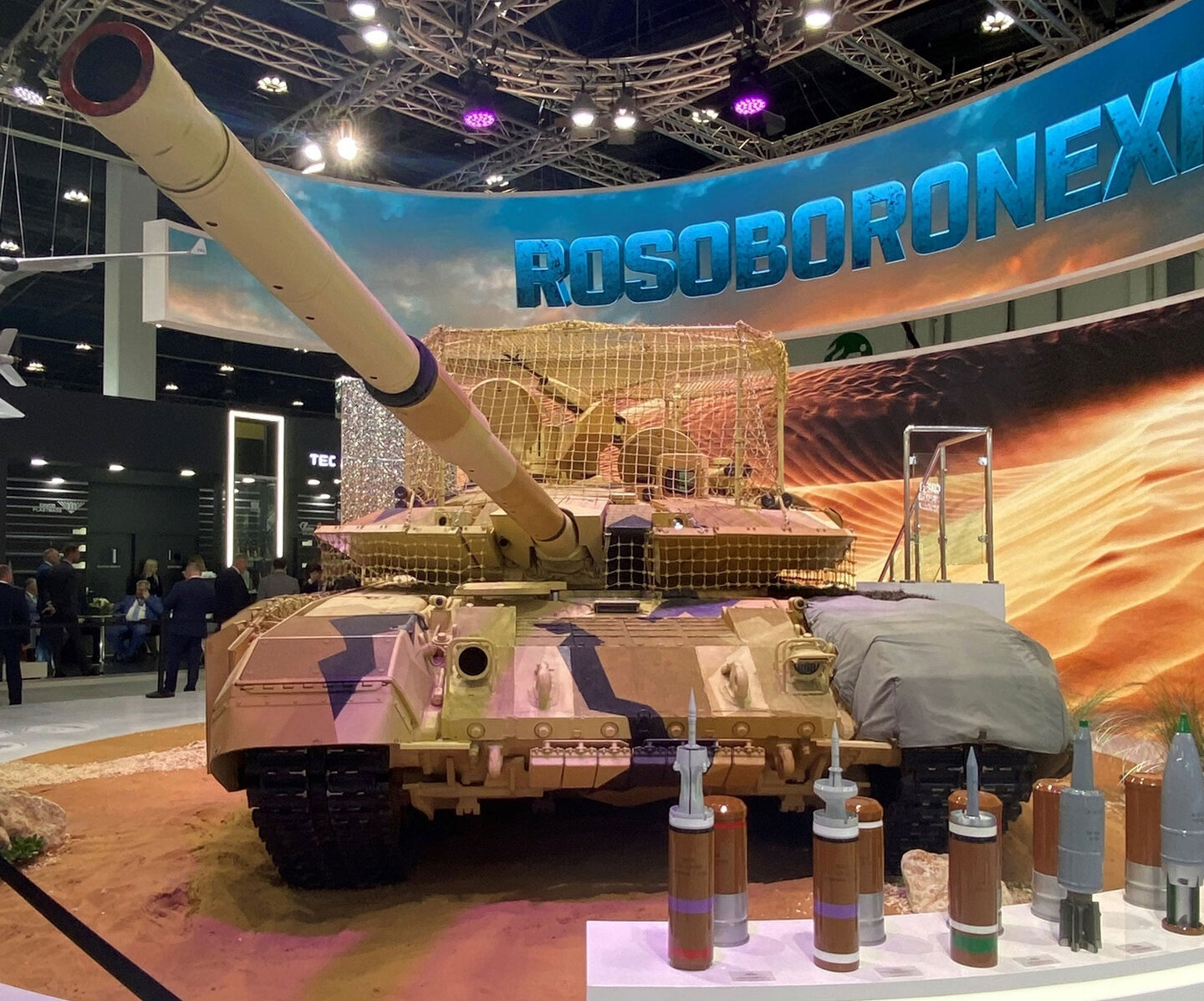
The Russian government pushed the T-90MS main battle tank, equipped with slat armour, during IDEX 2025. Credit: John Hill
A chief selling point was the cope cage the platform came with, considering, the Russian press release read, “the combat experience of countering the entire range of modern [Western] anti-tank weapons,” on the ground in Ukraine.
Russia’s immediate, evasive solutions contrast not only with the UK’s emerging capabilities but also with those of its ally, China, which showcased its own suite of advanced C-UAS capabilities in a parade in Beijing in early September. But it must be understood that the Russian Army is forced to adapt to the modern drone threat in real-time with what legacy resources are available.
Likewise, many of these advanced solutions, particularly DEW systems, are some time away from deployment even if they are proven in test conditions. Only the 100 kilowatt Israeli Iron Beam laser is said to be fully operational and battlefield ready.
A force structure problem
Matthew Palmer, research fellow for the Council on Geostrategy and British Army veteran, noted that despite the short-range air defence (SHORAD) problem, there are only two UK air defence regiments equipped with very short-range missiles, but “considering the threat picture", it is not enough.
“Air defence is an all-arms problem now – it’s no longer just for a small number of specialists,” he contended, as every unit will need some degree of C-UAS.
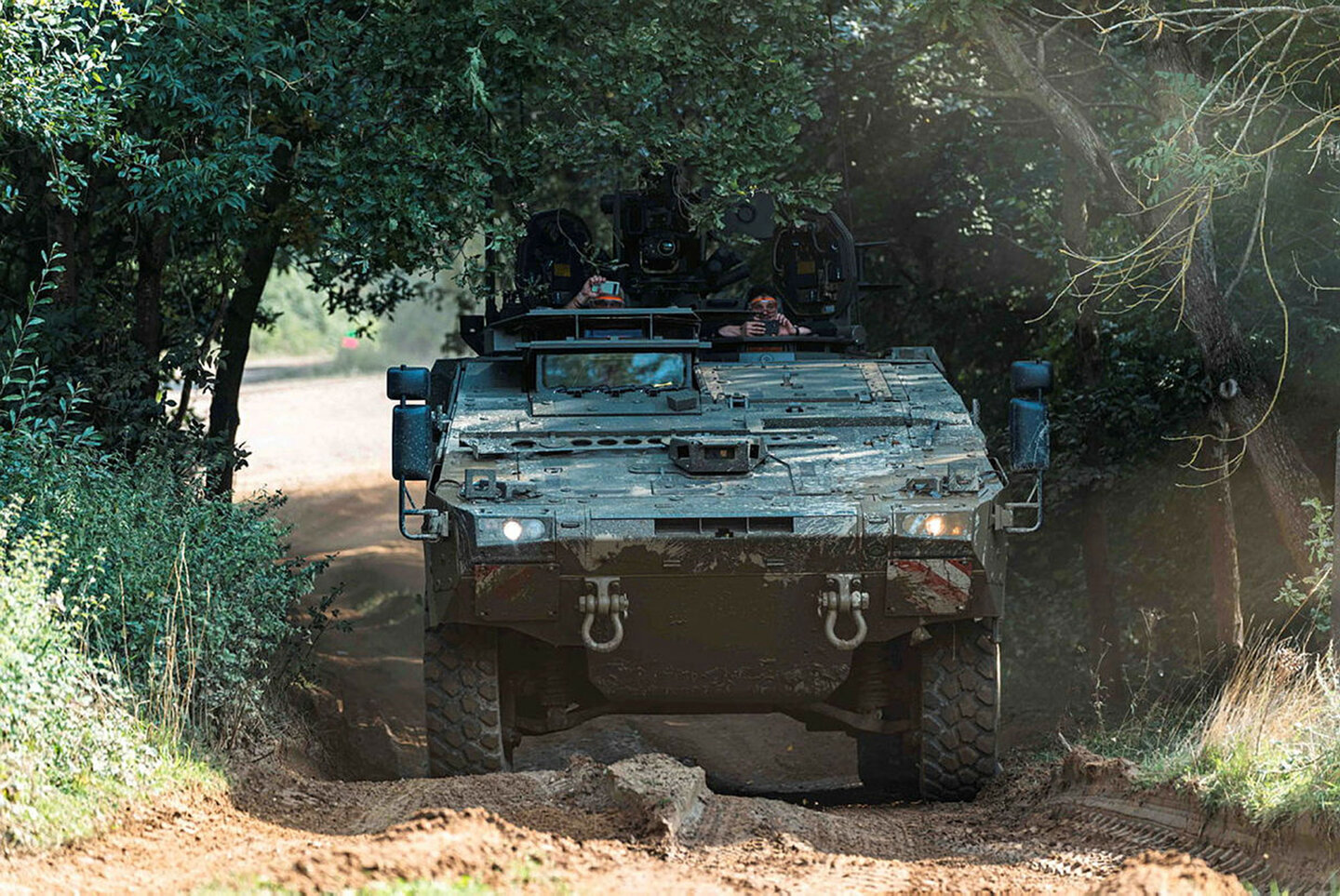
Pictured: Boxer multirole AFV on the test track at Millbrook during DVD2024. Credit: UK MoD/Crown copyright
But while the British Army is starting to address this capability gap by exploring new C-UAS solutions and modernising its legacy counterinsurgency vehicle fleet, the UK must tackle the issue of how it will “disseminate the capabilities down and make sure you’ve got enough [SHORAD capability]… it’s about how it fits into the force structure.”
While the Army wait for its 8x8 Boxer vehicles, Babcock could also produce Patria’s 6x6 CAVS in the UK for the service as of September 2025.
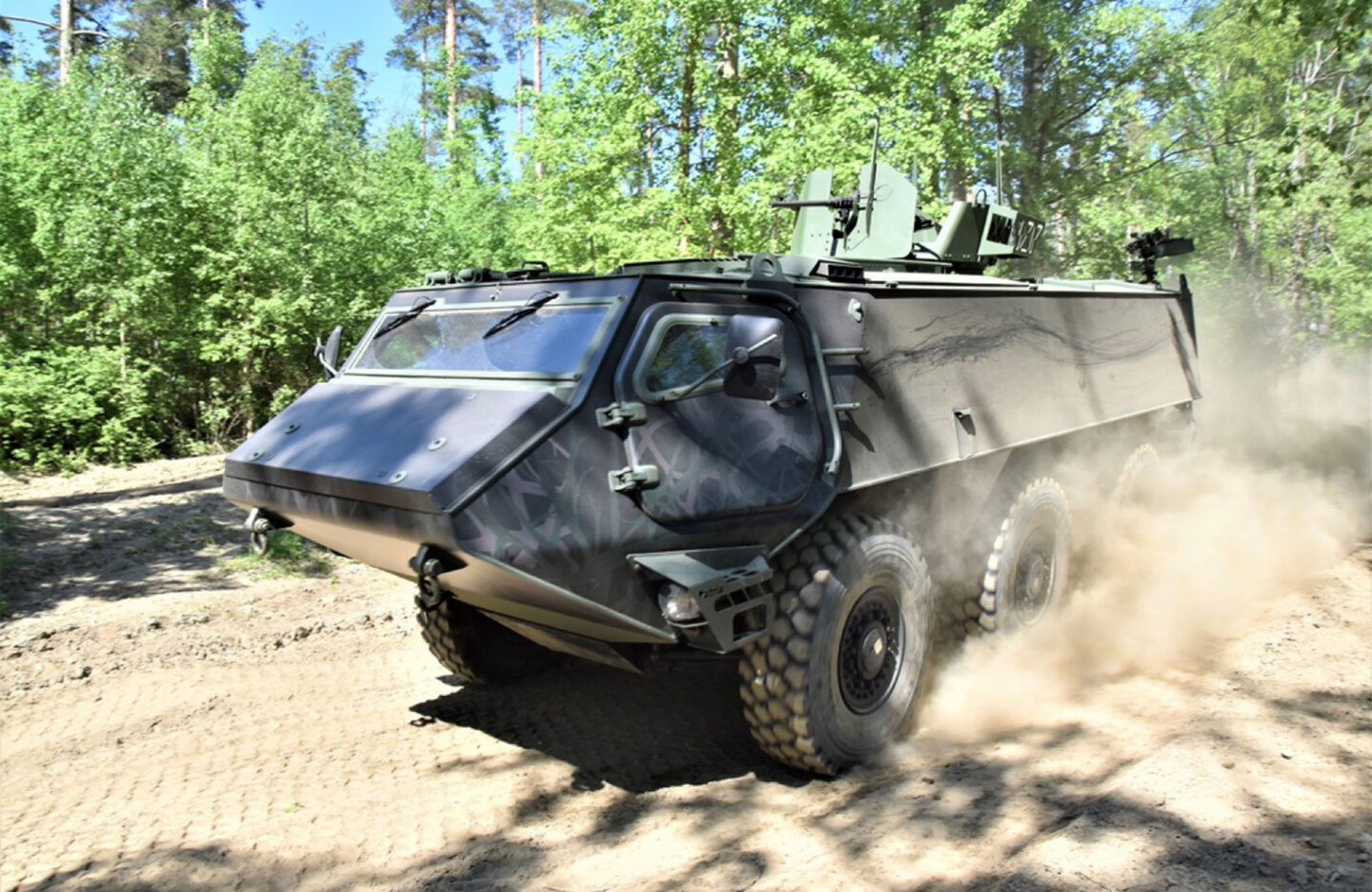
Patria 6x6 CAVS. Credit: Patria
But the Boxer-CAVS dynamic raises questions about duplication: “they are not immediately too dissimilar from each other,” Palmer considered. “You’ve got Boxer, which is bigger and heavier, but the Patria isn’t that much smaller in size.
“One Division… [would be] lighter wheeled, which makes sense, but I don’t know how they play the Boxer-Patria game,” Palmer said.
Automation: driving and firepower
One solution many companies are playing with is an automated response to the drone threat. Palmer also offered his insight into the trend toward automated weapons systems mounted on AFVs.
“So how do we make [an AFV] better at dealing with the [air defence] issue?” he asked. “We automate the guns… It’s an obvious upgrade to what you have already. I think in the counter air space, that’s going to be the start – making sure as many vehicles as possible have got some ability to do that.”
But there are several options: a fully autonomous turret, which can operate independently, and automated options, which are pre-programmed with humans in the loop. This can take the form of remotely controlled systems or a semi-automated solution, where only parts of a weapon system such as the loading and fire control components are automated.
Rheinmetall extols the digital architecture of its KF41 Lynx combat vehicle. This central network encompasses the electrical and software architecture that interconnects all of the vehicle’s subsystems. This allows for the smooth flow of data from sensors, weapons, and other systems.
In conjunction, the modular open systems architecture allows for different configurations. One mode, showcased at DSEI 2025, is the Lynx Skyranger 35 mobile air defence system which utilises an automated air defence component. The turret can independently detect, track, and engage threats but human operators are still required for engagement supervision as well as command control.
Automation can be scaled to driving, too. Tuuli Tolmats-Aia and Enn Laanso, cofounders of a Talinn-based startup known as Telearmy, spoke to Global Defence Technology to address the supposed hype around full autonomy when extending uncrewed capability to driving AFVs. However, the two still argued that militaries ought to pursue remotely operated driving for armoured vehicles.
“The complexity of [autonomous] technology is totally different [from remote control], the price of technology is totally different, and probably the speed of both technologies is totally different,” argued the chief operations officer, Tolmats-Aia.
Remote driving, on the other hand, “is like making old trucks do new tricks,” she joked, “you have things lying around that are not functional or as useful anymore, and then it might open up a new page,” she suggested.
Telearmy has proven the remote-control concept in Ukraine with unspecified heavy army vehicles, as well as 4x4 Toyota Hilux pick-up trucks, but the capability has the potential to breathe new life into a wide range of legacy vehicles that the West have dropped into the lap of the war-torn country in recent years.
“Our message is that the tactics are upside down thanks to drones, but you still need land vehicles to win the war,” Tolmats-Aia continued, “taking into account that it’s a higher risk for soldiers inside a vehicle.”
Flirting with full autonomy
Yet few AFV manufacturers offer a fully autonomous capability. Moral and legal issues have shaped culture and doctrine to confine full autonomy to a future battlefield vision even though the technology exists today.
Still, there are concepts on the horizon. The K9A3 self-propelled howitzer, for example, which will have the ability to operate autonomously in movement and firing, will come to market in the early 2030s.
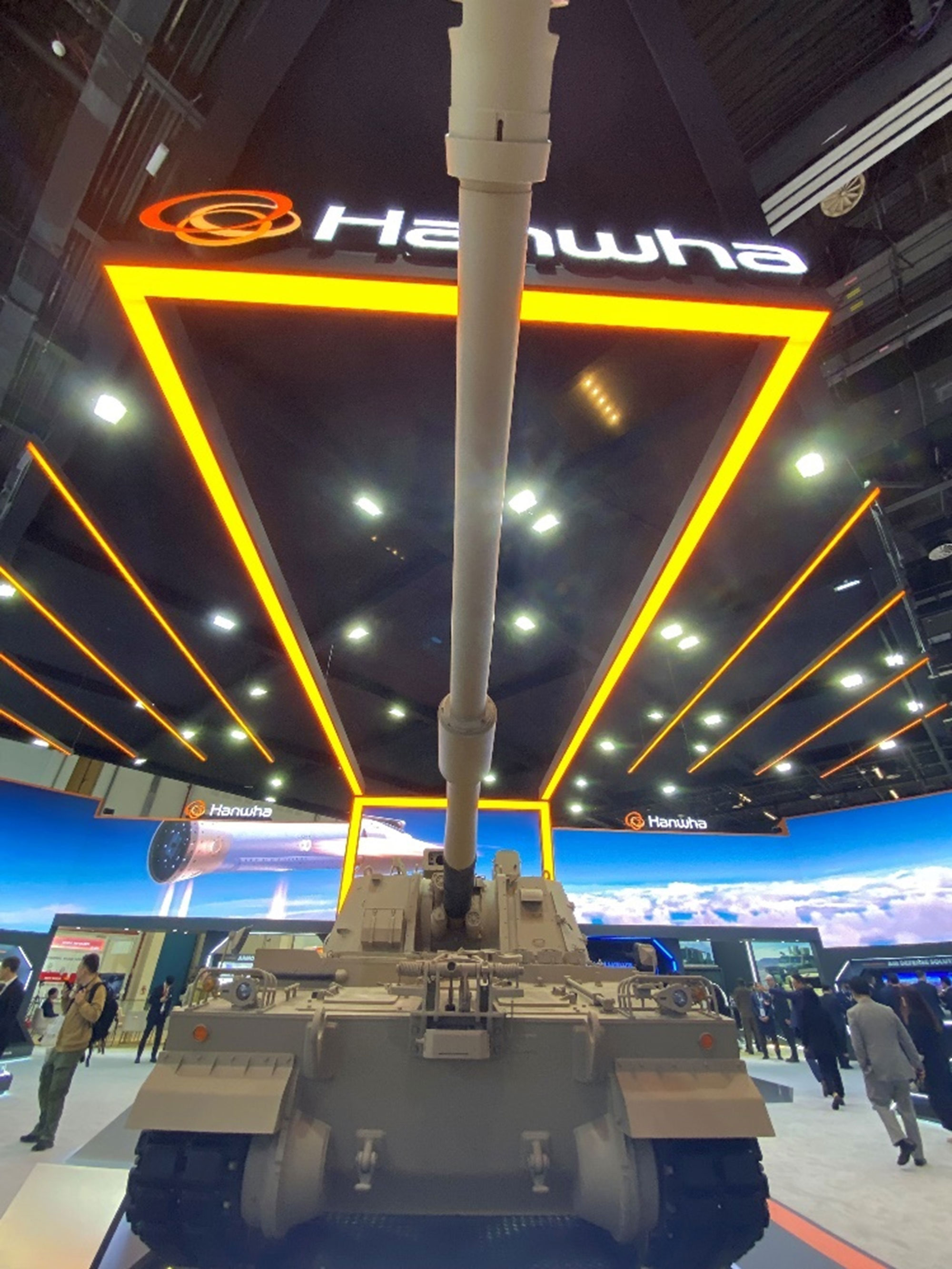
Hanwha Aerospace K9 self-propelled howitzer during IDEX 2025 in Abu Dhabi. Credit: John Hill
Poland, a Central European country that already operates the A1 variant, with plans to produce its own indigenous variant – the K9PL – which includes features of the A2, such as an automatic ammunition loader, indicates that autonomy is not immediately a focus area.
At the same time, Poland’s Armament Group PGZ already signed a statement of intent with Hanwha to assess the possibility of using the Polish Krab chassis for A3 gun howitzers, which suggests that the Polish Army have at least one toe in the water when it comes to embracing a fully autonomous component in its AFVs.
There is some movement toward full autonomy in the strictest sense – for driving as well as firing, in a completely uncrewed capacity – as BAE Systems demonstrate in the transition from the widespread 1960s-era M113 armoured personnel carrier (APC) to the Armoured Multipurpose Vehicle (AMV).
For the US Army at least, the AMV will be integrated with Armored Brigade Combat Teams, where it will operate alongside the M1 Abrams main battle tank and the M2 Bradley infantry fighting vehicle.
Brian Gathright, vice president in business development and strategy planning at BAE Systems, said that “you will see more of this [autonomy] and we kind of tease some of it [out] if you’ve seen some of our social media around the work that we're doing with AMV", referring to the recent announcement that BAE will work with Forterra to accelerate the development of an autonomous AMV prototype.
Gathright also divulged the UK is particularly interested, with discussions ongoing with the Ministry of Defence to possibly deliver a light autonomous platform, a concept that will likely take shape through the AMV programme.
Business as usual
This autonomy focus contrasts with Patria’s newly unveiled TRACKX, an all-terrain tracked APC, based on a simpler Finnish design that will jostle with the AMV to succeed the M113 for some European users. It is also an attractive option to take over the Soviet-era MT-LB.
This new platform will be developed within the framework of the multinational European Defence Agency-funded FAMOUS programme to improve and interoperate combat vehicles. Finland, which currently operate 700 APCs, including the M113 in decreasing numbers, has already placed an order with Patria to deliver the initial TRACKX units as early as 2026.
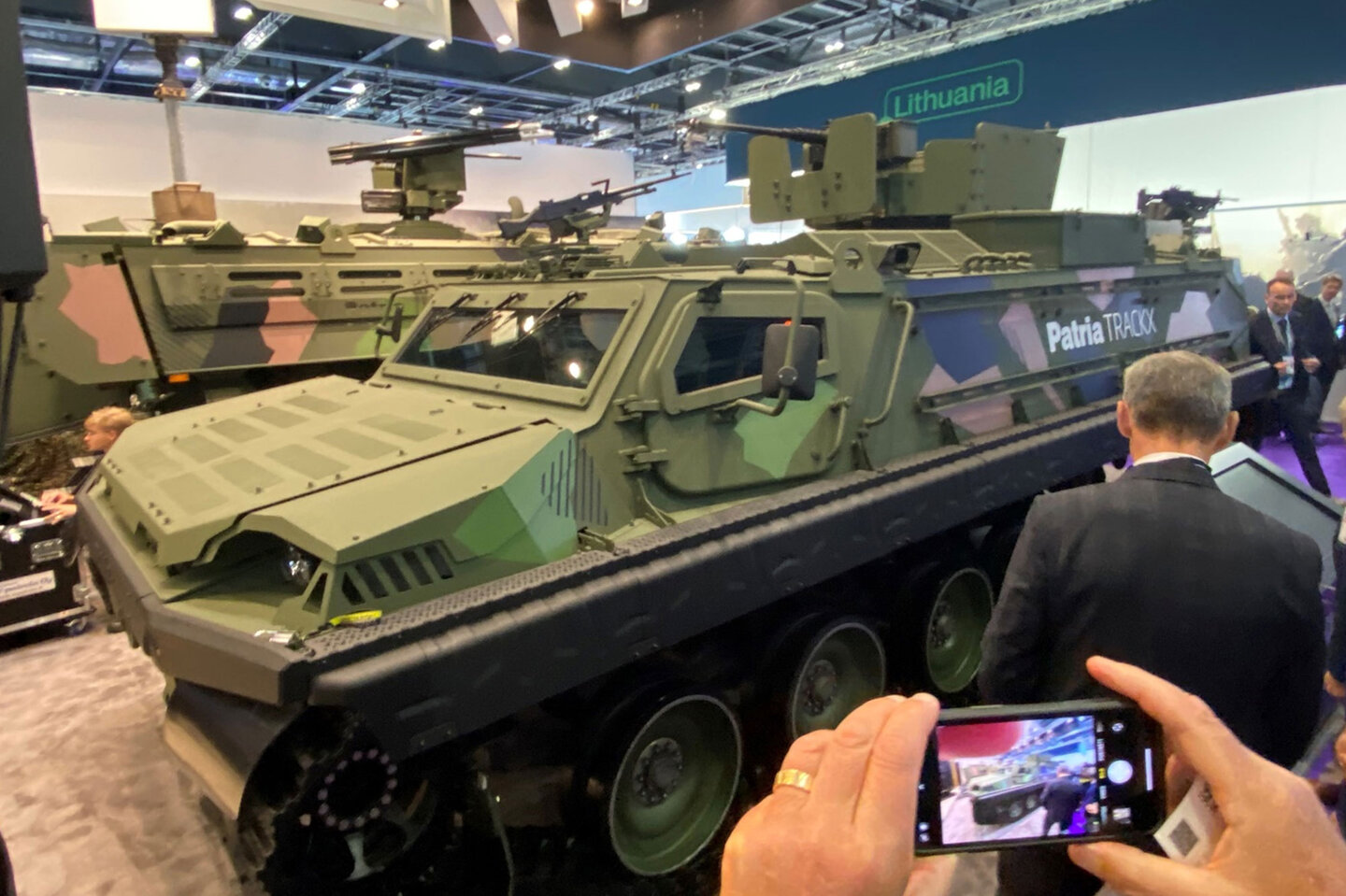
Patria TRACKX unveiled for the first time at DSEI 2025. Credit: John Hill
Contrary to the allure of future autonomous capability, Patria’s main focus is on off-road mobility: mass efficiency, wide rubber tracks, low ground pressure, a low and centrally positioned centre of gravity, independently adjustable hydropneumatic suspension for each track wheel, and an almost flat underside without torsion bars.
Meanwhile, many land primes are adding more space for personnel on AFVs. During DSEI 2025, General Dynamics UK (GDUK) unveiled the new Ajax infantry fighting vehicle (IFV) variant for the first time. It will likely be in the running to replace the British Army’s 625 ageing Warrior IFVs, the first of which entered service in 1988, and will begin decommissioning from 2027.
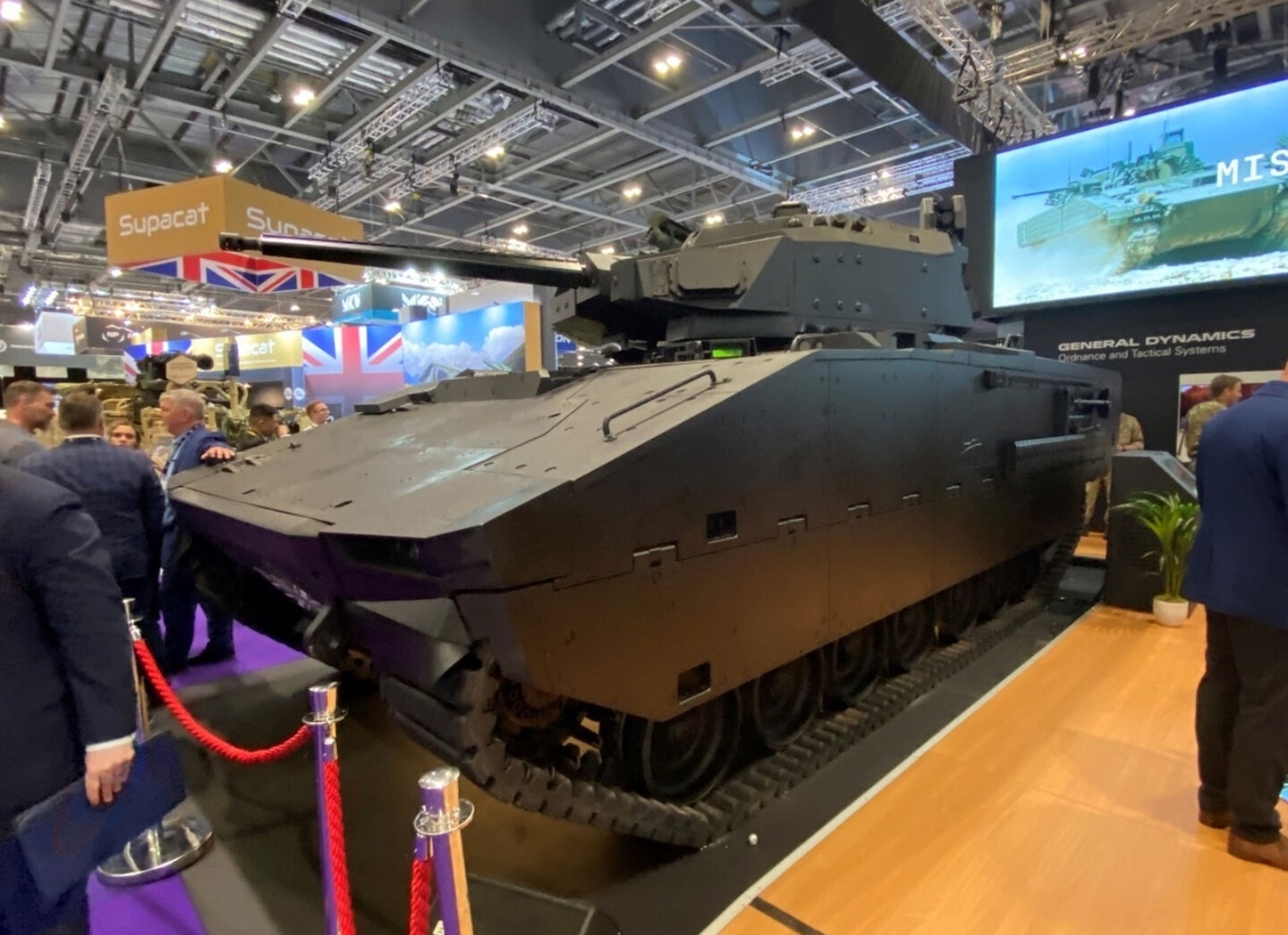
Side view of Ajax IFV presented for the first time at DSEI 2025. Credit: John Hill
The only automated component is the modular CT40 turret, but GDUK expanded the platform to provide a rear compartment to seat eight additional personnel, each with under-armour stowage. GDUK has learned that the Army need to accommodate more troops as the original Ajax reconnaissance vehicle only provides space for three crew members.
Palmer also acknowledged this trend: “Everything is getting bigger and heavier – vehicles are massive now. Modularity and digitalisation are the big trends.”

Russia has learned how to use its helicopters not just better, but far more effectively.
Lt Col Emiliano Pellegrini, Nato
To modernise the platform, via an April request for information, the USAF is canvassing the inclusion of a new radar, electronic warfare equipment and enhanced
communications to create an “Advanced E-7”. Two such examples are sought within seven years, after which other E-7s could be retrofitted with the modifications.
As for the UK, three 737NG aircraft are currently undergoing modification in Birmingham, the first completing its maiden flight in September 2024.
Global Defence Technology asked Boeing what makes the E-7 stand out, and a spokesperson listing three points. First is its allied interoperability. “With the aircraft in service or on contract with Australia, South Korea, Türkiye, the UK and USA – and selected by Nato – its unmatched interoperability benefits a growing global user community for integration in future allied and coalition operations.”
The US is by far the largest spend on nuclear submarines. Credit: US Navy
Country | 2024 | 2025 | 2026 | 2027 | 2028 | 2029 | 2030 | 2031 | 2032 | 2033 | 2034 |
Australia | 3,582 | 3,586 | 3,590 | 3,594 | 3,613 | 3,622 | 6,183 | 6,207 | 6,216 | 6,239 | 6,380 |
China | 2,607 | 2,802 | 3,040 | 3,081 | 3,174 | 3,291 | 3,396 | 3,603 | 3,664 | 3,710 | 4,316 |
India | 2,320 | 2,533 | 3,675 | 2,457 | 2,526 | 2,639 | 2,741 | 2,873 | 2,958 | 3,350 | 3,560 |
Russia | 2,701 | 2,893 | 2,973 | 3,334 | 3,458 | 3,106 | 3,235 | 3,405 | 2,958 | 3,487 | 3,942 |
US | 16,957 | 18,037 | 18,522 | 18,607 | 18,137 | 18,898 | 18,898 | 19,643 | 19,876 | 22,592 | 23,730 |
Lisa Sheridan, an International Field Services and Training Systems programme manager at Boeing Defence Australia, said: “Ordinarily, when a C-17 is away from a main operating base, operators don’t have access to Boeing specialist maintenance crews, grounding the aircraft for days longer than required.
“ATOM can operate in areas of limited or poor network coverage and could significantly reduce aircraft downtime by quickly and easily connecting operators with Boeing experts anywhere in the world, who can safely guide them through complex maintenance tasks.”
Boeing also uses AR devices in-house to cut costs and improve plane construction times, with engineers at Boeing Research & Technology using HoloLens headsets to build aircraft more quickly.
The headsets allow workers to avoid adverse effects like motion sickness during plane construct, enabling a Boeing factory to produce a new aircraft every 16 hours.
Elsewhere, the US Marine Corps is using AR devices to modernise its aircraft maintenance duties, including to spot wear and tear from jets’ combat landings on aircraft carriers. The landings can cause fatigue in aircraft parts over its lifetime, particularly if the part is used beyond the designers’ original design life.

Caption. Credit:
Phillip Day. Credit: Scotgold Resources
Total annual production
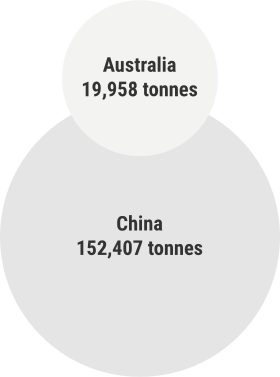
Australia could be one of the main beneficiaries of this dramatic increase in demand, where private companies and local governments alike are eager to expand the country’s nascent rare earths production. In 2021, Australia produced the fourth-most rare earths in the world. It’s total annual production of 19,958 tonnes remains significantly less than the mammoth 152,407 tonnes produced by China, but a dramatic improvement over the 1,995 tonnes produced domestically in 2011.
The dominance of China in the rare earths space has also encouraged other countries, notably the US, to look further afield for rare earth deposits to diversify their supply of the increasingly vital minerals. With the US eager to ringfence rare earth production within its allies as part of the Inflation Reduction Act, including potentially allowing the Department of Defense to invest in Australian rare earths, there could be an unexpected windfall for Australian rare earths producers.
