Analyst Comment
The revamp of Ireland’s defence
Despite a long-standing policy of neutrality, Ireland has recognised Russia as a threat and is following Europe in rearmament. Callum Kaye, senior analyst at GlobalData, provides key insights.
Powered by


Main image credit: Stephen Barnes/Shutterstock.com
See GlobalData’s recently published ‘Ireland Defense Market Data 2026-2035‘ for more information.
Since its inception as an independent state, Ireland has maintained a policy of neutrality. Initial considerations to join Nato during its founding in 1949 stalled on the issue of entering a formal alliance with the UK while the latter still maintained control over Northern Ireland.
Nato membership remains highly unpopular among the Irish public, and the country instead participates in the alliance’s Partnership for Peace (PfP) programme.
Given this policy of neutrality, the capabilities of the Irish Defence Forces have been modest. The dominant service branch is the Irish Army, with its main manoeuvre elements being light infantry that are trained to fulfil a mechanised infantry role mounted on the current Piranha IIIH armoured personnel carrier.
However, the size of the Piranha III fleet means that little more than one of the seven infantry battalions can be mounted on the vehicle at any one time, and the vehicles are largely used for overseas UN peacekeeping missions.
Within Ireland itself, the infantry predominantly carries out an internal security role given Ireland’s benign relations with its neighbours. The most potent asset the army fields is the Medium Reconnaissance variant of the Piranha IIIH.
Indirect fires capabilities are similarly modest, with this primarily vested in the 105mm L118 towed light gun in addition to the M87 120mm mortar.

Callum Kaye, senior analyst at GlobalData
In the air domain, the Irish Air Corps lacks the ability to both detect aircraft with their transponders switched off and carry out interception missions of such aircraft. State visits by foreign dignitaries in recent years saw patrols carried out by the PC-9M turboprop, which itself is only armed with machine guns and unguided rockets, an armament completely unsuited to counter-air interception.
Meanwhile, maritime patrol capabilities have recently seen an improvement with the C295M, while they offer superior surveillance capability with better avionics and a more powerful engine than the fleet of CN-235 they were replacing, like their successors they remain unarmed.
In the maritime domain, the Irish Naval Service (INS) operates a small fleet of patrol vessels, the largest of which are the four Samuel Beckett-class offshore patrol vessels. The INS has been severely impacted by personnel shortages in recent years, with contractors relied upon to crew vessels.
Ireland’s military deficiencies were made apparent during the state visit made by Ukrainian President Volodymyr Zelenskyy in December 2025. Several drones, believed by the Irish Government to be of Russian origin, were observed by the Irish naval vessel LÉ William Butler Yeats near Howth.
The crew is believed to have considered engaging the drones with the vessel’s 20mm anti-aircraft gun, but this was assessed to be ineffective.
Due to Ireland’s current military deficiencies, the country de facto relies on the UK for national defence. The Royal Navy would be required to deter an incursion by hostile surface vessels and submarines. Similarly, the Royal Air Force is relied upon for air domain interception missions against suspicious aircraft.
Analysing Ireland’s options
The Irish Government has recognised the lack of capabilities of the country’s defence forces, having formulated the Detailed Action Plan, which aims to increase defence spending to €1.5bn ($1.76bn) and increase the total number of personnel to 11,500 by 2028.
The suspected Russian drone incursion in December 2025 has catalysed further defence investment, with defence minister Helen McEntee announcing a €1.7bn ($1.9bn) five-year spending plan.
This further expands the potential for firms to enter Ireland’s defence market. All service branches of the defence forces are to see significant procurements.
In February 2026, this was followed with the announcement that a new maritime strategy would be formulated, in recognition that “Russia is a threat to everybody” and noting the vulnerability of subsea cables in Ireland’s territorial waters.

Ireland will revamp its defence forces. Credit: Ronin of Rock/Shutterstock.com
The Irish Air Corps is to be renamed the Irish Air Force. As outlined in our Analyst Briefing discussing potential Irish fighter aircraft procurement, Ireland is to procure a primary radar system, and at the time of writing, it is a significant likelihood that a squadron of between eight to 12 fighter aircraft will be procured.
Together, these will allow the Irish Air Force to identify and intercept potentially hostile aircraft, removing the need for assistance from RAF Typhoons.
The Irish Naval Service is to be renamed the Irish Navy, with its number of surface vessels expanding from eight to 12, which will expand operational bandwidth and allow for patrols of Irish territorial waters and participation in EU naval missions simultaneously.
Most importantly, the procurement of a “Multirole Combat Vessel” is being considered. This would provide the Irish Navy with its own, albeit small-scale ASW [anti-submarine warfare] capabilities and act as a deterrent to Russian submarine activity in Ireland’s territorial waters. This, in turn, would free up Royal Navy assets for patrols elsewhere in the North Atlantic.
The Irish Army is to see a replacement of its fleet of Piranha IIIH armoured personnel carriers and RG-32 patrol vehicles, with the former completing a mid-life upgrade at the end of 2025. The Armoured Fleet Replacement Project, valued between €600m and €800m ($700m to $935m), will see 100 vehicles to replace both.
At the time of writing, it is believed that the KNDS SCORPION series of vehicles, consisting of the Griffon armoured personnel carrier, the Jaguar armoured reconnaissance vehicle, and the Serval light multipurpose vehicle, is the leading contender in the Armoured Fleet Replacement Project.
The SCORPION series would be of particular interest to Ireland as three vehicles would be procured in one deal, in addition to readily available spare parts, allowing for cost-effective fleet maintenance. The Jaguar, especially, would represent a significant increase in the lethality of the Irish Army armoured cavalry capability, restoring it to levels seen before the retirement of the FV101 Scorpion in 2017.
Ultimately, while it is almost certain that Ireland will never join Nato fully, the country remains “Nato-adjacent”, and interoperability with Nato remains important. Dublin expects that the Irish Defence Forces will always operate as part of UN or EU missions, largely with other EU member states who themselves are predominantly members of Nato.
To that end, all major procurements for the Irish Defence Forces will be produced by companies of European Nato members. For these companies, Ireland represents a transparent allied market with modest requirements that allow for a long-term presence to be established.
The EW element
Iran has primarily relied on its ability to emulate and reverse engineer systems. This is largely because of global sanctions going back to the state’s inception in the 1979 revolution.
A significant portion of medium range air defence is vested in the Mersad, a low- to medium-range air defence system, which is a reverse engineered MIM-23 HAWK with some modifications.
These are fielded alongside indigenous designs including Ra'ad 1, Ra'ad 2, 3rd Khordad and Tabas systems.
For long-range defence, Iran has developed the Bavar-373 which has comparable capabilities to the Russian S-300. While for its short-range air defence, the country has reverse engineered the Chinese HQ-7 as the Ya Zahr, and in 2021 the Zoubin system was unveiled.
Besides these copycat systems, the country also leans on ageing Russian air defences, most notably the S-300PMU-2 battery.
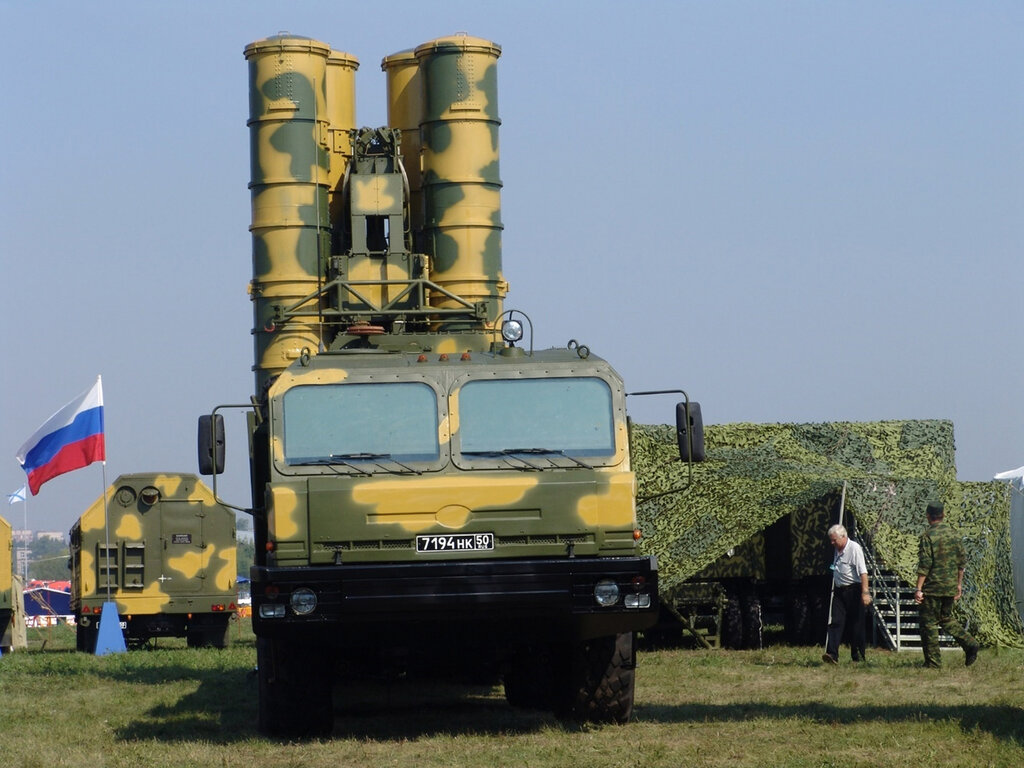
S-300PMU-2 air defence launcher unit. Credit: Vitaly V. Kuzmin / Wikimedia Commons
However, Israel destroyed a significant number of these components in October 2024 and during the 12-Day War. Worse still, the Israel Defence Forces learned all it could about the system in 2015 during joint air drills with Greece, which formerly operated its predecessor, the S-300PMU-1.
In doing so, the exercise enabled Israel to develop comprehensive electronic warfare (EW) technologies specifically designed to compromise radars used by S-300 batteries, such as the Icebreaker missile and Harop loitering munitions which hunt such radar units.
“The Israelis are masters at this,” said associate RUSI fellow Dr Tom Withington, speaking with Global Defence Technology. “Remember, they’ve had the advantage of fighting Russian and Soviet origin air defence systems and larger integrated air defence systems… since the missile age, since the creation of Israel in 1947.
“Notwithstanding the three aircraft that we see lost to… friendly fire,” Withington continued, “the lack of losses so far as combat operations are ongoing really does underscore, I think, how efficient and how capable the EW effort, the cyber warfare effort of both countries has been at this point in the conflict.”

The Israelis are masters at this
Dr Tom Withington, RUSI
The US and Israel are among the few countries to develop and operationally deploy gallium-nitride (GaN)-based airborne EW jammers. These next-generation, wideband phased-array EW systems offer increased power, longer range, and directional jamming capability. They also feature cognitive artificial intelligence to support autonomous, real-time threat response.
In the ongoing conflict, the US would mostly rely on the recently operationalised AN/ALQ-249 EW systems developed by RTX while Israel, by contrast, would primarily deploy Rafael’s Sky Shield and IAI’s Scorpius SP (ELL-8222SB) escort jamming systems.
Particularly in the opening of the joint strike campaign, it is highly likely that the US repeated its electronic warfare [EW] effects against Iran, just as US Special Forces had against Venezuela’s tactical variant of the same air defence system, the tracked S-300VM, two months ago.
“Much like their counterparts in Venezuela, the remaining [Iranian] S-300 batteries would be highly vulnerable to the EW capabilities of US and Israeli aircraft, particularly the F-22, F-35, and the EA-18G Growler, itself a dedicated EW aircraft,” Kaye considered.
At the same time, however, Iranian S-300 batteries most likely used an indigenous radar system instead of an original Russian one, which would offer inferior detection capability.
In using these indigenous radar components instead, Kaye continued, “operators of the remaining batteries would have needed to increase their radar power output, which in turn would have revealed their position and left them open to strikes from AGM-88 anti-radiation missiles, which is fielded by both Israel and the US.”
Can reshoring metals industry work?
But the harder question to answer is if all this energy and effort will actually wrest supply chains and capacity back from China. Alice Wu, policy manager, clean energy & supply chains at the Federation of American Science, said in this effort to build-up rare earth and magnet industries, the government is ultimately taking on the risk the private sector isn’t willing to take on.
“So, you expect a slightly higher rate of failure,” Wu said. “And that is the government's role – to take that extra risk because it's good for US national security.”
But Wu added that there is not a lot of public information, specifically on some of these equity plans. Others agreed there wasn’t a ton of transparency on how some of these deals – or even the international partnerships – would work.
“We don't know if they're taking a smart portfolio approach, or if it's willy-nilly,” Wu said, adding, “I would like to think that there's a strategy, but until that’s shared, we don’t know.”

Terbium is vital for the defence industry. Credit: Ployker/Shutterstock.com
Many experts and people involved in the rare earth industry suggested some people were overpromising on what they could deliver – and when.
“The reality is, we didn't get in this position overnight. We're not going to get out of it overnight,” said said Ed Richardson, president of the US Magnetic Materials Association, who was warning about America’s dependency on China for rare-earth magnets for decades.
“People want a Manhattan Project where you bring all the best scientists in the world together and they solve this problem in six months,” Richardson added. “It's not that we don't know what to do. We know how to do this, but you've got to build institutional knowledge. You have to build a workforce that knows what they're doing.”
Lewis, of Northwestern, said promises of a magnet from the ground in five years isn’t realistic. “We lost a lot of the capability and the equipment. The good equipment to make this still comes from China.”
I would like to think that there's a strategy, but until that’s shared, we don’t know.
Alice Wu, Federation of American Science
As Gracelin Baskaran, the director of the Critical Minerals Security Program at the Center for Strategic and International Studies wrote: “Even once operational, MP Materials is projected to produce only 1,000 tons of neodymium-iron-boron magnets annually by the end of 2025—less than 1 percent of the 138,000 tons China produced in 2018.”
As the US transitions, it will still need to rely on China, for example, to turn rare earth oxide into metal. Any stockpile started now will need to involve China.
While there is no question that the US needs to de-risk from China, especially for its defence components, a federal rule, set to go into effect in 2027, will ban defence contractors from using magnets from China in weapons. It is not clear, now, how contractors will meet that requirement – and what it means, especially amid billions in investment, if they cannot.

Dr. David W. Bates, Chief of General Internal Medicine at Brigham and Women’s Hospital

Caption. Credit:
Total annual production

Australia could be one of the main beneficiaries of this dramatic increase in demand, where private companies and local governments alike are eager to expand the country’s nascent rare earths production. In 2021, Australia produced the fourth-most rare earths in the world. It’s total annual production of 19,958 tonnes remains significantly less than the mammoth 152,407 tonnes produced by China, but a dramatic improvement over the 1,995 tonnes produced domestically in 2011.
The dominance of China in the rare earths space has also encouraged other countries, notably the US, to look further afield for rare earth deposits to diversify their supply of the increasingly vital minerals. With the US eager to ringfence rare earth production within its allies as part of the Inflation Reduction Act, including potentially allowing the Department of Defense to invest in Australian rare earths, there could be an unexpected windfall for Australian rare earths producers.
