Feature
Rare earth reboot: US on the hunt
The United States wants to break the rare earth stranglehold that China has on the sector. Jen Kirby reports.
Powered by


The United States wants to secure rare earth metals. Main video supplied by DeoTree/Creatas Video via Getty Images
An often-repeated phrase around rare earth elements is that they are not really rare. Terbium might be close to the exception.
Terbium is a heavy rare earth element (HREE), one of 17 that fit under this ‘rare earth’ grouping because of their particular atomic makeup. Southern China has deposits of terbium, but China is increasingly turning to mining raw materials from Myanmar, a country in the middle of a civil war, with few environmental or health regulations around extraction. Here, the earth is treated with corrosive chemicals.
The goal is to separate the terbium from other unwanted minerals. Then, it is refined into a rare earth oxide. That oxide, like bits of ceramic, will be turned into metal. That metal needs to be alloyed, essentially mixing a bunch of metals together to create the basis for the magnet that China will eventually make. Because China will almost certainly make it: it controls 91% of the world’s rare earth refining capacity and 94% of the world’s magnet manufacturing, according to the International Atomic Energy Agency. Chinese factories refine almost all – 99.9% – of the world’s terbium supply.
Terbium can be used in fluorescent lighting or to enhance the color of TVs. It helps generate the green-tinged screens in night-vision goggles. But terbium really makes for a great magnet.
Adding even a little terbium to a neodymium iron boron (NdFeB) magnets allows it to perform at high temperatures – from about 80 degrees to 200 degrees Celsius. That makes it an attractive addition to something that must function in variable conditions, like an electric car – or an advanced fighter jet.
It is why the US Government considers terbium, alongside other rare earth elements, as critical for national security.
“Rare earths show up in almost every modern military system: to steer precision-guided missiles, lasers and sensors in aircraft, communication for soldiers, communication gear, night-vision goggles,” said Abigail Hunter, executive director, Center for Critical Minerals Strategy at SAFE, a non-partisan think tank focused on energy and supply chain policy.
“If it moves, sees, communicates in today's military, we usually say there's probably a rare earth in it,” Hunter said.
By now, of course, the problem is clear: America’s weapons – from artillery shells to radar systems to targeting sensors – depend on magnets made from rare earths. Just about every advanced capability requires some kind of magnet. One F-35 fighter jet is supposed to have more than 400kg of rare earths inside it.
And China dominates the entire rare-earth supply chain.
Now, the United States is racing to make its supply chains more resilient for commercial and defence industries, for both rare earths and other critical raw materials, such as cobalt and copper. Here, Washington is reaching out to partners and investing billions to boost its domestic supply of rare earths – but, more vitally, rebuild the separation capabilities.
The US goal is a “mine-to-magnet” supply chain. The question is whether it can pull this off – and on what kind of timeline.
The US needs rare earths
In April 2025, in response to President Donald Trump’s ‘liberation day’ tariffs, the Chinese Government required special licenses for the purchase of seven rare earth elements and magnets, including terbium. It prompted shortages, threatening the shutdown of factories in the United States and around the world. In June, the US and China struck a deal on tariffs and rare earths, restoring the flow, for now.
“Although it's not clear that the defence-industrial base faced immediate disruptions from those cut offs, it is true that a lot of the advanced manufacturing that defence requires, including aviation, in particular, but not only – electronics, as well – requires an array of advanced materials that we don't have enough non-China supply of,” said Chris Miller, professor of international history at The Fletcher School at Tufts University and the author of Chip War.
The story of how China came to dominate the rare-earths market is a decades-long story of the US slowly outsourcing the dirty work of separating and refining these rare earths to China. Eventually all the technical know-how and equipment went with it.
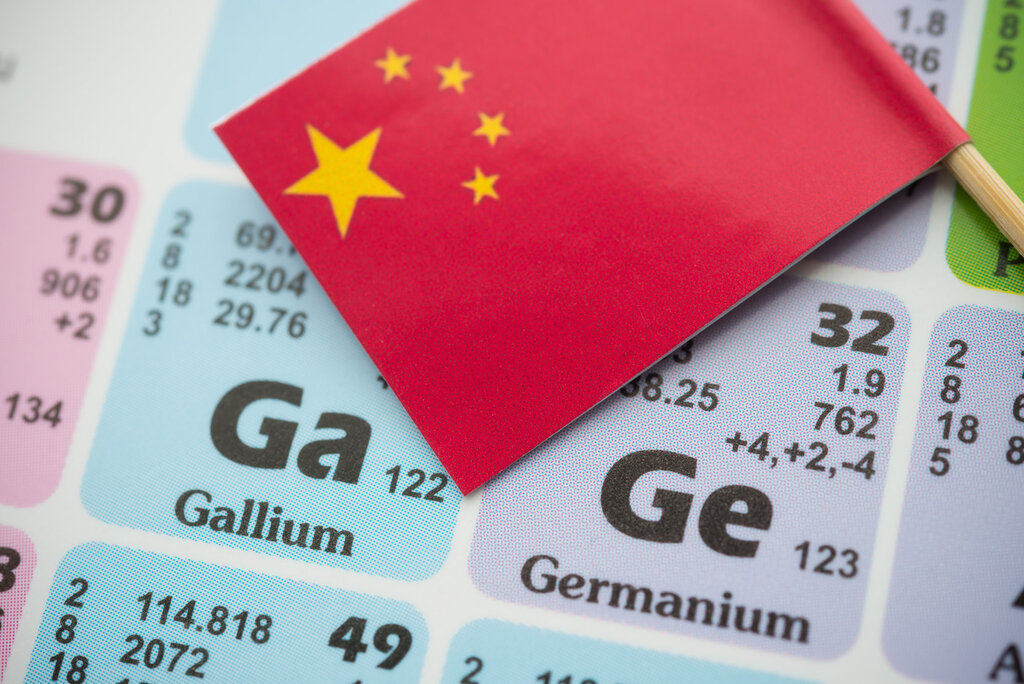
China maintains a near monopoly over rare earth metal extraction. Credit: Pla2na/Shutterstock.com
“The world was really happy. China – the mess was in their backyard. They were giving us the rare earths we wanted. It was very inexpensive, so there was no motivation for anything to change,” Laura H. Lewis, a professor of chemical engineering at Northeastern University, whose research includes strategic materials and supply chains.
“Then people woke up to the fact that our military defence capabilities are now not under our control,” Lewis said.
Part of this is the odd economics of rare earths. They make up a very small share of the global market, though estimates vary, in part because rare earth supply chains are small, opaque, and volatile.
The US defence industry is a small buyer of rare earths in an already small market. Its needs are niche, and it may use rare earths in certain applications that most of the commercial industry doesn’t. But even then, the US military only needs a tiny bit.
“The challenge with rare earths is that you don't really need a lot of it – but they're critical,” said Raul Munoz, US & Canada Mining and Natural Resources Industry Leader for a Marsh Risk.
A little terbium can go a long way in a magnet. But good luck getting a drone to go a long way without something like terbium.
The chokepoints
Energy Fuels, a Denver-based company, mines uranium in the United States. During a tough time for the industry, the company started looking around for other options, and rare earths rose to the top. The separation for rare earths involves similar processes as what they’d done for uranium.
“We have all the expertise, the infrastructure, the tailings, the track record of doing it responsibly,” said Curtis Moore, the senior vice president of marketing and corporate development at Energy Fuels.
The company now has the capacity to produce up to 1000 metric tons of NDPR oxide – a combination of neodymium and praseodymium – used in rare-earth magnets. As Moore notes, they are not yet producing that much but are continuing to explore ways to expand rare earth operations.
What makes Energy Fuels unique is that it’s doing the uranium business as usual, while simultaneously pursuing rare earths alongside it, building the capacity and technical know-how so it’s there, ready to be tapped into, when needed – but not the thing that will make or break the company.
It offers one model for how the US might wrest back some of its separation and processing capacity back from China. In the meantime, the US Government is throwing money – a lot of it – at a nascent rare-earth and magnet-making industry in hopes of jumpstarting US capacity.
A lot of the talk in the US around rare earths or critical minerals access centers around the raw materials: a deal with Ukraine or the Democratic Republic of Congo over deposits, for example.
But the dirt isn’t the biggest problem. It can take almost three decades to open a mine in America, and it shouldn’t, but experts say, the issue is anything the US digs up now, no matter where, still has to get shipped back to China for separation.
“The real constraint is midstream capacity: processing, separation, magnet-making,” said Benedetta Girardi, programme coordinator for Europe in the Indo-Pacific and strategic analyst at the Hague Centre for Security Studies.

The real constraint is midstream capacity: processing, separation, magnet-making.
Benedetta Girardi, Hague Centre for Security Studies
The Trump administration is aggressively trying to boost this capacity, too. Maybe the biggest example is a public-private partnership deal the Department of Defense signed in July with MP Materials, which runs Mountain Pass in California, the US’s only operating rare-earth mining and processing site, which is also restarting NdFeB magnet manufacturing in Texas.
As part of this deal, the US took an equity stake in MP Materials, and in the deal announced, indicated that it is establishing a price floor and guaranteeing the purchase of the magnets. The Pentagon is now the largest stakeholder in MP Materials.
The Trump administration has taken equity stakes in other rare-earth and critical mineral companies, including USA Rare Earths, Trilogy Metals, and Lithium Americas.
The Trump administration has landed on critical materials as a rare area of cooperation with allies and partners. In February, the administration hosted a Critical Minerals Ministerial in Washington, DC, hosting dozens of countries and signing bilateral deals with countries such as Japan and Mexico.
At the ministerial, the US introduced the Forum on Resource Geostrategic Engagement (FORGE) that would replace the Biden-era Minerals Security Partnership (MSP), an effort to friend-shore critical minerals supply chains. Vice President JD Vance suggested that FORGE could create a “preferential trading zone for critical minerals” with enforceable price floors to stabilize prices, including against China flooding the market.
The administration also announced Project Vault, a stockpiling initiative that allies and partners could collaborate on. The details of both projects are still being knocked out, but as Ambassador Geoffrey Pyatt, the former Assistant Secretary of State for Energy Resources during the Biden administration pointed out, the programmes represented “the reality of the fact that we have to work with others.”
Can reshoring metals industry work?
But the harder question to answer is if all this energy and effort will actually wrest supply chains and capacity back from China. Alice Wu, policy manager, clean energy & supply chains at the Federation of American Science, said in this effort to build-up rare earth and magnet industries, the government is ultimately taking on the risk the private sector isn’t willing to take on.
“So, you expect a slightly higher rate of failure,” Wu said. “And that is the government's role – to take that extra risk because it's good for US national security.”
But Wu added that there is not a lot of public information, specifically on some of these equity plans. Others agreed there wasn’t a ton of transparency on how some of these deals – or even the international partnerships – would work.
“We don't know if they're taking a smart portfolio approach, or if it's willy-nilly,” Wu said, adding, “I would like to think that there's a strategy, but until that’s shared, we don’t know.”
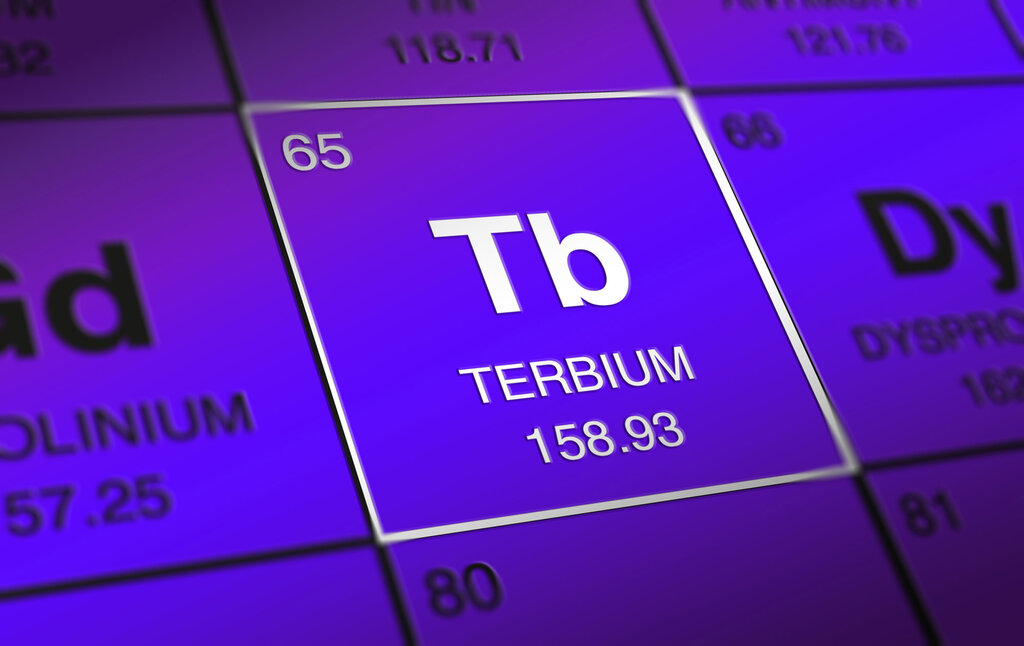
Terbium is vital for the defence industry. Credit: Ployker/Shutterstock.com
Many experts and people involved in the rare earth industry suggested some people were overpromising on what they could deliver – and when.
“The reality is, we didn't get in this position overnight. We're not going to get out of it overnight,” said said Ed Richardson, president of the US Magnetic Materials Association, who was warning about America’s dependency on China for rare-earth magnets for decades.
“People want a Manhattan Project where you bring all the best scientists in the world together and they solve this problem in six months,” Richardson added. “It's not that we don't know what to do. We know how to do this, but you've got to build institutional knowledge. You have to build a workforce that knows what they're doing.”
Lewis, of Northwestern, said that promises of producing a magnet from the ground in five years isn’t realistic. “We lost a lot of the capability and the equipment. The good equipment to make this still comes from China.”
I would like to think that there's a strategy, but until that’s shared, we don’t know.
Alice Wu, Federation of American Science
As Gracelin Baskaran, the director of the Critical Minerals Security Program at the Center for Strategic and International Studies wrote: “Even once operational, MP Materials is projected to produce only 1,000 tons of neodymium-iron-boron magnets annually by the end of 2025—less than 1 percent of the 138,000 tons China produced in 2018.”
As the US transitions, it will still need to rely on China, for example, to turn rare earth oxide into metal. Any stockpile started now will inevitably need to involve China.
While there is no question that the US needs to de-risk from China, especially for its defence components, a federal rule, set to go into effect in 2027, will ban defence contractors from using magnets from China in weapons. It is not clear, now, how contractors will meet that requirement – and what it means, especially amid billions in investment, if they cannot.

Dr. David W. Bates, Chief of General Internal Medicine at Brigham and Women’s Hospital

Caption. Credit:
Total annual production

Australia could be one of the main beneficiaries of this dramatic increase in demand, where private companies and local governments alike are eager to expand the country’s nascent rare earths production. In 2021, Australia produced the fourth-most rare earths in the world. It’s total annual production of 19,958 tonnes remains significantly less than the mammoth 152,407 tonnes produced by China, but a dramatic improvement over the 1,995 tonnes produced domestically in 2011.
The dominance of China in the rare earths space has also encouraged other countries, notably the US, to look further afield for rare earth deposits to diversify their supply of the increasingly vital minerals. With the US eager to ringfence rare earth production within its allies as part of the Inflation Reduction Act, including potentially allowing the Department of Defense to invest in Australian rare earths, there could be an unexpected windfall for Australian rare earths producers.
