Feature
Connecting the dots: Ukraine’s procurement revolution
In a bid to speed up delivery of key equipment, Ukrainian brigades are able to procure directly from manufacturers. Richard Thomas reports.
Main image: Oksana Ferchuk, Deputy Minister of Defence of Ukraine for Digital Development, Digital Transformation and Digitalization. Credit: IT Arena

As much as the Ukraine-Russia conflict is teaching Western nations about changing operational concepts on the modern-day battlefield, Ukraine is also able to demonstrate a new approach in equipment procurement and sustaining units in the field.
In an exclusive interview with Global Defence Technology, Oksana Ferchuk, Deputy Minister of Defence of Ukraine for Digital Development, Digital Transformation and Digitalization discussed Ukraine’s evolved military procurement practises during a war where time is of the essence.
“Doing it [via traditional Western European procurement], you would spend months, years [waiting for delivery]. Now you are able to test in a week’s time, adjust your products and delivery gap,” Ferchuk said, speaking to Global Defence Technology in Lviv in late-September.
Ukraine’s “unique” postal service is also able to deliver systems to units in the field without risk of being uncovered via a security weakness or a loose paper trail.
Maintaining a two-pillar procurement structure, where lethal capabilities are acquired through more traditional government-led structures, along with the rapid delivery of non-lethal systems, such as drones, sensors, and electronic warfare (EW) systems, to battlefield units via the DOT-Chain platform.

Richard Thomas in conversation with Ukraine's Oksana Ferchuk, at an undisclosed location in Lviv. Credit: Author
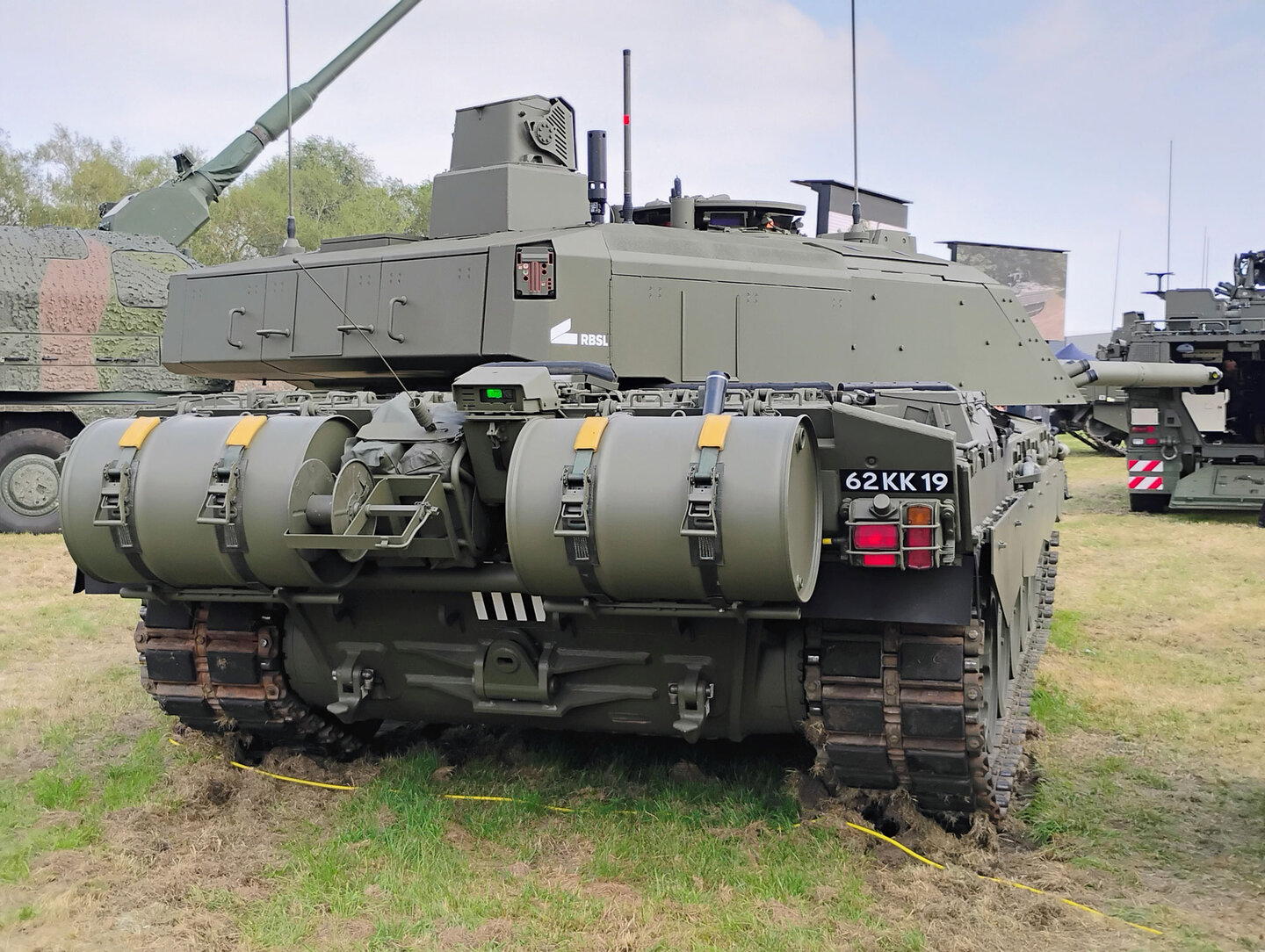
The DroneGun Mk4 is a handheld countermeasure against uncrewed aerial systems. Credit: DroneShield
Through the DOT-Chain digital marketplace, certain Ukrainian brigades order drones and other equipment direct from the manufacturer. This allows defence start-ups and SMEs to pitch directly to the customer, who can then provide feedback and quickly iterate, a key requirement for Ukraine’s ever-evolving battlefields.
“Each brigade actually has their own budget, supplied from the local communities because brigades are paying a lot of taxes,” said Ferchuk. “It was a decision made by the country that a portion of those taxes and the local authorities will return to the military units as a donation. In such a way, our brigades currently have their own budget, which they are able to spend to the specific tasks.”
With this funding, selected Ukrainian brigades can acquire platforms outside the usual acquisition structures, that could otherwise take significantly longer to deliver.
“When the government noticed that such direct procurement is working effectively, they started to allocate directly from Ministry of Defence. This is the reason why the brigade can procure directly, not everything, but in areas where the general staff and army commanders decide that it’s wise. It is working very well,” Ferchuk explained.
While Global Defence Technology was in Ukraine, the country’s Ministry of Defence revealed that within two months of the launch of the DOT-Chain initiative, the country’s military had ordered nearly 17,000 UAVs worth about UAH 600m ($14.3m). Currently, 12 combat brigades in key sectors, including Kharkiv, Zaporizhzhia, Donetsk, and Kherson, are participating in the pilot project.
The process enabled the delivery time of drones to the front line to be reduced “from months to just a few days”, stated Denys Shmyhal, Minister of Defence of Ukraine, at the time.
Digitising Ukraine’s administration
As reported by Global Defence Technology in 2024, Ukraine has taken strides in digitising much of the administrative processes of the miliary and reserve services, bringing efficiencies at a time when the system itself has had to expand exponentially to manage the demands of the war.
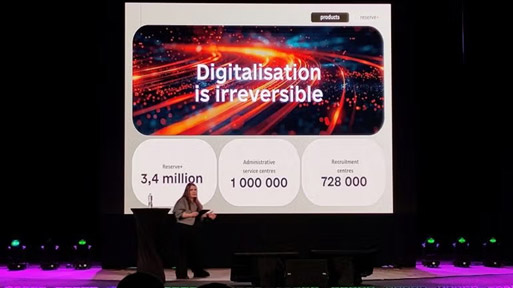
Kateryna Chernohorenko, Ukraine’s previous Deputy Minister of Defence for digital transformation, disclosing the Army+ app in 2024. Credit: Author
This includes the development and launch of the Army+ and Reserve+ digital apps, aiding training and administration for existing personnel as well as future recruitment.
Ferchuk, who prior to Russia’s 2022 large-scale invasion had executive experience inside Ukraine’s telecommunications sector, described the Reserve+ app as “really successful” in finding a way to “communicate with your potential audience” and help prepare those at initial or early stages of determining eligibility and recruitment.

It's a really complicated task, but we have to perform it.
Oksana Ferchuk
The Army+ initiative has since evolved with the launch a new version, dubbed Impulse, which is in rollout and acts as an analytical database to catalogue skillsets and needs of the individual soldier.
While such digital systems are increasingly common in the civil sectors, the adoption by Ukraine’s government for defence purposes is a distinct non-traditional approach.
“It's a really complicated task, but we have to perform it. There is no other way. If such data, such important data, do not exist online and you cannot rely on it, then your processes and decision making can lead to the incorrect solutions,” Ferchuk said.
Ukraine’s DOT-Chain: success continues
By early-December, Ukraine’s Defence Procurement Agency (DPA) revealed that in nearly four months of operation, the DOT-Chain defence marketplace had supplied equipment worth UAH 6.154bn to the country’s military.
Including in the equipment are first-person view (FPV) drones, electronic warfare systems, fixed-wing UAVs, and other equipment. In total more than 143,000 pieces of equipment have been delivered, the DPA stated in a 2 December social media post.
The next step is to scale up its functionality.
Arsen Zhumadilov, Ukraine DPA director
“The next step is to scale up its functionality,” said Arsen Zhumadilov, director of the DPA, at the time.
It is likely that UAVs and FPV represent a significant proportion of equipment delivered, with 17,000 UAVs packaged off to frontline units in the first two months of the DOT-Chain initiative.
Of note, the average delivery time of equipment ordered is around ten days, although instances of deliveries inside of three days have been recorded.
To modernise the platform, via an April request for information, the USAF is canvassing the inclusion of a new radar, electronic warfare equipment and enhanced
communications to create an “Advanced E-7”. Two such examples are sought within seven years, after which other E-7s could be retrofitted with the modifications.
As for the UK, three 737NG aircraft are currently undergoing modification in Birmingham, the first completing its maiden flight in September 2024.
Global Defence Technology asked Boeing what makes the E-7 stand out, and a spokesperson listing three points. First is its allied interoperability. “With the aircraft in service or on contract with Australia, South Korea, Türkiye, the UK and USA – and selected by Nato – its unmatched interoperability benefits a growing global user community for integration in future allied and coalition operations.”
The US is by far the largest spend on nuclear submarines. Credit: US Navy
Country | 2024 | 2025 | 2026 | 2027 | 2028 | 2029 | 2030 | 2031 | 2032 | 2033 | 2034 |
Australia | 3,582 | 3,586 | 3,590 | 3,594 | 3,613 | 3,622 | 6,183 | 6,207 | 6,216 | 6,239 | 6,380 |
China | 2,607 | 2,802 | 3,040 | 3,081 | 3,174 | 3,291 | 3,396 | 3,603 | 3,664 | 3,710 | 4,316 |
India | 2,320 | 2,533 | 3,675 | 2,457 | 2,526 | 2,639 | 2,741 | 2,873 | 2,958 | 3,350 | 3,560 |
Russia | 2,701 | 2,893 | 2,973 | 3,334 | 3,458 | 3,106 | 3,235 | 3,405 | 2,958 | 3,487 | 3,942 |
US | 16,957 | 18,037 | 18,522 | 18,607 | 18,137 | 18,898 | 18,898 | 19,643 | 19,876 | 22,592 | 23,730 |
Lisa Sheridan, an International Field Services and Training Systems programme manager at Boeing Defence Australia, said: “Ordinarily, when a C-17 is away from a main operating base, operators don’t have access to Boeing specialist maintenance crews, grounding the aircraft for days longer than required.
“ATOM can operate in areas of limited or poor network coverage and could significantly reduce aircraft downtime by quickly and easily connecting operators with Boeing experts anywhere in the world, who can safely guide them through complex maintenance tasks.”
Boeing also uses AR devices in-house to cut costs and improve plane construction times, with engineers at Boeing Research & Technology using HoloLens headsets to build aircraft more quickly.
The headsets allow workers to avoid adverse effects like motion sickness during plane construct, enabling a Boeing factory to produce a new aircraft every 16 hours.
Elsewhere, the US Marine Corps is using AR devices to modernise its aircraft maintenance duties, including to spot wear and tear from jets’ combat landings on aircraft carriers. The landings can cause fatigue in aircraft parts over its lifetime, particularly if the part is used beyond the designers’ original design life.

Caption. Credit:

Phillip Day. Credit: Scotgold Resources
Total annual production
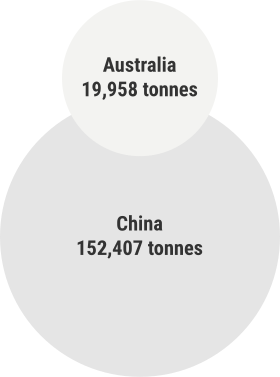
Australia could be one of the main beneficiaries of this dramatic increase in demand, where private companies and local governments alike are eager to expand the country’s nascent rare earths production. In 2021, Australia produced the fourth-most rare earths in the world. It’s total annual production of 19,958 tonnes remains significantly less than the mammoth 152,407 tonnes produced by China, but a dramatic improvement over the 1,995 tonnes produced domestically in 2011.
The dominance of China in the rare earths space has also encouraged other countries, notably the US, to look further afield for rare earth deposits to diversify their supply of the increasingly vital minerals. With the US eager to ringfence rare earth production within its allies as part of the Inflation Reduction Act, including potentially allowing the Department of Defense to invest in Australian rare earths, there could be an unexpected windfall for Australian rare earths producers.
