
Interview
Drone warfare: adopting the swarm
XTEND offers Israeli lessons for US War Department lethality doctrine with new remotely operated sUAS swarm kits. John Hill reports.
Main image: XTEND Scorpio PSIO sUAS in urban environment. Credit: XTEND
Interview
Triple target: Aselsan on Steel Dome, the UK, and AI
Aselsan CEO, Ahmet Akyol, discusses plans for Türkiye’s Steel Dome, the UK defence market, and AI. John Hill reports.
Aselsan CEO, Ahmet Akyol. Credit: Aselsan
While the saturation of small uncrewed aerial systems (sUAS) in airspace has changed the way belligerents conduct war, one Israeli company is beginning to determine how to coordinate the swarm concept remotely and more easily at the tactical edge.
XTEND Reality, an artificial intelligence (AI) and robotics supplier, won a multimillion-dollar deal with the US War Department (formerly the Department of Defense) in November to rapidly develop and deliver affordable close quarter modular effects first-person view drone kits (ACQME-DK).
The concept will support Department of War small tactical team operators to help increase precision strike lethality and survivability when conducting assigned irregular warfare operations in complex urban terrain and rural confined spaces.
XTEND’s chief executive officer and co-founder, Aviv Shapira, spoke to Global Defence Technology at the time the contract was announced.
John Hill: Could you walk me through the operational scenario for how these sUAS kits will be used?
Aviv Shapira: Essentially, it’s a team of drones – or another word for teams is swarm – and they can work together. You have one operator [who is] able to fly all of them together. This is why we need different types of drones in one system.
So, for example, if you have an indoor drone that is capable of ISR [intelligence, surveillance and reconnaissance] inside a building, it’s great, but it doesn’t carry payloads outside or it doesn’t fly for ten kilometres. We found that in order to solve a complex mission, you need different types of tools.
The way we've actually built the system is that we have what we call AI [artificial intelligence] pilots supporting the human so most of the mission is done by autonomous pilots.
All our AI pilots are downloadable. Let’s say you want to hit a missile launcher. Before the flight you would download the relevant AI pilot app and you can [then] find and destroy rocket launchers [from anywhere].
Simple things like flying to the destination, looking for different targets, homing on them – so interception – all of these are autonomous. What we call tasks are orchestrated by the human.
John Hill: Has the conflict in the Middle East informed any aspect of this capability?
Aviv Shapira: So, when this war started here in Israel, especially on the northern side, we found that we really have a huge problem with comms resilience. And it will always be a problem.
It doesn’t matter how good your cyber protections [are] and… it doesn’t even matter which company you use. The enemy is always going to try to beat you… to jam your comms. So, we went into fibre.
Now this is the first system that has both fibre and [radio frequency] comms, meaning that if you do cut your fibre, or if you do need to fly farther, you can just cut down the fibre and contain the mission.

The mine’s concentrator can produce around 240,000 tonnes of ore, including around 26,500 tonnes of rare earth oxides.
Gavin John Lockyer, CEO of Arafura Resources
John Hill: Could you tell me a bit about the contract: where are you producing these drones, how many, and which US service will use them?
Aviv Shapira: The Department of War has been doing covert evaluation for us in the in the PSIO [Precision Strike Indoor and Outdoor Small Unmanned Aerial Systems] programme. This contract is basically because they were happy. Now they want to move to swarm operations.
The programme has been kicked off and we are starting to deliver. But in terms of numbers, I would just say… we are producing hundreds a week in the US, at least. We have 20,000 [square] feet in Tampa [Florida]. They approved the multimillion-dollar deal. It’s less than [a] hundred million.
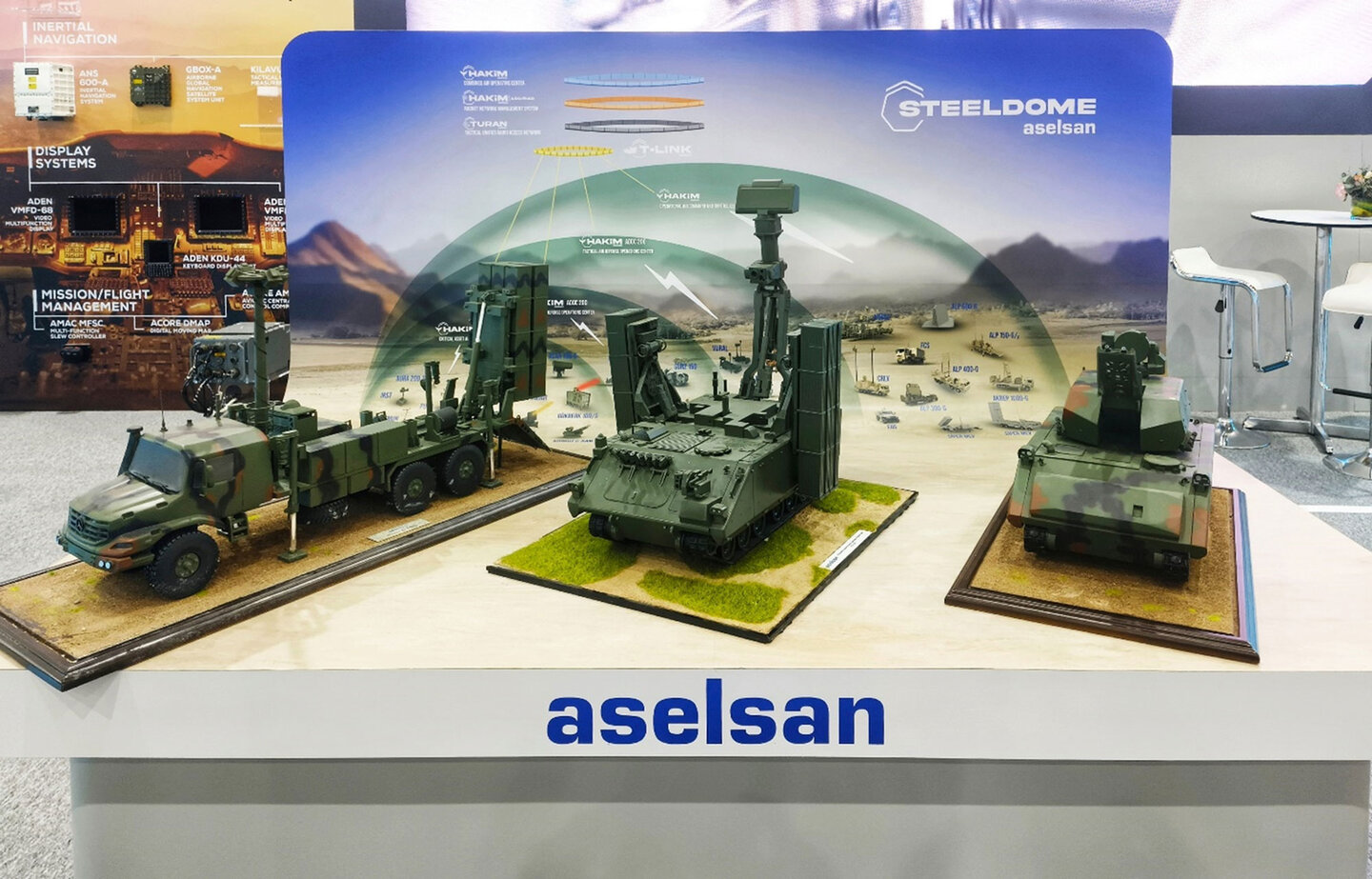
A model of Steel Dome air defence systems. Credit: Shutterstock/Allora Empire Art
Through precise outputs from the integrated fire-control loop, EW systems are directly employed as soft-kill effectors. This approach delivers cost-effective engagement by integrating the fire-control and kill chain across all layers — close-range, tactical, operational, and strategic — even against low-cost yet challenging aerial threats.
Unlike other systems, Steel Dome is not just a [countermeasure for rocket, artillery, and mortars]. It is a comprehensively integrated structure that leverages all sensing and interception resources to provide full-spectrum protection, from mini and micro drones to ballistic missile defence, across every layer of air and missile defence.
John Hill: The concept appears to align with the War Department’s lethality priority. To what extent does it meet that policy in the US now?
Aviv Shapira: We are the only drone in the US market that has been certified as a lethal one-way attack drone with [a] high voltage safe and arm. So, a lot of companies are on the market, like Android flare and others, we’re the first one to actually get certified.
The safe and arm [device] and everything around it has been certified by us, and now we can build different types of products around it. So, increase the distance, more power. This is ammunition that you can send to the target, and it can come back. So, it's a ‘safe and arm’, or ‘arm and safe’, it's constantly learning.
What we do in the company is that every time a human intervenes – like they take it over – we understand what happened to the autonomy and we learned from this instance to actually make it more autonomous next time.
