Feature
Live and let lift
Aircraft builders scramble to find their niche in the military airlift sector. John Hill reports.
Main image: A UK Royal Air Force A400M transporter. Credit: Crown copyright/UK Ministry of Defence
Cover Story
Eye in the sky
As the first line of threat detection, airborne early warning is a must-have capability for the world’s militaries. Gordon Arthur reports.
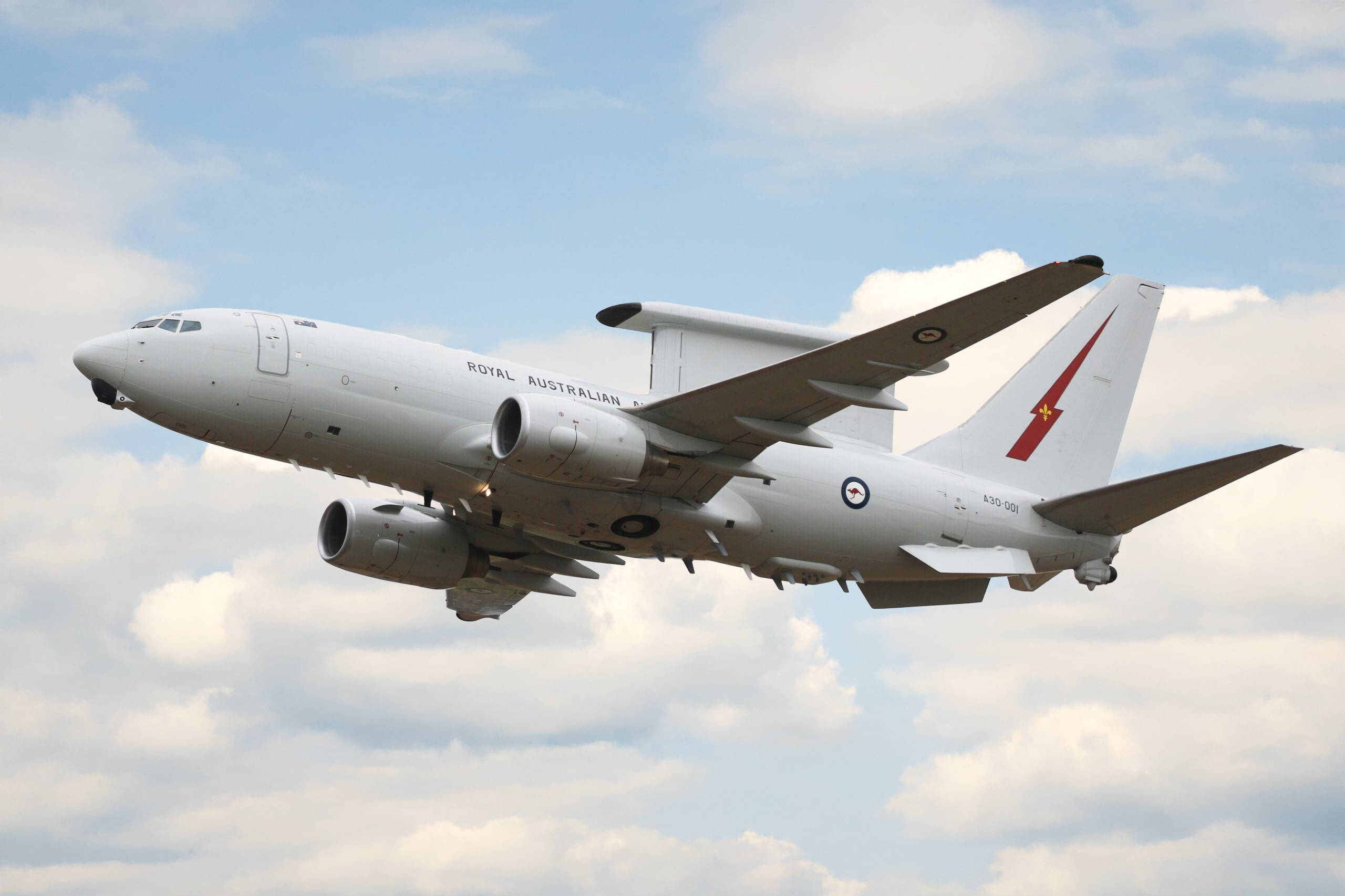
Australia was the first country to adopt the E-7A Wedgetail. Credit: Gordon Arthur
Thailand is the first and only country to place an order for the Multi Role Tanker Transport Plus (MRTT+). The new iteration builds on the widely used aerial refuelling MRTT, which is itself based on Airbus’ commercial A330 airliner.
The main differences, you may be wondering, include a Rolls-Royce Trent 7000 engine, increasing the maximum take-off weight by another nine tonnes, and 8% better fuel efficiency. But the platform is said to retain 95% airframe commonality.
All this indicates the little room with which aircraft builders must make a mark in the military fixed-wing airlift sector. Companies are jostling over these useful albeit trifling percentage points – fuel, size and weight efficiency – extending them as much as possible.
“The fundamental requirements for airlift haven’t really changed,” said the Royal United Services Institute’s leading airpower specialist, Justin Bronk, in discussion with Global Defence Technology.
Arguably, the last major shift in the market was the A400M, another Airbus platform, which straddles the line between a tactical and strategic airlifter, but the programme is now more than 20-years old.
But with global conflict on the rise in an increasingly unstable world, manufacturers are now trying to find their niche as the future battlespace, and the need to secure logistical chains, takes shape in Europe and the Indo-Pacific regions.
According to intelligence firm GlobalData’s analysis into the global fixed-wing aircraft market, the sector, valued at $87.2bn in 2025, is projected to reach $139.9bn by 2035 and cumulatively value $1.3 trillion over the forecast period.
While combat aircraft will dominate the market, with a 74.7% slice, the transport aircraft segment will be the second largest with 9.1% share. Among geographic segments, North America is projected to dominate the sector with a share of 31.3%, followed by Europe and Asia-Pacific with shares of 27.2% and 26.7% respectively.
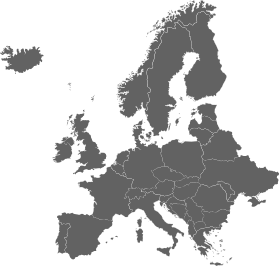
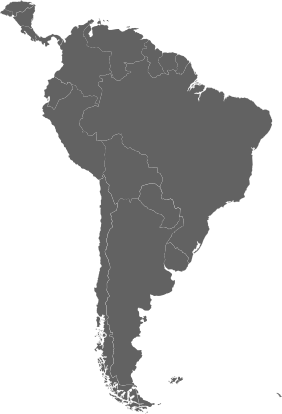
Explore the region’s aircraft:


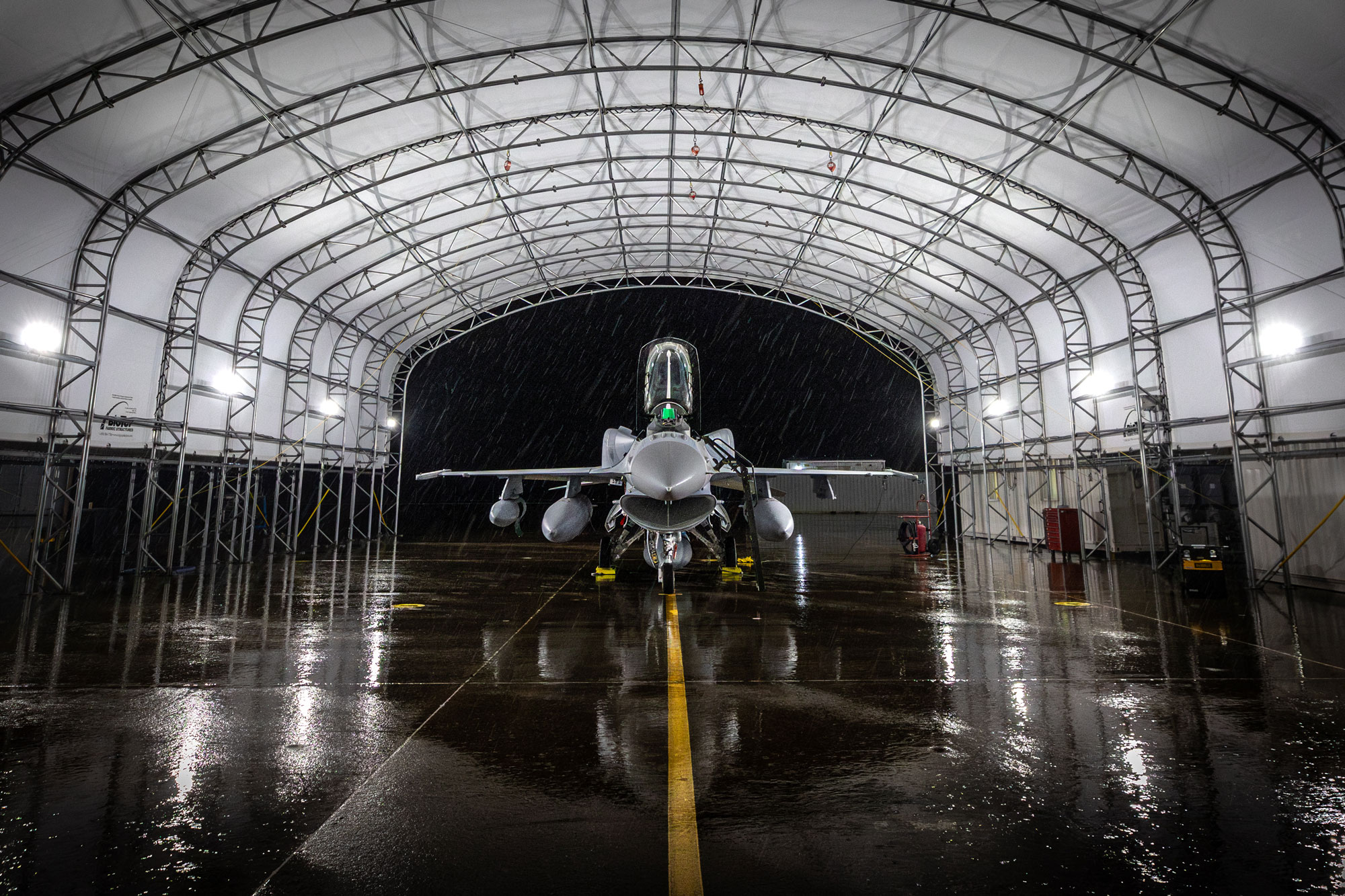
The first Bahraini F-16V ahead of its ferry in 2023. Credit: Lockheed Martin
Combat air: Bahrain
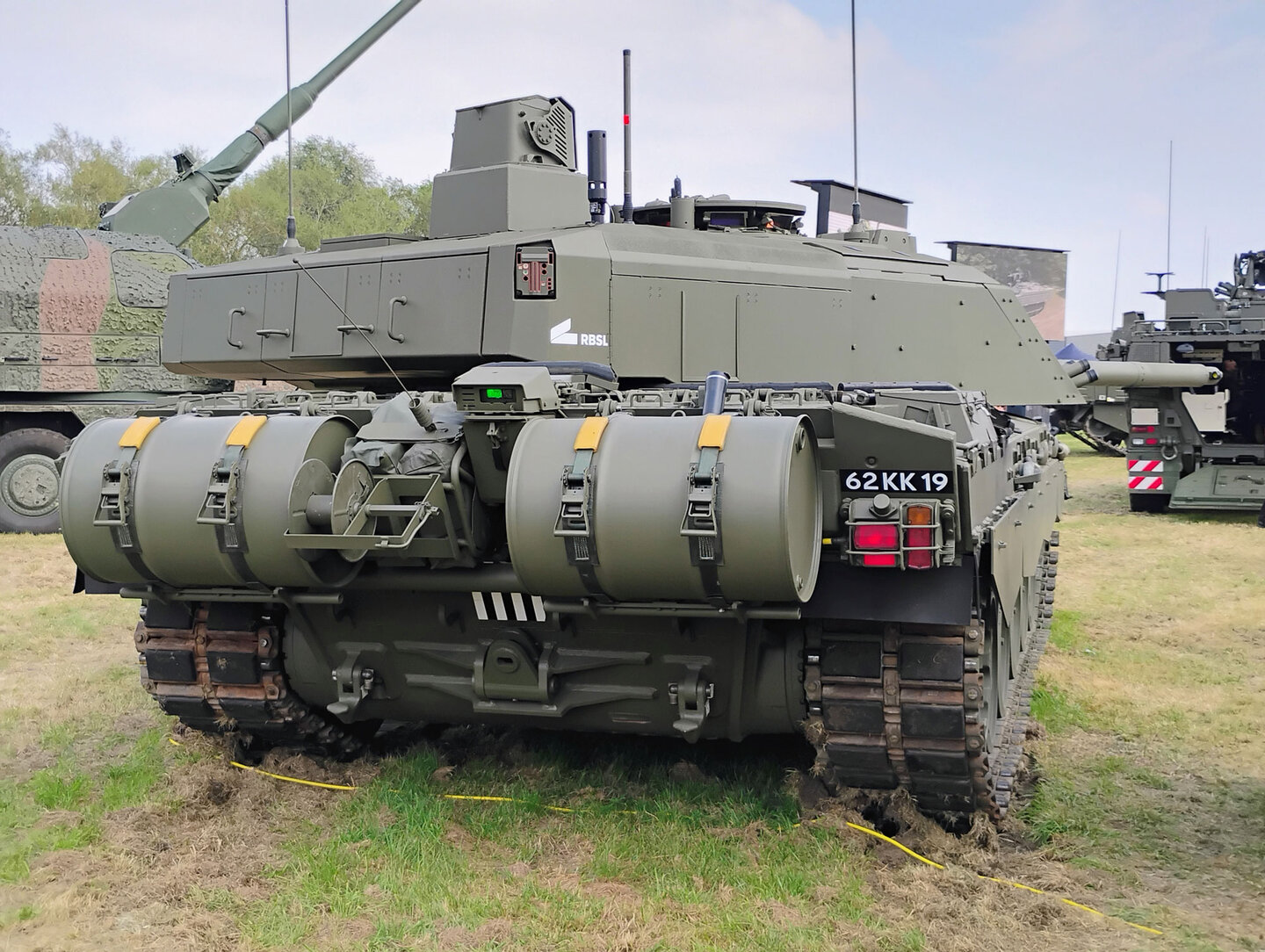
Central to the £800m (~$1bn) contract awarded by the UK Ministry of Defence in 2021 to Rheinmetall BAE Systems Land – a joint venture (JV) between Rheinmetall and BAE Systems – will be the fitting of the German company’s L55A1 120mm smoothbore gun in a new turret.
Additional upgrades include an upgraded engine with new cooling system and hydrogas suspension, a new suite of thermal cameras and sights, a secretive new modular armour, and an automated target detection and tracking system.
Global Defence Technology explores the range of suppliers, both UK and overseas, that are playing a part in the development of the British Army’s future, if decidedly small, MBT force.
To modernise the platform, via an April request for information, the USAF is canvassing the inclusion of a new radar, electronic warfare equipment and enhanced
communications to create an “Advanced E-7”. Two such examples are sought within seven years, after which other E-7s could be retrofitted with the modifications.
As for the UK, three 737NG aircraft are currently undergoing modification in Birmingham, the first completing its maiden flight in September 2024.
Global Defence Technology asked Boeing what makes the E-7 stand out, and a spokesperson listing three points. First is its allied interoperability. “With the aircraft in service or on contract with Australia, South Korea, Türkiye, the UK and USA – and selected by Nato – its unmatched interoperability benefits a growing global user community for integration in future allied and coalition operations.”

The E-7 platform is less expensive to operate compared to platforms based on small business jets.
Boeing spokesperson
The US is by far the largest spend on nuclear submarines. Credit: US Navy
Country | 2024 | 2025 | 2026 | 2027 | 2028 | 2029 | 2030 | 2031 | 2032 | 2033 | 2034 |
Australia | 3,582 | 3,586 | 3,590 | 3,594 | 3,613 | 3,622 | 6,183 | 6,207 | 6,216 | 6,239 | 6,380 |
China | 2,607 | 2,802 | 3,040 | 3,081 | 3,174 | 3,291 | 3,396 | 3,603 | 3,664 | 3,710 | 4,316 |
India | 2,320 | 2,533 | 3,675 | 2,457 | 2,526 | 2,639 | 2,741 | 2,873 | 2,958 | 3,350 | 3,560 |
Russia | 2,701 | 2,893 | 2,973 | 3,334 | 3,458 | 3,106 | 3,235 | 3,405 | 2,958 | 3,487 | 3,942 |
US | 16,957 | 18,037 | 18,522 | 18,607 | 18,137 | 18,898 | 18,898 | 19,643 | 19,876 | 22,592 | 23,730 |
Lisa Sheridan, an International Field Services and Training Systems programme manager at Boeing Defence Australia, said: “Ordinarily, when a C-17 is away from a main operating base, operators don’t have access to Boeing specialist maintenance crews, grounding the aircraft for days longer than required.
“ATOM can operate in areas of limited or poor network coverage and could significantly reduce aircraft downtime by quickly and easily connecting operators with Boeing experts anywhere in the world, who can safely guide them through complex maintenance tasks.”
Boeing also uses AR devices in-house to cut costs and improve plane construction times, with engineers at Boeing Research & Technology using HoloLens headsets to build aircraft more quickly.
The headsets allow workers to avoid adverse effects like motion sickness during plane construct, enabling a Boeing factory to produce a new aircraft every 16 hours.
Elsewhere, the US Marine Corps is using AR devices to modernise its aircraft maintenance duties, including to spot wear and tear from jets’ combat landings on aircraft carriers. The landings can cause fatigue in aircraft parts over its lifetime, particularly if the part is used beyond the designers’ original design life.

Caption. Credit:
Phillip Day. Credit: Scotgold Resources
Total annual production
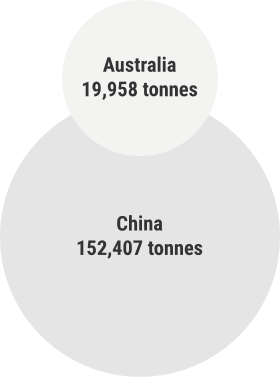
Australia could be one of the main beneficiaries of this dramatic increase in demand, where private companies and local governments alike are eager to expand the country’s nascent rare earths production. In 2021, Australia produced the fourth-most rare earths in the world. It’s total annual production of 19,958 tonnes remains significantly less than the mammoth 152,407 tonnes produced by China, but a dramatic improvement over the 1,995 tonnes produced domestically in 2011.
The dominance of China in the rare earths space has also encouraged other countries, notably the US, to look further afield for rare earth deposits to diversify their supply of the increasingly vital minerals. With the US eager to ringfence rare earth production within its allies as part of the Inflation Reduction Act, including potentially allowing the Department of Defense to invest in Australian rare earths, there could be an unexpected windfall for Australian rare earths producers.

Europe
In Europe, Airbus introduced a unique solution in A400M that meets at least some of the strategic envelope of a heavy lift transporter but also tactical capabilities too.
Bronk neatly observed that the design operates on “the lighter side of heavy lift” but with all the tactical trimmings of insertion on unpaved airstrips and cruising at low altitudes despite its 37-tonne payload capacity. Blurring the lines as a ‘strat-tact’ airlifter, the A400 demonstrated that it can reach places the C-17, a conventional strategic airlifter, cannot.
In May 2015, a relief mission in Nepal revealed the weight limits of numerous American and British C-17s on the runway of Kathmandu airport, where cracks appeared, forcing the local authorities with the help of the airmen to repair 250 square feet of tarmac.
A few years later, the UK demonstrated the long-term priority of the aircraft in its force structure. Initially, the government decided to induct more A400s rather than letting the proven C-130J reach the end of its in-service date despite parliamentary pressure. In 2023, the Defence Committee argued:
“One of the most significant cuts… was the early retirement of the C-130J Hercules fleet some seven years before its planned out-of-service date. Our witnesses were almost unanimously critical of this decision, which has significantly reduced the overall capacity of the air mobility fleet.”
With 131 aircraft in service among seven European users, A400 is the latest design to shift the military airlift sector, even encouraging other aircraft manufacturers to look at niches.
“Ten to fifteen years ago, with C-130, you wouldn’t expect the Leonardo C-27 to sell as well as it does now,” Bronk pointed out.
A tactical transporter, the C-27 Spartan has been upgraded over the years with new avionics, enhanced systems and aerodynamic winglets in an enduring effort to extend the aircraft’s efficiencies much like the MRTT+.
South America
For a more obvious modern tactical transport option, Europe has recently gravitated toward Embraer’s C-390 Millennium, a Brazilian design, that is not so much a successor to the C-130 than it is a competitor to the Cold War cargo plane still in production.
C-390 can carry up to 26 tonnes and reach a range of up to 1,080 nautical miles with a full payload. The medium-lift aircraft, which is smaller than the turboprop A400M, requires a greater takeoff distance of up to 1,500 metres due to its jet engines.
The difference comes down to the use of a traditional turboprop engine compared to a jet engine. It is the latter where the C-390 comes into its own. This feature challenges the dominance of turboprop for tactical airlift missions due to fuel efficiency, cost effectiveness, and thrust at low speeds.
However, the jet powered Millennium still maintains short-field performance and the ability to operate in austere environments. Embraer mounted the two V2500 engines high on the wings and incorporated a specialised landing gear to withstand operations in semi-prepared airfields.
As manufacturers seek marginal efficiencies and look to offer a particular niche, the user, in the end, is faced with certain trade-offs to fit their operational requirements.
United States
An intense game of wills between the US and China is playing out in the vast Indo-Pacific region, the result of which will determine the future world order. In such a complex and largely maritime space, range is key for both powers.
For the US, which will be forward operating, its armed forces will need to benefit from versatile airlift capabilities to enable their movement of troops and equipment.
A Pacific Air Force Public Affairs officer told this reporter that the US ultimately “requires resilient logistics, facilitated by fixed-wing airlifters that support Agile Combat Employment [ACE] by swiftly moving personnel and resources to dispersed locations.”
A mix of platforms – like the C-130J for tactical lift and the C-17 for strategic range – will provide the balanced capability the region demands, the officer contends, “and it is strengthened by our alliances and partnerships [in the region], providing an asymmetric advantage as we enhance maintenance and logistics to meet those requirements.”
However, Boeing ended C-17 production in 2015, leaving a finite albeit large American strategic fleet available for service – 222 units according to GlobalData intelligence – making the aircraft ever more valuable.
Meanwhile, another critical area of concern is ‘last-mile logistics’. Unlike commercial logistics, this final leg of the supply chain is typically in a hostile, complex and contested environment, making it the most challenging and dangerous part of the resupply process. This area is undergoing significant change; what a tactical airlifter like the C-130J would accomplish could now be done by cheaper uncrewed aerial systems (UAS).
The Marine Corps is already making this transition with drones in the air, on and below the sea. Cathy Close, a Marine Corps Combat Development and Integration spokesperson, said that they are pursuing any design that is “affordable, attritable, and capable to deliver sustainment effectively to the operating forces.”
To this end, during the AUSA exhibition in Washington, Sikorsky unveiled a concept in which it converted a UH-60L Black Hawk helicopter into an autonomous UAS, known as the U-Hawk.
China
On the other side of this great power competition, the People’s Liberation Army Air Force (PLAAF) is making its own strides in the airlift sector.
In early October, it was widely reported that China’s aerospace industry conceived a design for a new generation strategic transporter featuring a blended wing body (BWB) – a radical shift in conventional configuration design. It is said that the new airlifter is envisioned to carry up to 120 tonnes of cargo with a maximum takeoff weight approaching 470 tonnes, surpassing China’s current heavy transport fleet.
However, Bronk shed light on the challenging reality of the concept. Besides the increased lift and drag, the tailless configuration means stability and control are more difficult compared to conventional aircraft with their high tails as seen with the A400 and C-390.
At the same time, this early concept must be for a highly specialised mission envelope since China has been ramping up its production of the Y-20B, the PLAAF’s version of the C-17. In fact, some say that the Y-20 design was informed by military technical data retrieved by Chinese hackers in 2014, which surely represents the success of the lynchpin across American and allied fleets.
Currently, the Y-20 fleet can transport two light airborne brigades, or one light mechanised airborne brigade if it uses its entire inventory of transport aircraft, leaving the limited extra capacity for emergency transport of materiel or other tasks.
This “relative weakness”, as observed the China Aerospace Studies Institute, which is currently being rectified, would put the lift required for a Taiwan invasion scenario at risk.