Company Insight
Sponsored by BAE Systems
Delivering mission readiness
Its heritage of innovation spans more than 450 years - from 16th-century gunpowder mills through the industrial revolution, the rise of aviation and space exploration, to today’s cyber and digital capabilities.
Main image credit:
BAE Systems is widely recognised, but its history and scope are often less understood. Its heritage of innovation spans more than 450 years - from 16th-century gunpowder mills through the industrial revolution, the rise of aviation and space exploration, to today’s cyber and digital capabilities. This focus on adopting new technologies and advancing cost‑effective, high‑capability solutions is especially evident in its Maritime Simulation and Training activities.
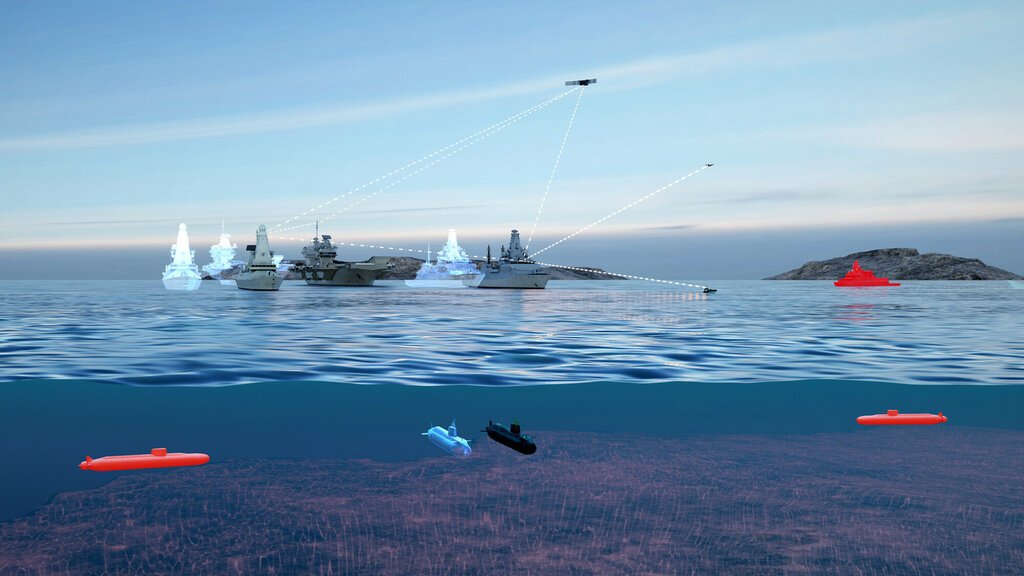
The use of synthetic environments to enable realistic simulation is well established but has become increasingly important for modern militaries. It allows testing, training and experimentation to take place safely, securely and at significantly lower cost than live activity. To be effective, these systems must deliver high fidelity, closely reflecting real-world conditions, including accurate representation of weapons and sensor performance. They also need open architectures to support interoperability, enabling integration with other systems and the inclusion of multiple assets.
BAE Systems Maritime Simulation and Training has developed its own synthetic environment - MIMESIS® - from the Greek for “imitation of reality” is the evolution of technologies used in Royal Navy surface and subsurface training. It provides a continually evolving, high‑fidelity synthetic training platform. Change and innovation across military capability are rapid, and this is equally true in simulation and training. BAE Systems supports this through advanced training capabilities, innovation, and collaboration with SMEs to harness their pace and innovation to incorporate specialist, scalable and integrated tailored solutions into MIMESIS to meet the ever-changing needs of the customer.
Caption. Credit:
Recent developments have focused on enhancing effectiveness and efficiency through advances in training for autonomous warfare, human–machine teaming and embedded analytics.
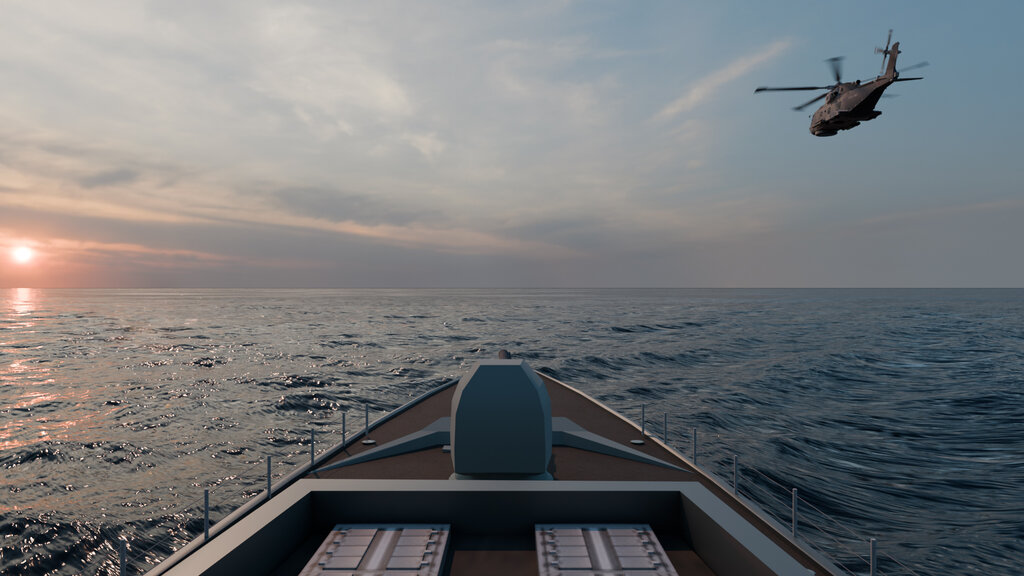
As part of efforts to provide advanced operational tools and effective efficient training solutions, BAE Systems and its partners are delivering the Type 26 Global Combat Ship, now ordered by four navies. For this platform, innovation in the synthetic domain includes the Platform Enabled Training Capability (PETC), a significant enhancement to the effectiveness of maritime training. PETC addresses a key challenge for navies: training against modern threats—such as hypersonic missiles or drone swarms—that are difficult to replicate in live environments. When combined with live operations, blending the PETC environment with the real world delivers a significantly enhanced training capability for ships.
Caption. Credit:
While shore-based trainers offer one approach, they lack the realism of using onboard systems and do not involve the full ship’s company. PETC integrates a synthetic environment directly into the vessel, enabling crews to train at sea using their own equipment against realistic threat scenarios. When combined with live operations, this blended approach delivers a more immersive and effective training experience.
As synthetic training becomes increasingly central in modern defence, driven by cost, complexity and the pace of change: training, modelling and analysis are by necessity increasingly delivered at scale through synthetic environments. Through continued innovation and collaboration and by integrating our high-fidelity synthetic environments, with other SME capabilities enabled by our open and interoperable architecture such as integration of data analytics or VR/XR capabilities, we are helping to ensure forces are better prepared for evolving threats.
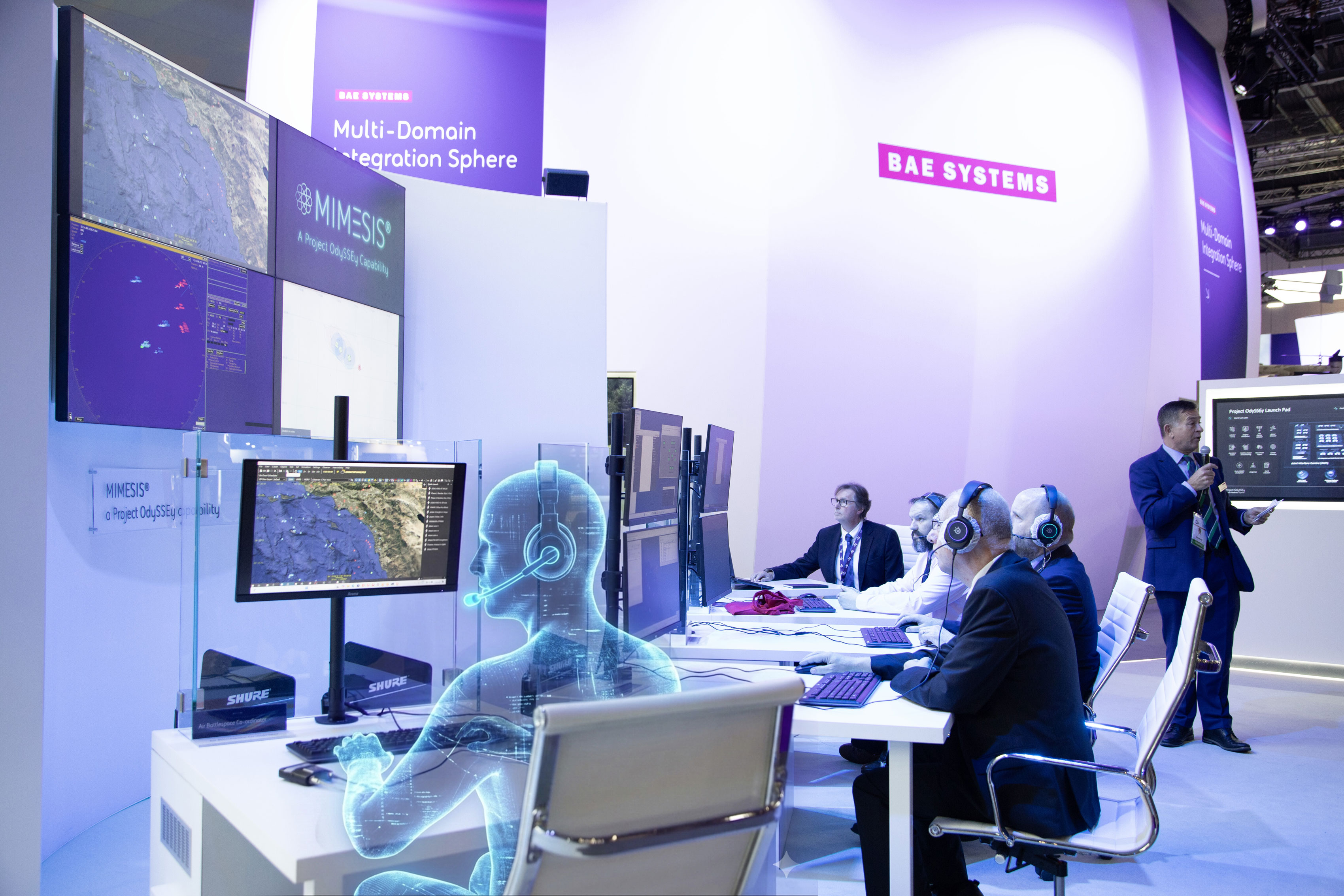
One way BAE Systems is developing options to support customer needs is by applying the responsible and safe development of AI to improve productivity, enabling faster and more efficient training design, and to enhance simulation. A key application is replicating and replacing or adding significant mass to the ‘white force’ traditionally a set of role players representing entities such as aircraft, or other military vessels or civilian craft.
Caption. Credit:
This ‘white force’ significantly enriches training, however finding the personnel and training them to act as and control the entities to ensure a coherent scenario, and to remain in date with latest tactics and doctrine can be costly and resource‑intensive. As a response to this and to create greater flexibility for shoreside or at sea training, we are developing and integrating AI role players into a synthetic environment. Not only does the AI interact with the training audience it also directly assimilated into the synthetic environment and scenario, meaning its activities affect how the training develops. This offers a scalable alternative to elements of the white force accurately modelling the behaviour and performance of military assets while adapting to the needs of each exercise.
Increasingly budgets are restricted and training time limited. This means that more than ever BAE Systems has looked at enhancing its products by working with SMEs to harness their niche capabilities so that our customers get the benefit of rapid innovation tailored to their requirement for scale, security and integration. This has been demonstrated by the collaboration in the simulation world to deliver key capabilities such as data analytics and VR/XR augmentation.
BAE Systems Maritime Simulation and Training is driving change with its delivery of world class training capabilities which are enabling customers to enhance readiness, accelerate capability development and maintain a decisive edge in an increasingly complex operating environment. For navies both at home and abroad this means training that is not just more frequent, but more realistic, scalable and cost‑effective.
Learn more about MIMESIS®

- Biffa internal savings data, average saving (January - August 2023)
- Nisbets internal savings data, average saving (January – September 2023)
- Compliance365 internal data, average savings
- HEINEKEN UK data, Calculations based on SmartDispense® active accounts each year since 2015 with 10 lines
- Independent test results based on subterranean and ground floor pub cellars of varying sizes
- Independent test results based on subterranean and ground floor pub cellars of varying sizes
