Interview
Pressure points: Aristeia’s new tourniquet
Norway-based Aristeia has developed a new life-saving tourniquet for use by military forces. Richard Thomas reports.
Powered by


Main video supplied by Stusya/Creatas Video+ / Getty Images Plus via Getty Images
Battlefield medicine is a fast-evolving sector, as militaries seek to find ways to reduce the lethality of combat injuries, amid the proliferation of dangers in the the modern battlespace.

Gard Moe, Aristeia’s managing director
To that end, Norwegian defence and security provider Aristeia is introducing a battlefield tourniquet into the market, offering new life-saving capability to personnel operating at the most kinetic edge of the modern frontline.
Global Defence Technology speaks with Aristeia’s managing director Gard Moe, on the company's new Generation 8 tourniquet, its use in Ukraine, and future market potential.
Richard Thomas: What was the motivation behind Aristeia’s decision to develop a new battlefield tourniquet, and how long did the process take?
Gard Moe: My first encounter with tourniquets came during my service in His Majesty the King's Guard in the Norwegian military. The seed of an idea, to develop a fundamentally different kind of tourniquet, took root some years later, while I was studying applied physics and mathematics in Trondheim.
The idea was a simple but significant one: what if you replaced the widespread windlass rod with a pull cord to generate pressure? The result would be faster pressure build-up to stop blood flow more quickly in life-or-death moments.
Before building anything, I spent months immersing myself in everything written about tourniquets (going back to the Battle of Mogadishu) determined to understand the sector inside out. That groundwork paid off: the concept caught the attention of the Norwegian Ministry of Defence and evolved into a joint project with the Norwegian Armed Forces, who recognised its wider potential. That’s how we came to work in defence.
Richard Thomas: How does the battlefield tourniquet work?
Gard Moe: On the surface, it's a deceptively simple concept: a pull-cord mechanism connected to a drivetrain that provides the mechanical advantage needed to tension a strap around an injured limb. Think of a lawn mower starter or an outboard engine; these devices also use large amounts of force to transfer pressure quickly.
But the real breakthrough lies in what the design eliminates. Because the strap feeds continuously through the device, it removes the primary point of failure in tourniquet application: the excess space that typically remains between the tourniquet and the limb after initial tightening. That gap costs precious seconds, and when someone is bleeding out it can literally make the difference between life and death.
There's a tactical advantage, too. The device can be self-administered with one hand, meaning that the wounded person doesn't have to pull a soldier away from the battlefield to help them.
Richard Thomas: What are the dimensions for the tourniquet, unit cost, and expected shelf life?
Gard Moe: The device is compact: just 40 mm tall, 89 mm long, and 80 mm wide. Much of that width is driven by the 48 mm strap, which is deliberately wider than most tourniquets on the market. That extra width isn't wasted space, it distributes pressure more evenly across the limb, lowering the occlusion pressure needed to stop blood flow and reducing the force required.
On the manufacturing side, we've invested heavily in driving production costs down to ensure we can remain competitive. The device isn't on the market yet, so we're not presenting a price point, but we're confident in where it's heading.
We're targeting a ten-year shelf life. Tourniquets are typically vacuum sealed in protective clear packaging to preserve material integrity over long storage periods. A tourniquet might sit untouched for years before the moment it's needed, and when that moment comes, it has to work.
Richard Thomas: What sort of market is the tourniquet being targeted towards, and is the company able to scale production to meet current and future demand?
Gard Moe: Tourniquets have only recently been widely adopted in defence, and we actually expect the civilian market to overtake them in the long term. The logic is straightforward: having a tourniquet available is one of the single most life-saving interventions in traumatic bleeding, and that applies far beyond the battlefield.
The device is also built for conditions where conventional tourniquets fall short. Its even pressure distribution at high levels may allow it to be applied over thick clothing while still retaining occlusion, making it suited to environments like Norway and Ukraine.
In 2022, the Ukrainian government approached us through its embassy in Oslo seeking tourniquets for frontline use. The team is committed to supplying hundreds of units and is now exploring technology transfer to enable production inside Ukraine itself.
We are currently scaling manufacturing meaningfully and are also considering options for relocating our operations abroad.
Richard Thomas: Have lessons learned/observed in current conflicts, such as Ukraine, helped inform Aristeia’s battlefield tourniquet?
Gard Moe: Ukraine has been invaluable as a source of design guidance and a test regime as well. The exchange goes both ways: we've shared our protocols and insights, and we've gained a depth of field knowledge that simply doesn't exist anywhere else. We believe that hard-won experience from Ukraine will be crucial in shaping the next generation of casualty care technology.
One of the most pressing issues in Ukraine has been the reliance on cheap, poor-quality imports that fail under real-world conditions. The consequences have been devastating: preventable deaths, both military and civilian, from bleeding that should have been controlled. That's exactly the problem we’re trying to solve.
There's a civilian dimension too. Many Ukrainians now carry tourniquets daily in case they're caught in bombings, drone strikes, or shootings. Making reliable, self-administered tourniquet technology available to ordinary citizens is a key reason why we're doing this.
Richard Thomas: You mention tech transfer to Ukraine, what feedback has the company received from the Ukrainian military in terms of the tourniquet’s efficacy?
Gard Moe: We've already received field feedback on an earlier generation of the device, alongside assessments from subject-matter experts. The concept has generated significant interest. Up to this point, the main challenge on our side has been producing sufficient volumes for further evaluation. That bottleneck is now clearing, and we're scaling manufacturing to a meaningful degree for the first time.
Caption. Credit:
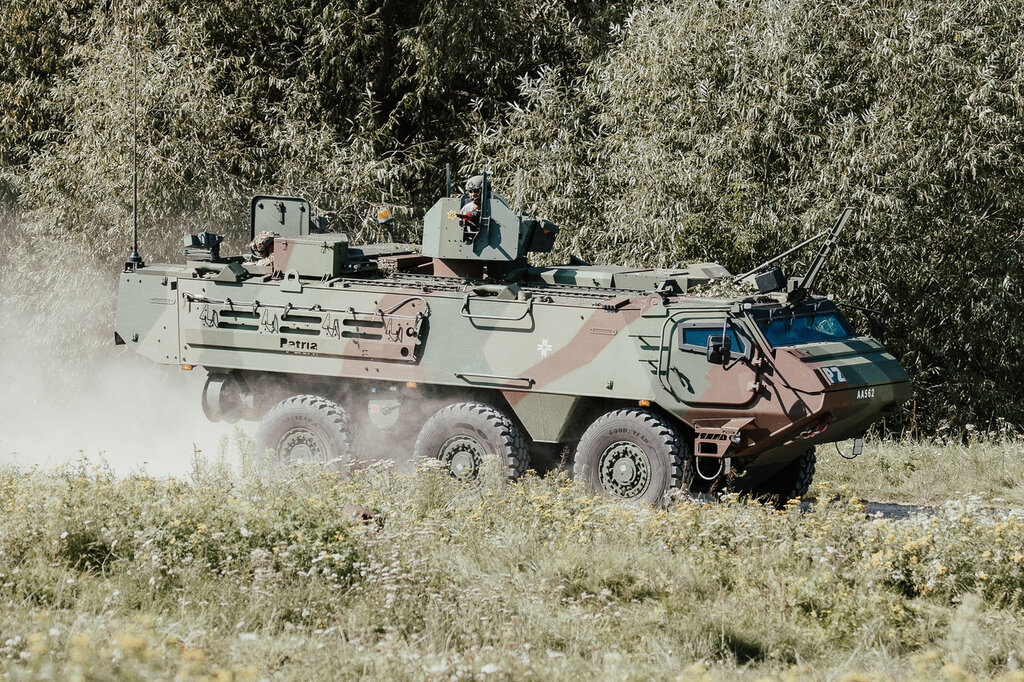
Patria’s CAVS is operated by a number of European countries. Credit: Karlis Miksons/Shutterstock.com

The real constraint is midstream capacity: processing, separation, magnet-making.
Benedetta Girada, Hague Centre for Security Studies

Total annual production
Australia could be one of the main beneficiaries of this dramatic increase in demand, where private companies and local governments alike are eager to expand the country’s nascent rare earths production. In 2021, Australia produced the fourth-most rare earths in the world. It’s total annual production of 19,958 tonnes remains significantly less than the mammoth 152,407 tonnes produced by China, but a dramatic improvement over the 1,995 tonnes produced domestically in 2011.
The dominance of China in the rare earths space has also encouraged other countries, notably the US, to look further afield for rare earth deposits to diversify their supply of the increasingly vital minerals. With the US eager to ringfence rare earth production within its allies as part of the Inflation Reduction Act, including potentially allowing the Department of Defense to invest in Australian rare earths, there could be an unexpected windfall for Australian rare earths producers.
