
Feature
Hybrid Approach: ICEYE on UK satellite plans
The company propose a ‘hybrid model’ for the UK’s satellite demands. John Hill reports.
Powered by


Main video supplied by Ilia Levchenko/Creatas Video+ / Getty Images Plus via Getty Images
The space-based data provider ICEYE has urged the UK to rethink how it approaches the space market, advocating that the Ministry of Defence ditch exquisite tech from the United States in favour of European collaboration.
In an interview with Global Defence Technology, Damon Olloman, the company’s vice president for missions in the UK and Canada, proposed an alternative hybrid model combining sovereign assets with commercial off-the-shelf satellites.
Such advice aligns with the principles espoused in the Defence Industrial Strategy published in September 2025. The document detailed an extensive overhaul of Cold War era procurement practices. This legacy system will be replaced with procedures embracing homegrown innovation, fast delivery and European security cooperation.
In this changing landscape, the Finnish satellite builder may be positioned to tap into British requirements, having already secured contracts with Germany, Greece, Poland, Portugal, Finland, Sweden and Ukraine.
What is this hybrid model?
Notwithstanding Olloman’s call for the Government to disentangle from America’s industrial web, the UK has been developing its own satellites in recent years.
Foremost among them is the Oberon programme. The constellation, made up of two 400kg Synthetic Aperture Radar (SAR) satellites, the first of which is set to launch in 2027, will be able to capture day and night-time images of the Earth’s surface.

The UK could get much more capability
Damon Olloman, ICEYE
Programmes like Oberon are cultivating a wider space supplier ecosystem in the UK. For example, Oxford Space Systems supplies the antennas for the spacecraft; the company has developed carbon fibre structures that stow away in small volumes for launch but spring into shape in orbit.
But the UK first began formal studies into SAR technology in 2019. Considering immediate ISR demands in the contemporary battlespace, it is not viable to wait seven years for a satellite.
“Not everything needs to be done in one big, expensive go,” Olloman said, challenging the UK’s effort to cultivate its apparatus alone.
It is here that ICEYE aim fill the UK’s capability gap and to complement sovereign assets with proven, off-the-shelf satellites.
Olloman calculated that the company could provide a lot in a short amount of time:
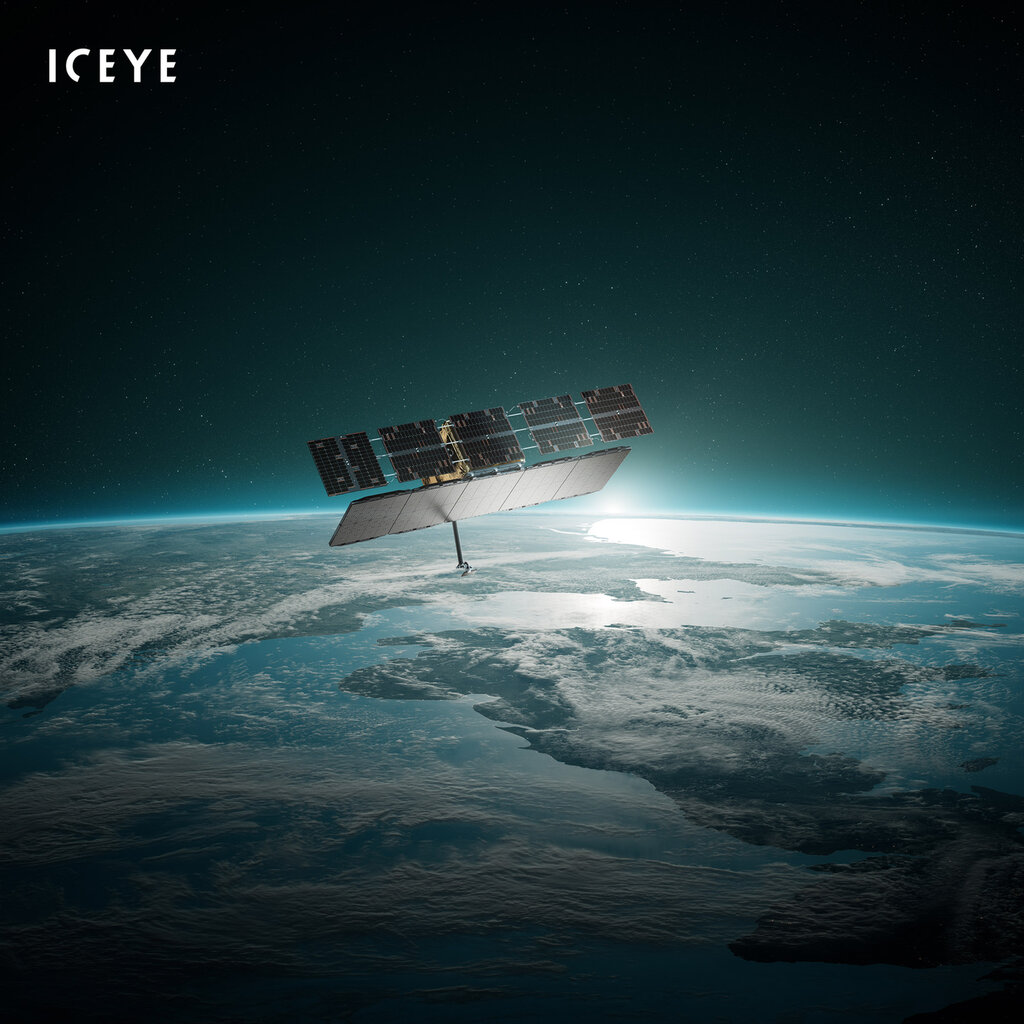
ICEYE SAR satellite in orbit. Credit: ICEYE
Based on current operations, he affirmed ICEYE could “certainly” build three satellites in the UK that can deliver about 95% of Oberon’s capability at a significant price decrease. The company also have the slots to launch them in 2027.
Use cases
Germany confronted a similar issue in its need for space-based imagery, but officials did not want to own or design satellites from scratch.
Instead, ICEYE supplied imagery from satellites it already owned, and later added new ones until the company agreed to build satellites in the country that will be operated by its leading arms builder, Rheinmetall, as part of a joint venture.
This gave the Bundeswehr sovereignty at any point in time, with Olloman describing the incremental commitment process as “a stop‑gap” until they decide to add to their capability.
“I think we could do something like that in the UK,” he suggested.
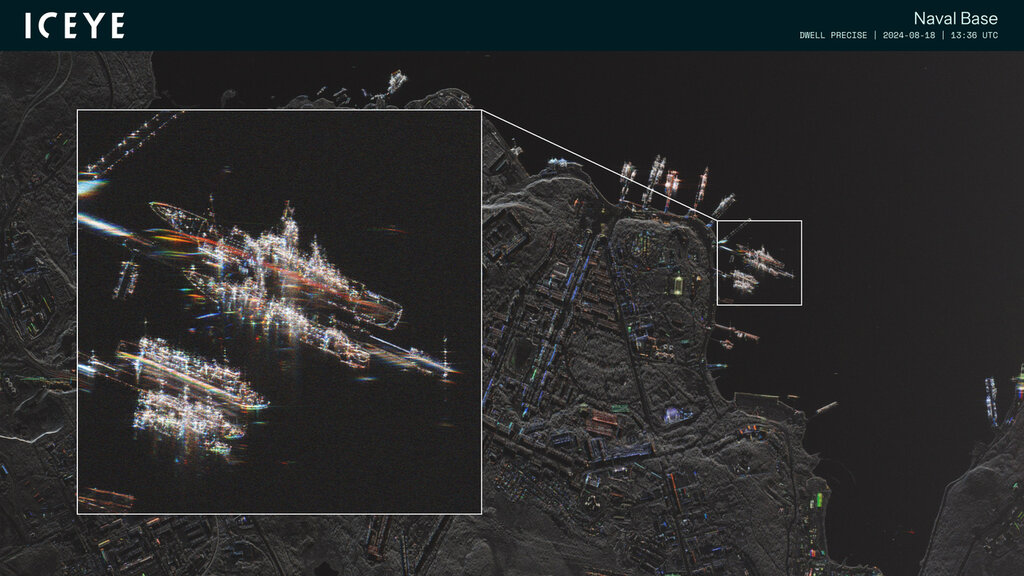
Space-based surveillance needs are increasing. Credit: ICEYE
Elsewhere, ICEYE are a close supplier of SAR imagery for Ukraine since before the full-scale invasion began and has since enhanced its support for the war-torn nation.
More recently, Olloman noted, “Ukraine has used our imagery to make strategic strikes deep into their adversary’s territory.”
The ability to conduct long-range strikes, well beyond visual line of sight, has become a necessity for success in contemporary conflict. The world took note of Iran’s ability to launch missiles 4,000 kilometres away, targeting the US-UK military base in Diego Garcia.
Europe is the answer
In December, the Netherlands, Poland and Finland signed a letter of intent to share their satellites.
By pooling resources with allies, a country can multiply its monitoring capabilities from space beyond the value of the initial investment.
Olloman was quick to point out that there will be 40 new ICEYE satellites launched in the next three years. In the case of the Netherlands, they bought four but get access to 40 satellites.
“The UK could get much more capability for the price of much less,” Olloman maintained.

Dr. David W. Bates, Chief of General Internal Medicine at Brigham and Women’s Hospital
Dr. David W. Bates, Chief of General Internal Medicine at Brigham and Women’s Hospital

The MIM-104 Patriot air defence system. Credit: Gordon Arthur

Caption. Credit:
Total annual production
Australia could be one of the main beneficiaries of this dramatic increase in demand, where private companies and local governments alike are eager to expand the country’s nascent rare earths production. In 2021, Australia produced the fourth-most rare earths in the world. It’s total annual production of 19,958 tonnes remains significantly less than the mammoth 152,407 tonnes produced by China, but a dramatic improvement over the 1,995 tonnes produced domestically in 2011.
The dominance of China in the rare earths space has also encouraged other countries, notably the US, to look further afield for rare earth deposits to diversify their supply of the increasingly vital minerals. With the US eager to ringfence rare earth production within its allies as part of the Inflation Reduction Act, including potentially allowing the Department of Defense to invest in Australian rare earths, there could be an unexpected windfall for Australian rare earths producers.
