

Feature
Prize fighters spar for dominance
Demand for combat air is shared evenly across North America, Europe, and Asia. Gordon Arthur reports.
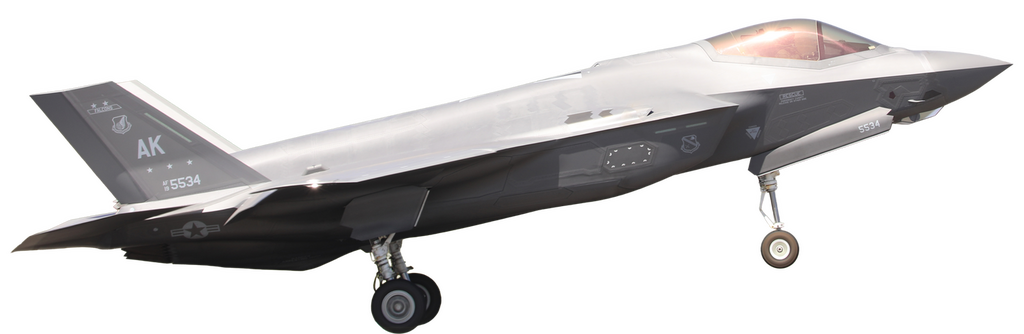
An F-35A of the US Air Force attending Aero India 2025. Credit: Gordon Arthur
Interest in fighter jets is surging. Even before Russia went to war in February 2022, a wave of rising defence spending was occurring. The Ukraine war triggered a second wave in interest, especially amongst European air forces, whilst a third boost has come from doubts over US alliance commitments.a
As Swedish Prime Minister Ulf Kristersson said in 2025, “We’re not at war, but we’re not at peace either.” Against such a backdrop, many air forces are acquiring fifth-generation fighters, although fourth- and 4.5-generation fighters remain a popular staple too.
According to GlobalData’s ‘Global Military Fixed Wing Aircraft Market Forecast 2026-2036’, the combat aircraft segment represents over 75% of the entire fixed-wing market, valued at nearly $90bn in 2026.
Geographically, market demand signals are spread evenly across the world, with the North American segment registering a share of just over 29%, followed by the Europe and Asia-Pacific regions at ~28% and ~27% respectively.
The new breed
Choices are limited when it comes to fifth-generation jets, as acquisitions depend on a country’s geopolitical persuasion. The Western market is dominated by Lockheed Martin’s F-35 Lightning II, whose production surpassed 1,325 units in April 2026. The F-35 has already participated in a number of combat operations, including Operation Epic Fury against Iran. The eight programme partners are supplemented by twelve other nations that have purchased the platform.
The F-35 is designed to evolve, and Technology Refresh 3 has now been rolled out, this designed to upgrade the F-35’s computing infrastructure and enable Block 4 capabilities. a Lockheed Martin spokesperson explained to Global Defence Technology: “With 70 major upgrades for all three F-35 variants, Block 4 is the most significant evolution of F-35 capabilities to date, including increased missile capacity, advanced electronic-warfare capabilities, improved target recognition and other classified capabilities.”
In February, Lockheed Martin flight-tested an artificial intelligence (AI)-enhanced combat identification capability integrated into the F-35’s information fusion system to help pilots identify threats faster. According to the spokesperson: “The successful demonstration, known as Project Overwatch, marks the first time a tactical AI model has been used in flight to generate an independent combat ID on the pilot’s display.”
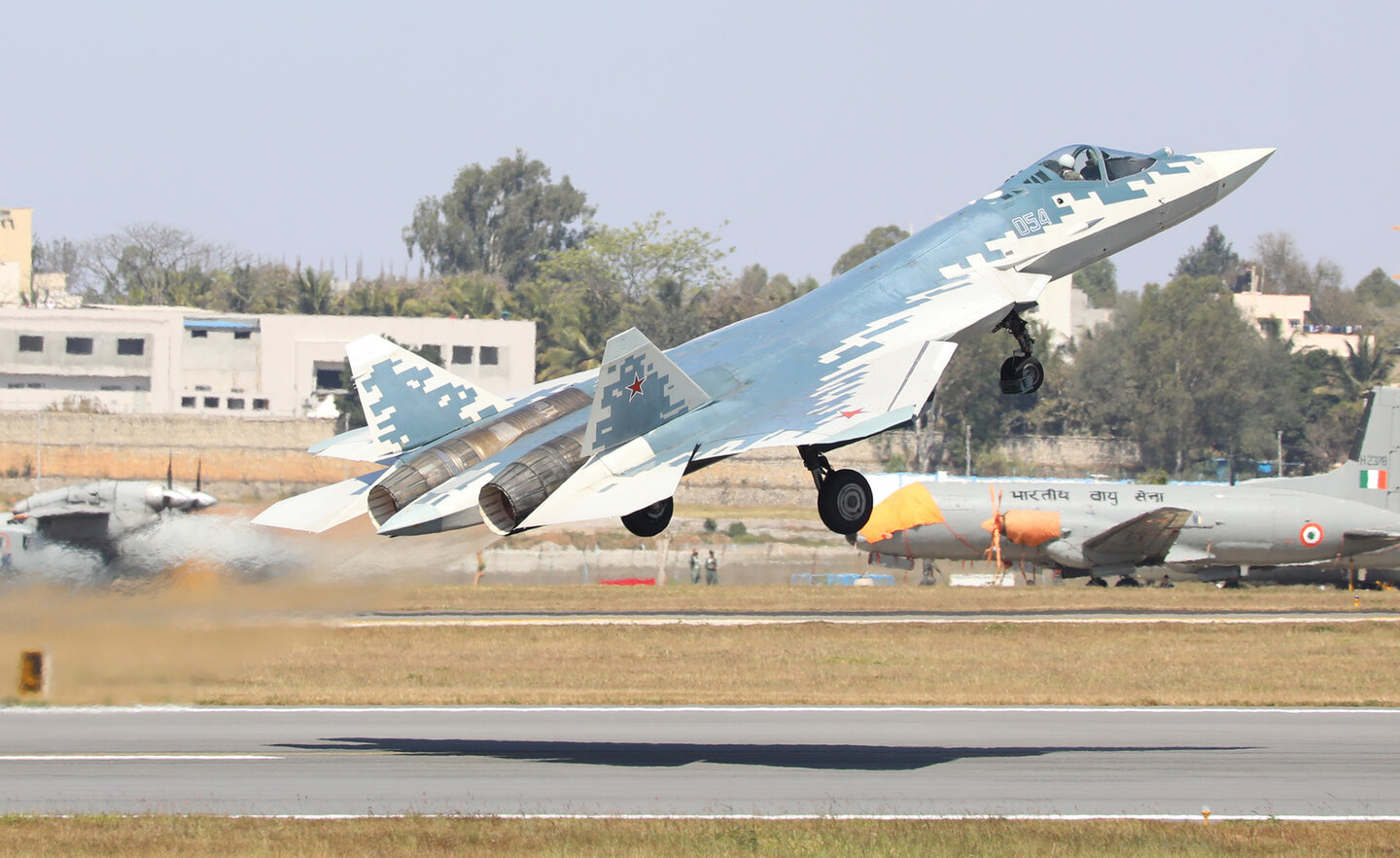
Russia is tempting India with offers of its fifth-generation Su-57E. Credit: Gordon Arthur
The only other fifth-generation fighters in service are the Russian Su-57 and Chinese J-20 and J-35/35A. Entering People’s Liberation Army Air Force (PLAAF) service in 2017, an estimated 300+ J-20s are in service. Alongside the J-20, the PLAAF is inducting J-35A fighters derived from the navy’s carrier-borne J-35. Smaller than the J-20, the J-35 gives the PLAAF a modern, high-low force mix.
Russian production of the Su-57 has been slow, and Algeria is its first export customer with 14 aircraft believed ordered. Moscow is also pushing the Su-57E on India. However, Delhi has not been swayed by Russian overtures yet, since India is pursuing its own fifth-generation Advanced Medium Combat Aircraft (AMCA). At the Aero India 2025 exhibitoin, a full-scale engineering model of the twin-engine fighter debuted.
The AMCA’s maiden flight is slated for 2028, and stakeholders are promising deliveries in 2034. Alas, Indian aircraft programmes typically run years behind schedule, although the involvement of private companies in production may prove ultimately beneficial.
Additionally, Turkish Aerospace is developing the Kaan next-generation fighter. The maiden flight of the P1 prototype is supposed to occur midyear, and first deliveries to Turkey are supposedly slated for around 2029.
Backbone fighters
Asked whether the legacy F-16 fourth-generation fighter is still relevant today, the Lockheed Martin spokesperson told Global Defence Technology: “Yes, with more than 2,800 aircraft flying in 29 countries, the F-16 Fighting Falcon remains the world’s most widely operated multirole fighter and a backbone of allied airpower.”
The combined F-16 fleet has achieved 21 million flight hours, and six countries are acquiring the latest Block 70/72 version. As of March, 37 of these had been delivered and 111 remained on order.
Regarding upgrades, the spokesperson said:: “Greece, Poland, South Korea and other nations are upgrading or acquiring the latest F-16 configurations, aligning their fleets with the most advanced fourth-generation technology flying today.”
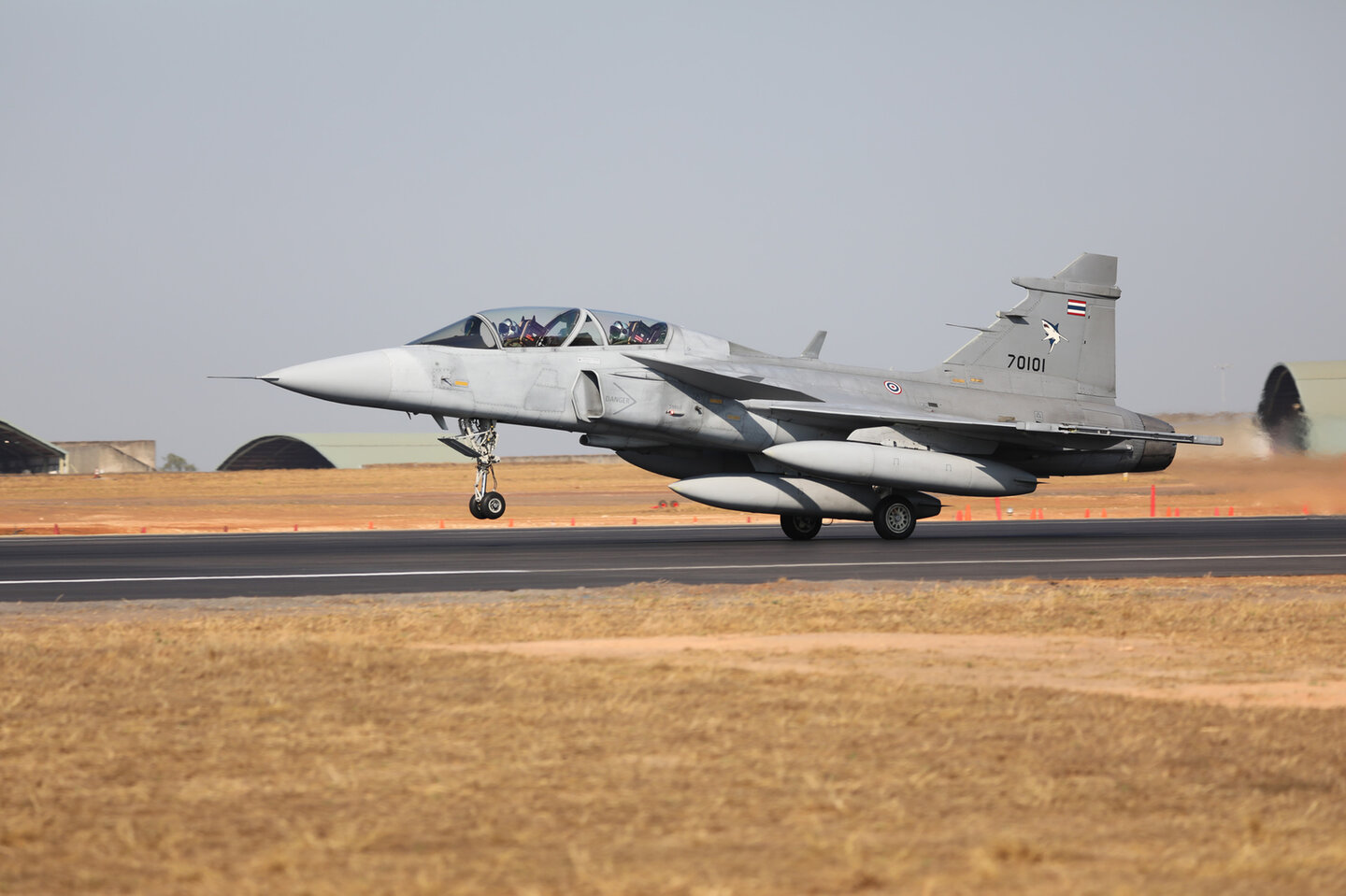
Saab’s Gripen is a popular choice for air forces wanting an alternative to a US platform. Credit: Gordon Arthur
Modernised F-16s “incorporate secure data links and mission systems, including the APG-83 active electronically scanned array radar, which shares 95% of its software and 70% of its hardware with the F-35 to enable faster data sharing and coordinated operations alongside fifth-generation platforms”.
One of the F-16’s fiercest competitors is Saab’s Gripen, the two recently butting heads in a Thai competition. Ultimately, Bangkok chose the Gripen E/F and ordered four of twelve fighters required for $555m in August 2025. A factor in the Gripen’s victory was Saab’s willingness, with the Swedish government’s backing, to transfer technologies. (Illustrating this approach, Brazil rolled out its first locally produced Gripen E on 25 March.)

We need industrial cooperation to ramp up; we need to strengthen our production.
Michael Franzén, chief marketing officer for Saab’s Gripen programme
The Thai offset package includes the Saab-developed Link-T data link, plus establishment of a local maintenance, repair and overhaul hub. Thai Gripens flew against Cambodia in a brief border melee in July 2025, representing its combat debut.
Buoyed by 21 sales last year (including 17 from Colombia), Saab is increasing annual production to 36 Gripens. Michael Franzén, chief marketing officer for the Gripen programme, said: “Today we need industrial cooperation to ramp up; we need to strengthen our production.”
The Gripen’s split software core permits rapid updates, as demonstrated by Project Beyond where a third-party AI agent was quickly integrated. Franzén said, with perhaps slight exaggeration, “We have the adaptability so that we can code in the morning, fly in the afternoon.”
Next year, Saab will fly an uncrewed fighter-sized demonstrator. Per Nilsson, Saab’s senior strategic advisor of Advanced Programmes, shared: “The overall purpose is to develop our future fighter system, but on its way, also develop an unmanned platform force multiplier.”
However, this potential future fighter depends upon whether the Swedish Government decides to join a multinational consortium or go it alone.
Another Gripen advantage is that it appeals to nations not wanting American platforms. It remains an intriguing prospect for Canada as it ponders a mixed fighter fleet alongside F-35s, plus Ukraine signed a letter of intent (LoI) for 100-150 Gripens last October.
Other European options
In addition to Gripens, Ukraine signed a strategic LoI for 100 Rafale F4s in November 2025. Elsewhere, Dassault Aviation handed over the first three of 42 Rafales to the Indonesian Air Force in January. India is another Rafale customer, with the Indian Navy finalising a $7.5bn deal for 26 carrier-borne Rafale-Ms in April 2025. In January 2026, India also approved the purchase of 114 Rafales, beyond the 36 already delivered.
A record 26 Rafales were manufactured last year, with another 220 units on order. At current production rates, this equates to a nine-year backlog. Dassault is also developing the Rafale F5, which will offer new weapons, loyal wingman integration, more powerful engines, enhanced survivability, new data links and Thales’ RBE2 XG radar.
French Defence Minister Catherine Vautrin explained the priority is completing F5 development instead of purchasing more F4s, as this “will allow our air and naval forces to carry out all their missions, restore our partnerships and maintain Rafale’s attractiveness for export”.
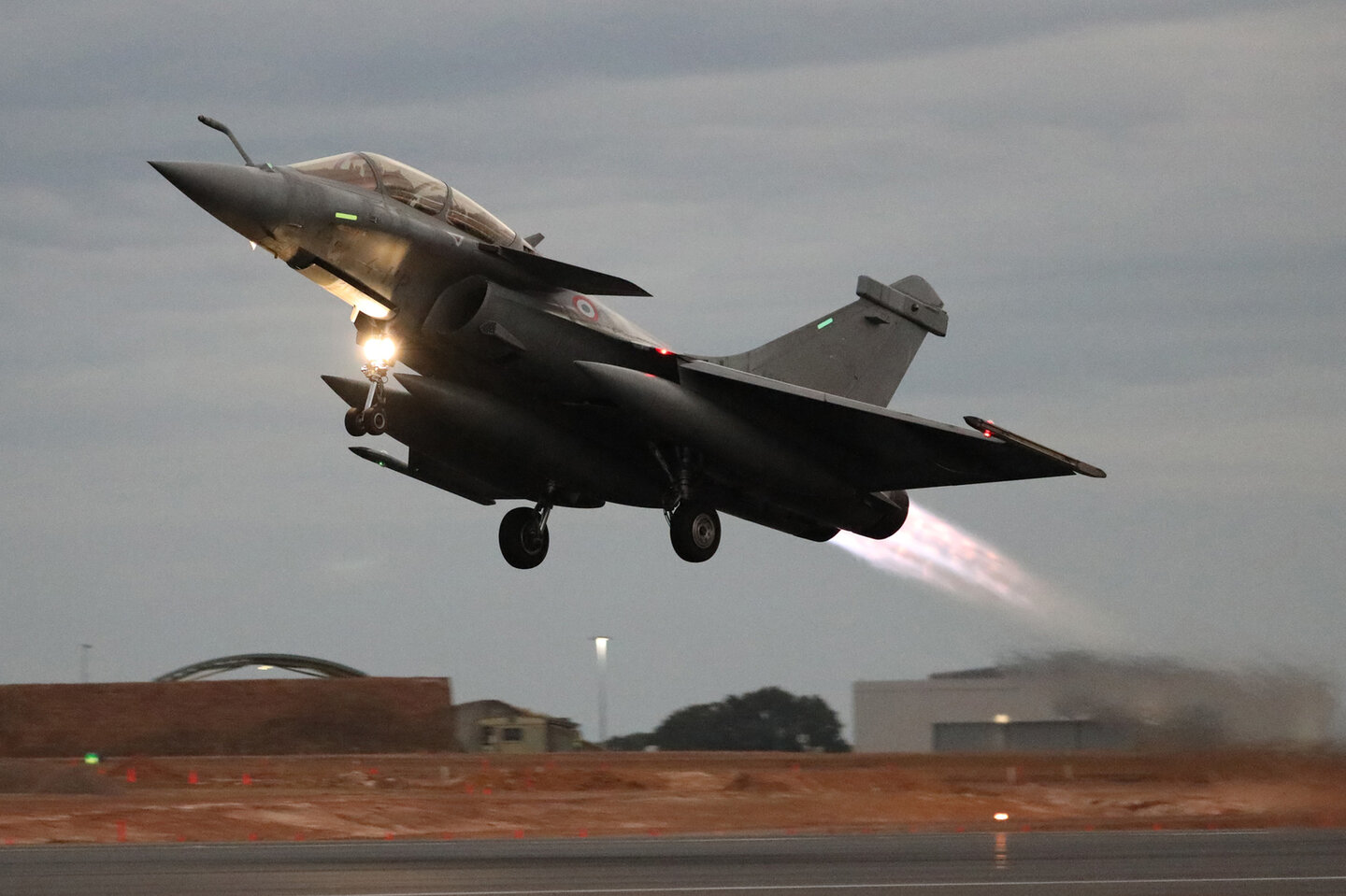
The Rafale was slow to attract exports but has since found success. Credit: Gordon Arthur
The F5 is supposed to enter French service in around 2030, but Paris will have to shoulder development costs alone after the UAE walked away from the programme due to dissatisfaction over access to sensitive technologies.
Yet another European fighter is the Eurofighter. More than 750 have been ordered by ten nations, with Turkey the newest customer. A continuous roadmap of upgrades will ensure the Eurofighter remains a backbone of European airpower into the 2060s, a Leonardo official told Global Defence Technology. It has not achieved an Asian sale yet, but this could change after Bangladesh signed an LoI to buy Eurofighters in December 2025.
Furthermore, Tommaso Pani, Leonardo Aeronautics senior vice-president of Marketing and Sales, shared: “We began engaging with the Philippines authorities around two years ago, and have maintained a continuous dialogue with the objective to fully describe how the Eurofighter Typhoon can best meet their operational requirements.”
Pani said the Eurofighter achieves “one of the highest availability rates in its class,” typically in the 85-90% range.
Asian action
Asian manufacturers are also gaining followings. China’s first modern jet sold overseas was the JF-17, and it is now used by Azerbaijan, Myanmar, Nigeria and Pakistan. The latter was also the J-10’s launch export customer, with the aircraft gaining fame after allegedly downing Indian Rafales in last year’s cross-border war.
Dr. Brendan S. Mulvaney, director of the China Aerospace Studies Institute, told Global Defence Technology the Indo-Pakistan conflict “clearly proves that Chinese-made equipment, even the export versions, are modern and capable, and are going to be a force to be contended with in the future, beyond just the borders of China”.
South Korea is Asia’s other major fighter exporter. Korea Aerospace Industries’ (KAI) top-shelf platform is the 4.5-generation KF-21 Boramae. The first serial-production KF-21 fighter rolled out on 25 March, and it is scheduled to enter Republic of Korea Air Force (ROKAF) service this September.
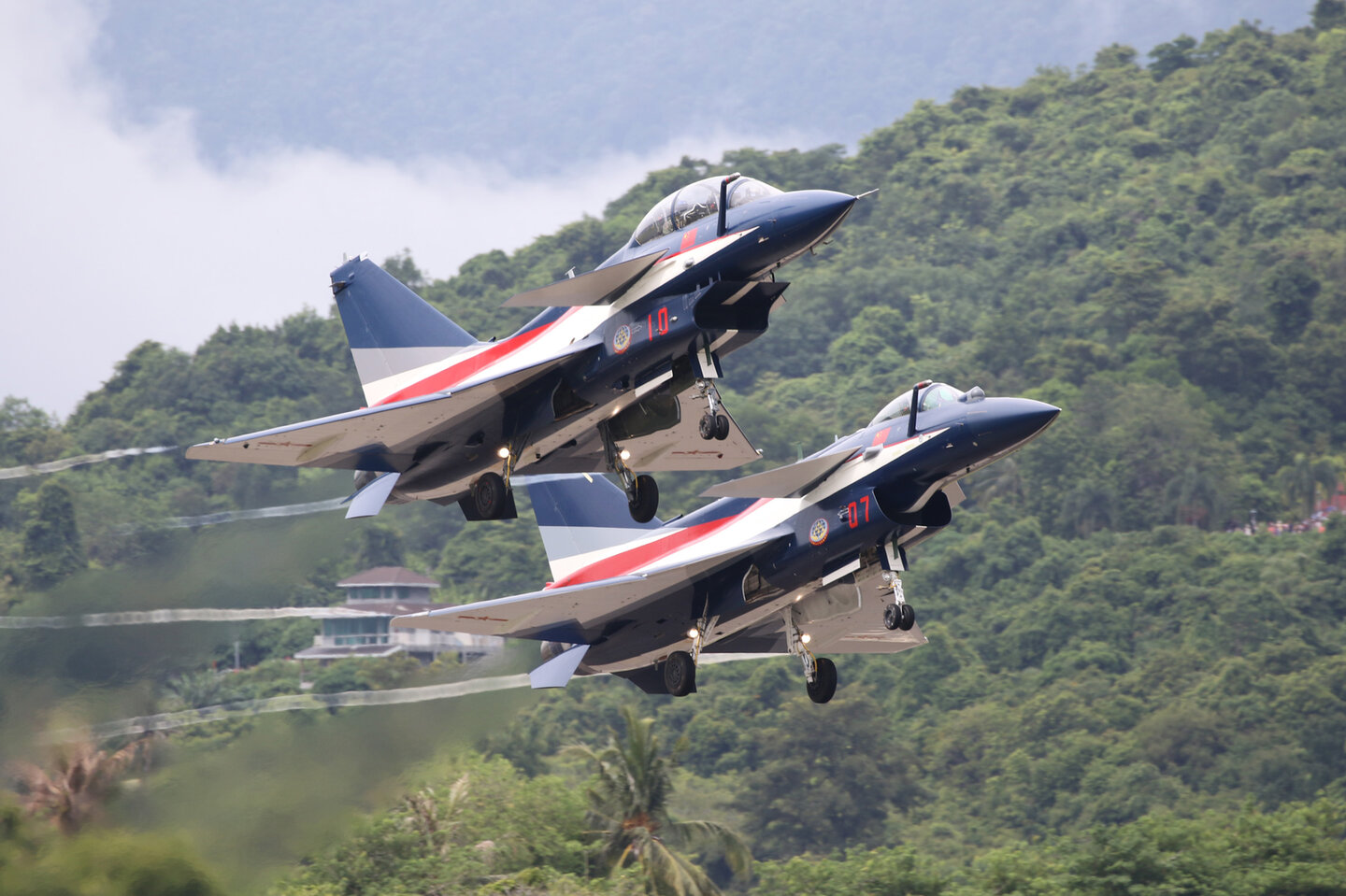
China has been pushing for more sales of its latest J-10C fighter. Credit: Gordon Arthur
The ROKAF has 40 KF-21 Block I aircraft optimised for air-to-air missions on order, with production due to end by 2028. Seoul plans to next order 80 KF-21 Block IIs that have expanded air-to-ground capabilities. The future Block III will feature internal weapons bays and a bigger engine. Other potential evolutions are a KF-21EJ electronic-jammer variant.
KAI is targeting export KF-21sales. Investment partner Indonesia has rights to buy it, but other possible clients are the Philippines and Gulf states. KAI has already enjoyed export success with its T-50/FA-50 light fighter to Indonesia, Iraq, Malaysia, the Philippines, Poland and Thailand.
Returning to the Subcontinent, the Indian Air Force’s fighter strength has depleted to 29 squadrons from its authorised 42. It is reliant on the home-grown Tejas from Hindustan Aeronautics Limited (HAL) to make up numbers but, as commonly happens in India, the Tejas suffers from long development times and slow production rates.
Nevertheless, a timely boost occurred when New Delhi finalised a $7.1bn contract for 97 Tejas Mk1A jets in September 2025. The Mk1A features an indigenous content level greater than 64%, with their delivery slated for 2028-34.
Russian jets like the Su-30/Su-35 have achieved past export sales, but they have fallen out of favour in recent times as Moscow prioritises its war with Ukraine and as US sanctions loom large. Recent orders or deliveries of Russian fighters include Algeria, Belarus, Iran and Myanmar.
