Company Insight
Sponsored by Andvare
Survivability innovation in the modern battlespace
Founded in Vienna in 1852, J. Blaschke Wehrtechnik has developed NBC protection for armed forces since 1980. From gas tight suits to casualty evacuation and sample handling, its equipment is made entirely in Austria and built for operations, not just for test conditions.
Main video credit: tuzla/Shutterstock.com
Throughout the 20 years of the Global War on Terror, the evolution of threats to the warfighter gained pace as the conflict diverged towards an asymmetric battlespace. From the placement of improvised mines and roadside bombs to the deployment of explosively formed projectiles, the incremental development of protected mobility vehicles barely kept pace with the changing threats.
From the earliest days of the conflict, the warfighter ranged the battlespace in the ubiquitous soft-skinned Humvee in Iraq and Afghanistan. As engagements moved towards insurgent warfare, the Humvee was found to be inadequate as a mobility platform. This led to the development and rapid deployment of armoured mobility platforms, including the Australian Bushmaster, designed from the ground up to withstand mine blasts.
The introduction of survivability
Troop mobility has progressed significantly since the days of the Second World War and Korea, where unarmoured vehicles ferried troops from the rear echelons to the front lines. The M113 armoured personnel carrier was a tracked, moderately armoured but flat-hulled vehicle designed to move troops around the European theatre in the event of a Soviet invasion. Its design reflected a markedly different threat environment from that subsequently encountered by troops in Iraq and Afghanistan.
The initial focus was limited to up-armouring existing platforms already deployed in theatre through adding steel plating, some designed and some simply added by vehicle crews themselves. The need for an engineered armoured platform became clear as improvised explosive devices caused mounting casualties.
The introduction of mine-resistant ambush-protected platforms in earnest in 2007 for route clearance and explosive ordnance disposal response increased the focus on protection for convoys and troop movements. Over this period, significant advancements in body armour systems also began to reach the warfighter on the ground, enhancing survivability beyond the vehicle itself.
Survivability in the modern theatre
The rapidly evolving technology of warfare in Ukraine has required a significant change in direction. The introduction of first-person view (FPV) drones to the front lines has made top attack a threat that extends beyond the expensive munitions traditionally deployed by advanced militaries.
The development of protected mobility platforms (PMV’s) over the past 20 years has largely been in response to the roadside threat. Drone attacks introduce different challenges for vehicle protection, in particular overhead protection.
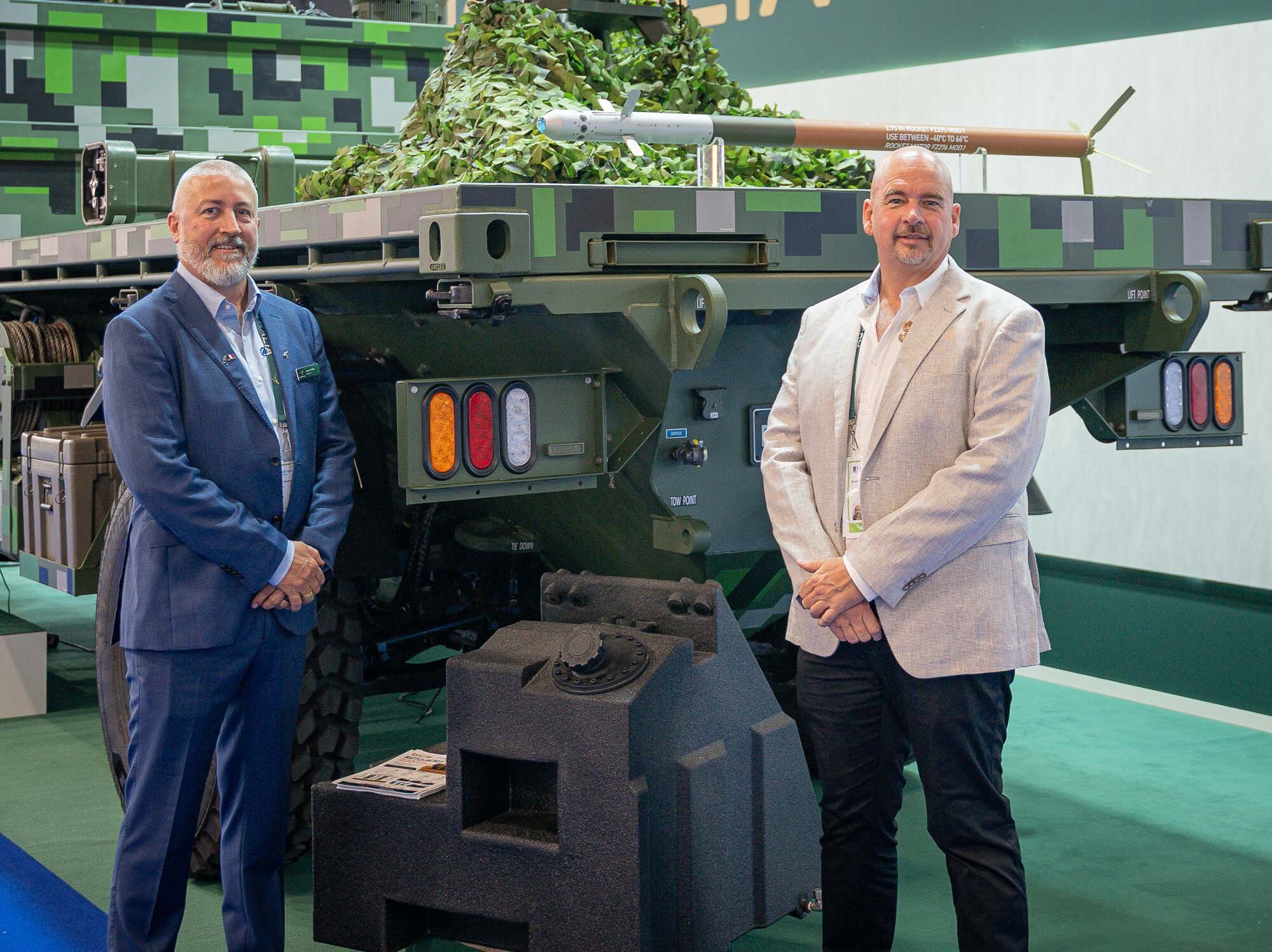
Andvare VI Defence Industries' Justin Willis with Global Coating Systems' Kim Boschman next to the self healing tank and the Bushmaster Mulga variant at Eurosatory in Paris, June 2026
Smaller, more nimble vehicles offer advantages for transport in and around frontline areas. However, protection of the warfighter from drone-deployed fragmentation munitions remains a challenge in thin-skinned or completely unarmoured platforms such as the Polaris MRZR series.
Traditional up-armouring of these platforms would eliminate their key advantages in being nimble and lightweight. Additional armour plating results in a heavier platform, with knock-on effects for the power-to-weight ratio, available payload and manoeuvrability.
Lightweight modular ballistic protection
One Australian company taking a different approach is Andvare VI Defence Industries (ADI), a company based in Perth, Western Australia, specialising in lightweight, modular ballistic armour systems for integration into thin-skinned and unarmoured vehicles.
ADI’s TYR-FR modular ballistic panels are a case in point. According to the company, the fragmentation-rated panel weighs approximately 8.5kg/m². The system can be deployed on the Polaris MRZR D4 at an average weight penalty of 16kg for a roof system, with an additional 8kg for a rear curtain, designed to stop high-speed suicide drones from entering the crew space from the rear.
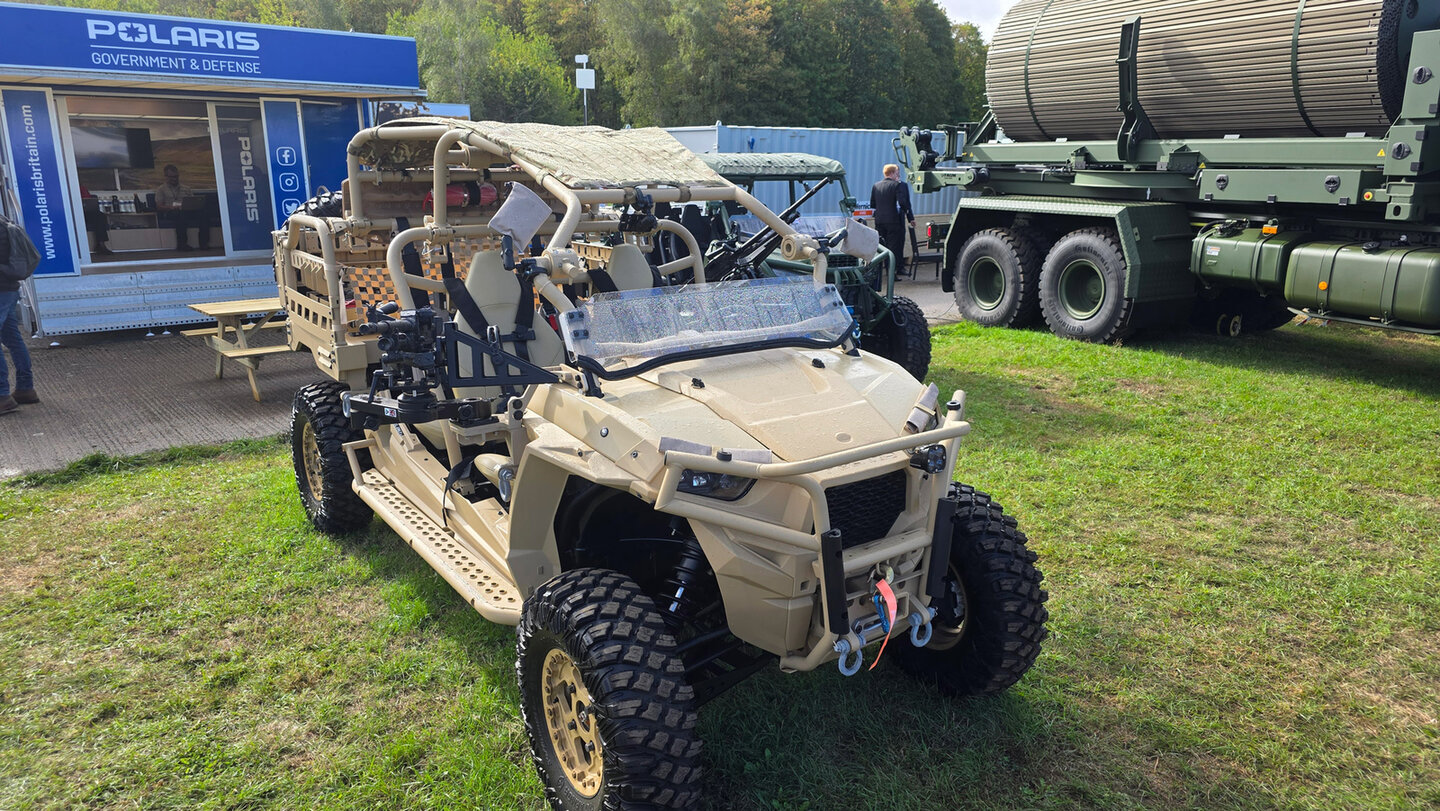
Andvare VI Defence Industries' armoured MOLLE roof for the Polaris MRZR D4 on display at DVD2026 in Millbrook, UK.
The system is intended to protect vehicle occupants from drone-deployed fragmentation munitions and suicide drones armed with simple high-explosive payloads.
ADI says the system was first displayed at SOF Week in Tampa in May 2026 and again at DVD 2026 in Millbrook, UK, in September 2026. The solution for the Polaris MRZR Alpha platform was unveiled at LandForces26, held in Perth, Western Australia in October.
Bushmaster survivability upgrades
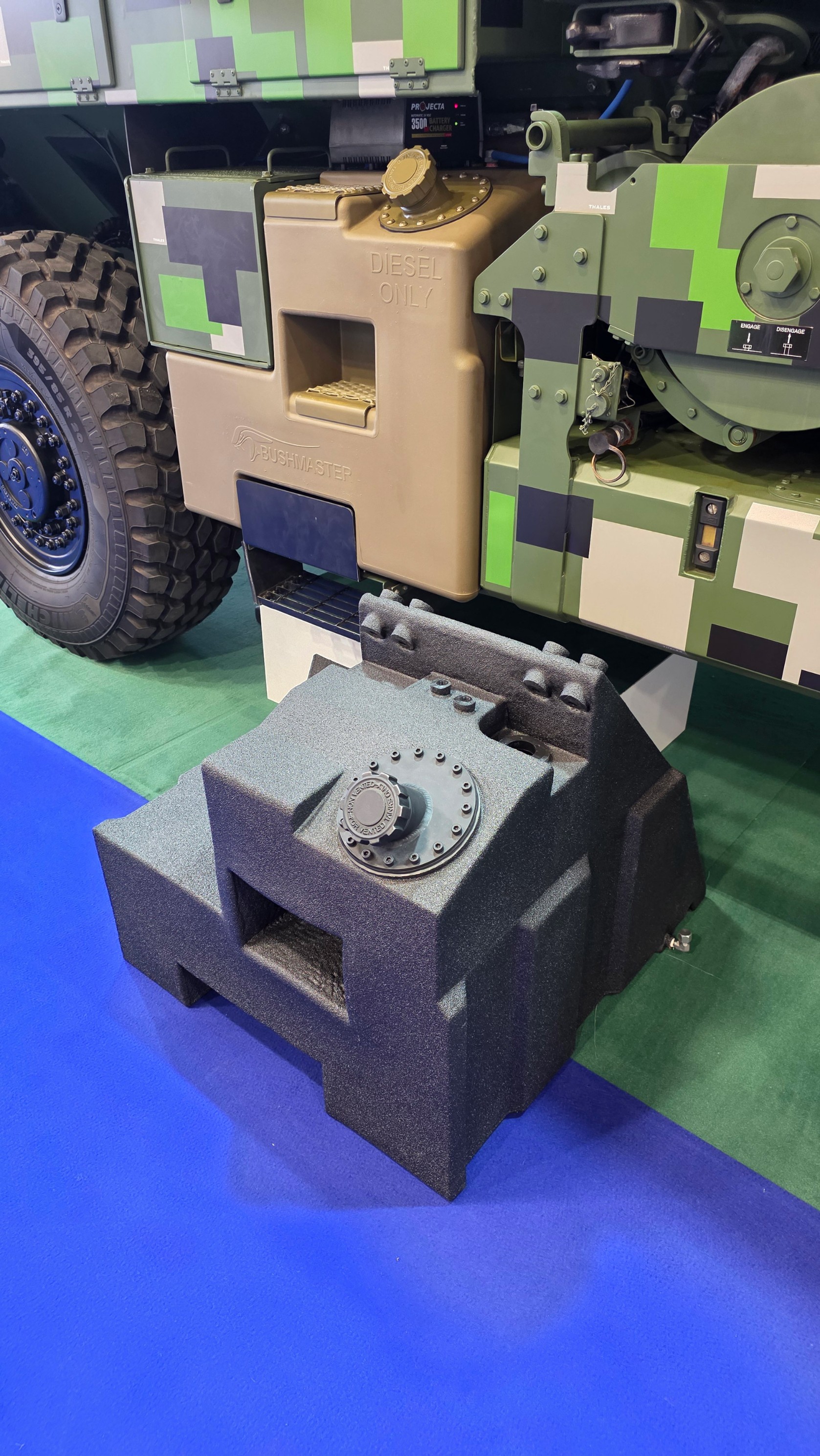
ADI has also contributed to survivability upgrades for the Bushmaster Phase 5.6 programme delivered by Thales Australia. In conjunction with another Western Australian company, Global Coating Systems, ADI says it helped design a self-healing fuel tank for the Bushmaster platform.
Andvare VI Defence Industries' armoured MOLLE roof for the Polaris MRZR D4 on display at DVD2026 in Millbrook, UK.
The tank was displayed alongside Thales Australia’s new Bushmaster Mulga variant at Eurosatory in Paris in June 2026, according to ADI. The self-healing fuel tank uses technology first implemented in the early days of the Iraq conflict, extending on the battlefield proving of the system.
The cooperation between the two companies facilitated the delivery of three proof-of-concept fuel tanks. ADI says approval to proceed was received from Thales Australia in February 2026, with the first tank sent to the US for coating less than six weeks later.
The second tank was used for fitment confirmation on a Phase 5.5 Bushmaster in Geelong, Victoria, and the third was sent directly to Paris for display at Eurosatory.
The survivability improvements do not stop there. Using its developments in the lightweight armoured roof system for the Polaris MRZR, ADI is designing specialised dual-purpose spall curtains for the troop compartment.
The hybrid system doubles as a litter for casualty evacuation and transport. By detaching the spall curtains and using them as armoured litters, crews could provide casualty evacuation functionality from the same vehicle.
ADI says the armoured litter concept was developed following a request from US defence contractor Bluesky Innovations after SOF Week 2026 and was first shown at Eurosatory the following month.
Developing hybrid composite armour
ADI is also extending the development and capabilities of its TYR-ULTRA hybrid composite armour system. According to the company, the aim is to provide improved side and top protection for the Bushmaster without affecting the platform’s overall gross vehicle mass.
ADI reports that its TYR-ULTRA 8 and TYR-ULTRA 12 designs have completed initial kinetic threat testing against STANAG 4569 KE2 and KE3 threats respectively. These are reported initial results, with further development planned for the TYR-ULTRA 14 range.
The TYR-ULTRA 8 system is designed as applique armour, enhancing the existing hull structure’s ballistic rating. ADI says testing has demonstrated protection against STANAG 4569 KE2 threats in this configuration, with a standalone VPAM Level 8 ballistic rating.
At an areal density of 46kg/m², ADI says TYR-ULTRA 8 is approximately 75% of the areal density of the existing appliqué armour on the Bushmaster platform yet increases the ballistic rating.
Contact information
Andvare Defence Industries
Unit 1, 28 Oxleigh Drive
Malaga WA 6090 Australia
PO Box 52 Karrinyup WA 6921
Phone: +61 413 185 119
Email: justin.willis@andvaregroup.com
Website: www.andvaregroup.com