

Briefing
The intelligence
Which teams are left in the UK’s LMV programme?

The British Army will replace its Land Rover utility vehicle. Credit: UK MoD/Crown copyright
An extraordinary series of social media posts from industry in October appeared to reveal which teams had been downselected by the UK Ministry of Defence (MoD) for the British Army’s Light Mobility Vehicle (LMV) programme. All the while, the MoD stayed silent, declining to confirm or deny which firms would compete to replace the in-service Land Rover and Pinzgauer fleets.
Why it matters: Teams Wolf, Grenadier, and Lionstrike, along with Babcock, Supacat, Jaguar Land Rover, and Itturri will all be assessed by the MoD.
Key stat: Up to 9,500 vehicles could be acquired.
Watch: Whether the UK opts for a US offering or sticks with a European solution, in the absence of a wholly UK-built platform.
Raytheon wins contract for SM-3 Block IB missiles
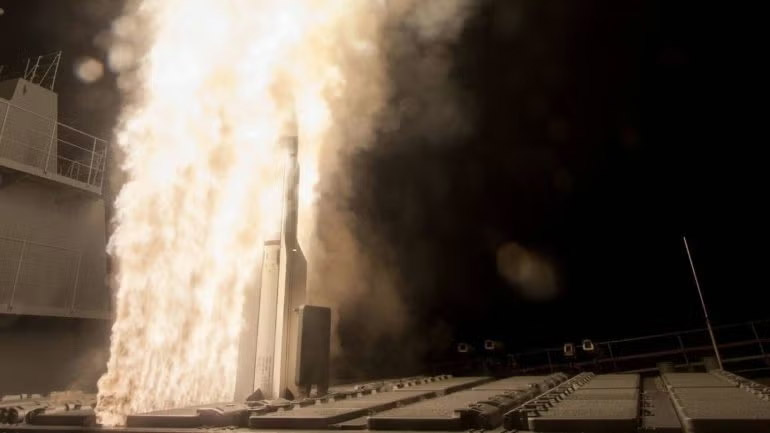
The SM-3 interceptor is designed to destroy short- to intermediate-range ballistic missiles. Credit: RTX/DVIDS
Raytheon has secured a contract worth up to $6.3bn from the US Department of War for the production and sustainment of Standard Missile-3 Block IB (SM-3 IB) interceptors. The agreement spans five years, with options for an additional two years. Under the terms of the contract, Raytheon will supply SM-3 IB interceptors designed to defend against short- to intermediate-range ballistic missiles.
Why it matters: The US is attempting to replenish munitions stockpiles that have been reduced in recent years.
Key stat: $6.3bn contract value.
Watch: Pentagon keen to create multiple-year contracts for industry to incentivise investment into capacity.
Ground broken on new B-21 assembly line

B-21 Raider is a next-generation stealth bomber. Credit: US Air Force
The US Department of the Air Force (DAF) and Northrop Grumman have broken ground on a new final assembly facility for the B-21 Raider at Air Force Plant 42 in Palmdale, California. The project will add more than one million square feet of facilities and support the planned 25% increase in annual production capacity for the long-range strike aircraft.
Why it matters: In February, the DAF and Northrop Grumman finalised an agreement to increase manufacturing capacity for the next-generation stealth bomber.
Key stat: Project will support the planned 25% increase in annual B-21 production.
Watch: The B-21 is currently in flight testing, with the first aircraft expected to be based at Ellsworth Air Force Base, South Dakota, in 2027.
Raytheon wins contract for SM-3 Block IB missiles
The SM-3 interceptor is designed to destroy short- to intermediate-range ballistic missiles. Credit: RTX/DVIDS
Raytheon has secured a contract worth up to $6.3bn from the US Department of War for the production and sustainment of Standard Missile-3 Block IB (SM-3 IB) interceptors. The agreement spans five years, with options for an additional two years. Under the terms of the contract, Raytheon will supply SM-3 IB interceptors designed to defend against short- to intermediate-range ballistic missiles.
Why it matters: The US is attempting to replenish munitions stockpiles that have been reduced in recent years.
Key stat: $6.3bn contract value.
Watch: Pentagon keen to create multiple-year contracts for industry to incentivise investment into capacity.
Ground broken on new B-21 assembly line
B-21 Raider is a next-generation stealth bomber. Credit: US Air Force
The US Department of the Air Force (DAF) and Northrop Grumman have broken ground on a new final assembly facility for the B-21 Raider at Air Force Plant 42 in Palmdale, California. The project will add more than one million square feet of facilities and support the planned 25% increase in annual production capacity for the long-range strike aircraft.
Why it matters: In February, the DAF and Northrop Grumman finalised an agreement to increase manufacturing capacity for the next-generation stealth bomber.
Key stat: Project will support the planned 25% increase in annual B-21 production.
Watch: The B-21 is currently in flight testing, with the first aircraft expected to be based at Ellsworth Air Force Base, South Dakota, in 2027.
EU Council approves five joint defence projects for EDIP funding

The projects are intended to strengthen Europe’s defence readiness and industrial capacity. Credit: Alexandros Michailidis/Shutterstock.com
The European Council has approved five European Defence Projects of Common Interest (EDPCIs), making the cross-border initiatives eligible for funding through the European Defence Industry Programme (EDIP). The projects cover drones and counter-drone systems, maritime and seabed security, space capabilities, integrated air and missile defence, and protection of the EU’s eastern flank.
Why it matters: The EDIP, adopted in 2025, established the EDPCI mechanism for collaborative industrial initiatives.
Key stat: The EDIP was given a €1.5bn budget to run from 2025-2027.
Watch: A dedicated slice of the total budget remains set aside for the Ukraine Support Instrument.
Tracking the developments shaping global construction
By the numbers

$353.8bn
Poland’s defence spend is forecast to more than double, reaching $353.8bn in 2026–31 (vs $173.7bn in 2022–26)
Why it’s key: The Polish Army, Navy and Air Force are undergoing an extensive modernisation programme at both pace and scale.
6.3%
%
The global body armour market is anticipated to register a compound annual growth of 6.3% over the next decade.
Why it’s key: The sector is expected to be dominated by the hard armour segment, which accounts for 54.8% of the market.
7.1%
%
The Australian defence budget is projected to grow at a compound annual growth rate of 7.1% through 2026-2031.
Why it’s key: The increase in defence expenditure is expected to be driven by higher investment in RDT&E programmes.
$19.4bn
The global remote weapon stations (RWS) and turret systems market is valued at $10bn in 2026 and will reach $19.4bn by 2036.
Why it’s key: The ability for platforms to equip a range of modular RWS is increasingly important in defence procurement.
Source: All information has been sourced from GlobalData’s business intelligence unit. For more, click here.
Revealing the scale of global construction demand
Movers & shakers
Revealing the scale of global construction demand
“What the *&$% is wrong with all of you?!”
Protester shouts at delegates during a US Army panel with US Secretary of War Pete Hegseth in Washington DC.
“No beardos, no wierdos, no wimps, no radicals, just warriors.”
US Secretary of War Pete Hegseth comments on the need to inculcate a new culture within the US military.
“A small strike drone is basically competing with a LAW.”
Industry official comments to Army Technology at AUSA 2026 on the role that FPV drones play in the battlespace.
“You’re asking lots of questions. How do I know you didn’t plant the package?”
Security official asks Army Technology if it is responsible for the planting of a suspicious package at AUSA 2026 in Washington DC.
Main video credit: rahathosen/Shutterstock.com