
Interview
Learning and the machine
Even once deployed, AI can be taught to improve its battlefield logic and reasoning. Richard Thomas reports.
Powered by

Main image: Andreas Hellander, CEO and co-founder of Scaleout. Main video credit: Infi Studio/Shutterstock.com
Drones and AI-assisted targeting are shaping modern warfare, with ongoing real-world examples being seen in Ukraine-Russia war and the ongoing Iran-US conflict. In Europe, the UK’s Defence Investment Plan (DIP) has put them at the centre of its Armed Forces’ future.
The DIP includes £100m ($134.6m) for Taskforce RAID, which will focus on AI-enabled swarms, intelligence fusion and AI in denied and degraded environments, alongside £100m for Project FRONTIER, £370m for the Army’s ASGARD recce-strike system and £1.8bn for the Digital Targeting Web.
Those systems will have to keep working when conditions on the battlefield change. An AI model must adapt to decoys, harsh operating environments and new camouflage, like the ‘dazzle camo’ designed to confuse AI-assisted targeting systems on the Ukrainian front.
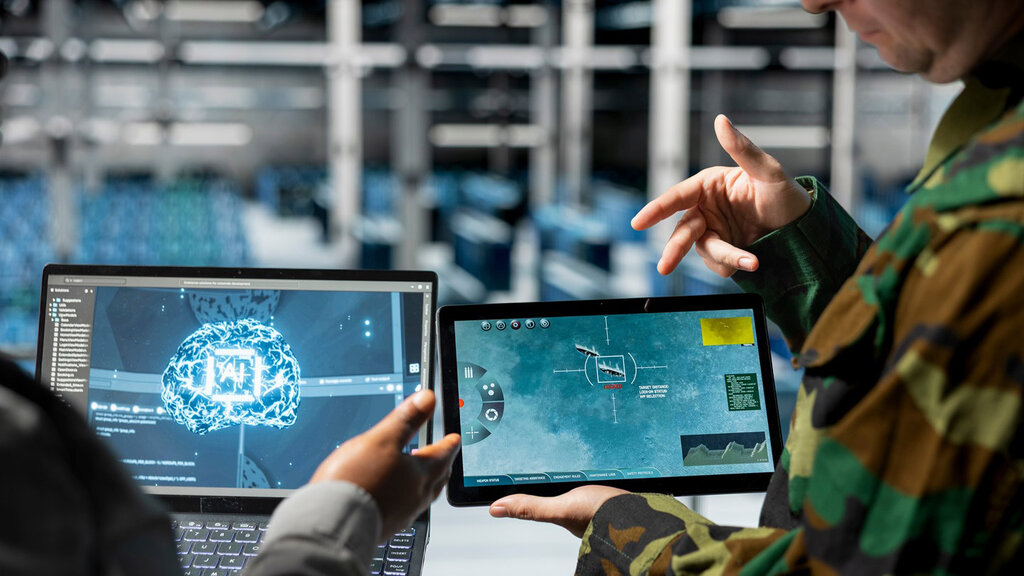
AI and drone warfare operations are becoming synonymous. Credit: DC Studio/Shutterstock.com
Sweden-based Scaleout helps AI models improve across distributed drone networks and sensors without moving raw data back to a central cloud, so target-recognition models can adapt as conditions change.
Scaleout has demoed at BAE Systems Bofors’ winter event, worked on FEDAIR, a Nato DIANA-backed project focused on distributed battlefield AI, and recently partnered with AI Verse to help defence AI models train before deployment and keep improving once they are in the field.
Andreas Hellander, CEO and co-founder of Scaleout, speaks with Global Defence Technology on how battlefield AI targeting systems can continue learning once deployed.
Richard Thomas (RT): How difficult is it for AI to understand a modern battlefield, to differentiate friend from foe, a truck from a tank?
Andreas Hellander: AI has become very capable at recognising objects under controlled conditions, but the battlefield is one of the least controlled environments imaginable. Lighting changes, weather changes, sensors differ, equipment is damaged, vehicles are modified, camouflage evolves, and adversaries deliberately try to deceive automated systems.
Modern AI systems are only as effective as the data they have been trained on. If a model encounters something it has not seen before, e.g., a new vehicle type, a new camouflage pattern or a changed operating environment, it may not perform as intended until it has been updated.
Differentiating between a truck and a tank is often achievable when the model has been trained on representative data. Distinguishing friend from foe is much harder because it depends on context beyond appearance alone, including location, behaviour, communications and operational information.
The challenge is therefore not simply building capable AI models but ensuring they can adapt quickly as conditions change. Systems that cannot update risk becoming temporarily blind to new threats.
“Where zero-emission options aren’t yet practical, efficient combustion engines – running on renewable fuels and hybrids – help customers reduce emissions while the transition progresses.”
Paul Franklin, EMEA TMT market sector leader, HDR

Mark Pestridge, executive VP and GM, Telehouse Europe
RT: What challenge is there for adversary EW to spoof or misdirect AI-driven drone swarms?
(AH): Electronic warfare has always been about disrupting information, and AI systems introduce additional opportunities for adversaries to interfere. An attacker does not necessarily need to compromise the AI model itself. They may instead target the sensors feeding it, disrupt communications, interfere with positioning systems, or manipulate the information the model relies on to make decisions.
Recent conflicts, particularly in Ukraine, have shown that battlefield networks cannot be assumed to be available, reliable or secure. Extensive electronic warfare has disrupted communications links, satellite navigation and data flows supporting unmanned systems, forcing greater reliance on onboard processing and resilient architectures. This highlights a broader challenge for AI-enabled systems: capability depends not only on the model itself, but also on the availability and integrity of the data pipelines supporting it.
This is one reason cloud-first AI architectures are difficult to rely on in contested environments. Systems that depend on continuously transferring operational data to a central location for analysis or retraining may become constrained when networks are degraded, contested or unavailable. EW can disrupt the data flows required to support AI decision-making, creating vulnerabilities in systems that rely on persistent connectivity.
This is exactly the problem federated learning is designed to solve. Instead of moving sensitive operational data to a central training environment, the model goes to where the data already exists, learns locally, and shares only model updates. This enables AI systems to improve while maintaining data sovereignty, security and resilience in environments where connectivity cannot be guaranteed. That reduces reliance on vulnerable data pipelines while allowing AI to continue improving even in disconnected or contested environments.
Continuous learning should never mean uncontrolled learning, however. Model updates still need to be validated, benchmarked and approved before deployment, with full provenance and audit trails so operators know exactly which version of a model is running and how it was trained.
Ultimately, resilience comes from combining robust sensing, distributed AI, governed model updates and human oversight. AI should enhance operational decision-making, but it should do so within an architecture designed for contested environments rather than assuming perfect connectivity.
RT: How does an AI ‘learn’ on the job? What elements is it looking to continue to evolve its understanding of the battlespace?
(AH): Traditionally, AI systems are trained centrally: data is collected, moved to a central location, used to retrain a model, and then the updated model is redeployed. That cycle can be too slow for environments where threats and conditions are changing rapidly.
Synthetic data is becoming an important part of the process. Synthetic data is artificially generated data designed to replicate the characteristics of real-world data used to train AI models. In defence applications, this can include simulated images, sensor readings or environments that represent different vehicles, terrains, weather conditions, lighting, camouflage patterns or threat scenarios. Because the data is generated rather than collected from real operations, it can be created at scale and comes with accurate labels that tell the AI system exactly what it is seeing.
This is particularly valuable because collecting and labelling real-world defence data can be slow, expensive, and operationally sensitive. Synthetic data allows developers to expose models to a much wider range of scenarios before deployment, including rare events or conditions that may be difficult to encounter in reality.
Once systems are deployed, however, the environment continues to change. New vehicles appear, adversaries adapt, weather and terrain conditions shift, and sensors encounter situations that were not represented in the original training data. The ability to continuously improve from real operational data therefore becomes critical.
Federated learning enables this by allowing an AI system to learn from data without that data ever having to leave the place where it was collected. Instead of sending all information back to a central location, the AI model learns locally on each device or site, then shares what it has learned to improve the overall model. This means AI systems can continue adapting to new information while keeping sensitive data secure and under the control of the organisation that generated it.
The future of defence AI will not be based on a single training approach. It will require a combination of synthetic data to accelerate development, real-world operational data to maintain relevance, and infrastructure that enables models to improve safely throughout their lifecycle.
RT: How successful have initiatives like ‘dazzle camo’ been in Ukraine, and are other known examples of actions that militaries take to disrupt AI analysis in the field?
(AH): Militaries have always adapted camouflage, concealment and deception techniques as detection technologies evolve. AI does not fundamentally change that dynamic; it accelerates the pace at which detection and adaptation occur.
Any advantage gained from techniques such as dazzle camo is therefore likely to be temporary. A disruptive pattern that initially reduces the confidence of automated detection systems may become less effective once examples are observed and incorporated into training datasets. A zebra-striped vehicle may initially represent an unusual signature, but as examples become available, AI systems can learn to recognise it as a vehicle rather than treating it as an ambiguous object.
The broader challenge is that this creates a continuous cycle of adaptation. Adversaries develop new camouflage patterns, concealment methods and decoys to defeat detection systems; AI models must then adapt to recognise those changes; and adversaries respond with new techniques. The advantage will go to those that can shorten the time between identifying a new battlefield signature and improving their models. Synthetic data will play an important role by allowing AI systems to be exposed to a wider range of potential threats and environmental conditions before those signatures are encountered in real operations.
The same principle applies to other signature-management techniques, including thermal signature reduction and multispectral camouflage. These methods aim not necessarily to make a target invisible, but to alter the data available to detection systems and reduce classification confidence. As with disruptive camouflage, their effectiveness is likely to diminish as examples are collected or replicated, models are updated, and synthetic data is used to expose AI systems to a wider range of possible battlefield conditions.