

Feature
Land Forces 2026: Australia decides
Australia’s defence procurement is largely decided, but opportunities remain. Gordon Arthur reports.
Main image: Thales Australia unveiled its BladeHaul extra-large UGV, developed in conjunction with 3ME, at Land Forces 2026. Credit: Gordon Arthur
Powered by

Thales Australia unveiled its BladeHaul extra-large UGV, developed in conjunction with 3ME, at Land Forces 2026. Credit: Gordon Arthur
When Australia issued two pivotal documents – the National Defence Strategy 2026 and Integrated Investment Program 2026 – on 16 April this year, the government pledged an additional A$14bn ($10bn) in defence expenditure over the next four years, and an extra A$53bn over the coming decade.
If this eventuates, it will bring Australia’s cumulative defence expenditure to A$887bn over the coming ten years and achieve a target of defence spending reaching 3% of GDP by 2033/34.
The documents acknowledged “that Australia will face elevated levels of geopolitical risk over the coming decade, and our exposure to force projection and military coercion will reach levels not seen since the Second World War”.
China ranks as the most formidable threat to security, and the army is bulking up on equipment suitable for littoral warfare, particularly in the archipelagic region to Australia’s north.
It was against this procuremtn background that Land Forces 2026 was held in Perth, Western Australia from 6-8 October.
With many army programmes already awarded – such as medium and heavy landing craft (Austal); amphibious cargo vehicles (Birdon); AS21 Redback infantry fighting vehicles (Hanwha); AS9 Huntsman self-propelled howitzers (Hanwha); Boxer combat reconnaissance vehicles (Rheinmetall); NASAMS (Raytheon); HIMARS (Lockheed Martin); AH-64E Apaches (Boeing); UH-60M Black Hawks (Sikorsky); Project Land 156 counter-drone integrator (Leidos); and Project Land 4140 C4I integrator (Boeing) – there are not many major projects left to fight over.
The situation is further compounded by the fact that Australia’s AUKUS Pillar I quest for nuclear-powered submarines is sponging up enormous amounts of cash – A$71-$96bn dollars in the coming decade, to be exact.
The decade-long breakdown in Integrated Investment Program 2026 estimates maximum total planned investment in battlefield aviation (A$7bn), land fires and strike (A$7.34bn), armoured vehicles and protected mobility (A$23.7bn), amphibious lift and littoral manoeuvre (A$11-12bn) and land command systems (A$7.6bn).
Air defence
The largest project about to cross the start line is an urgent requirement for medium-range ground-based air defence. A Project Land 6504 tender was expected to be launched before 16 October 2026, as the Australian Army seeks an air defence tier beyond that of NASAMS. This missile system will consume a good proportion of the A$7.2-$10bn promised for air defence over the coming decade.
Canberra wants a system able to intercept ballistic missiles in their terminal phase, as well as air-breathing threats.
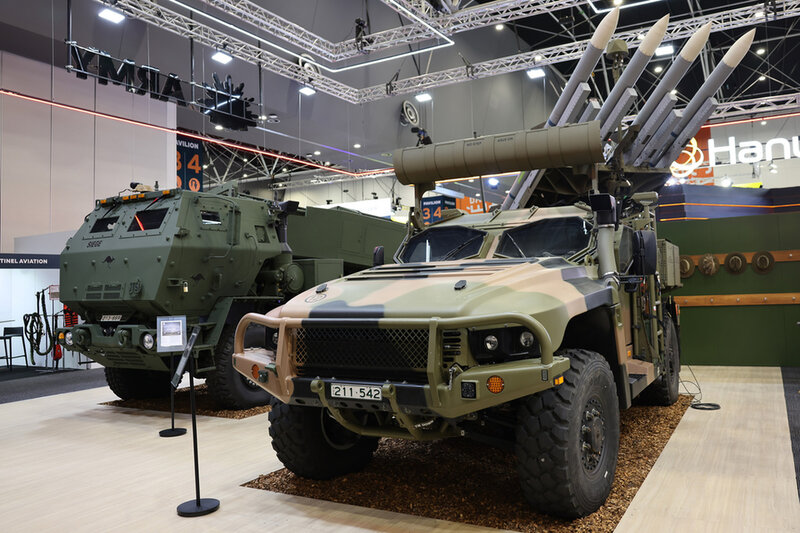
NASAMS is currently the Australian Army’s only ground-based air defence weapon. Credit: Gordon Arthur
Because of a very compressed timeline, Australia is seeking a proven, military-off-the-shelf solution, plus it must integrate with CEA Technologies radars and Lockheed Martin’s Joint Air Battle Management System. Bidders have until 26 November 2026 to provide a response, with final selection to occur by the end of 2027.
An initial operational capability is slated for the early 2030s, and a final operational capability in the mid-2030s. Vendors from Europe, Israel, South Korea, Türkiye and the US are showing interest.
New kit
The award for the biggest reveal at Land Forces 2026 goes to Thales Australia with its BladeHaul extra-large uncrewed ground vehicle (UGV). Designed for contested logistics, this UGV can carry a 20-foot container or 10-tonne payload. Based on the chassis of the Bushmaster protected vehicle, 3ME Technology has revamped the propulsion to a hybrid 660V power system offering 110kWh of power.
Thales Australia envisages three potential uses for the BladeHaul: contested logistics; as an exportable power source (for example, a field hospital or command post); and a mobile platform for sensors and effectors. Potential roles under the latter category include launching coastal anti-ship missiles, carrying counter-drone systems or air surveillance radars, reloading munitions or detecting/clearing mines.
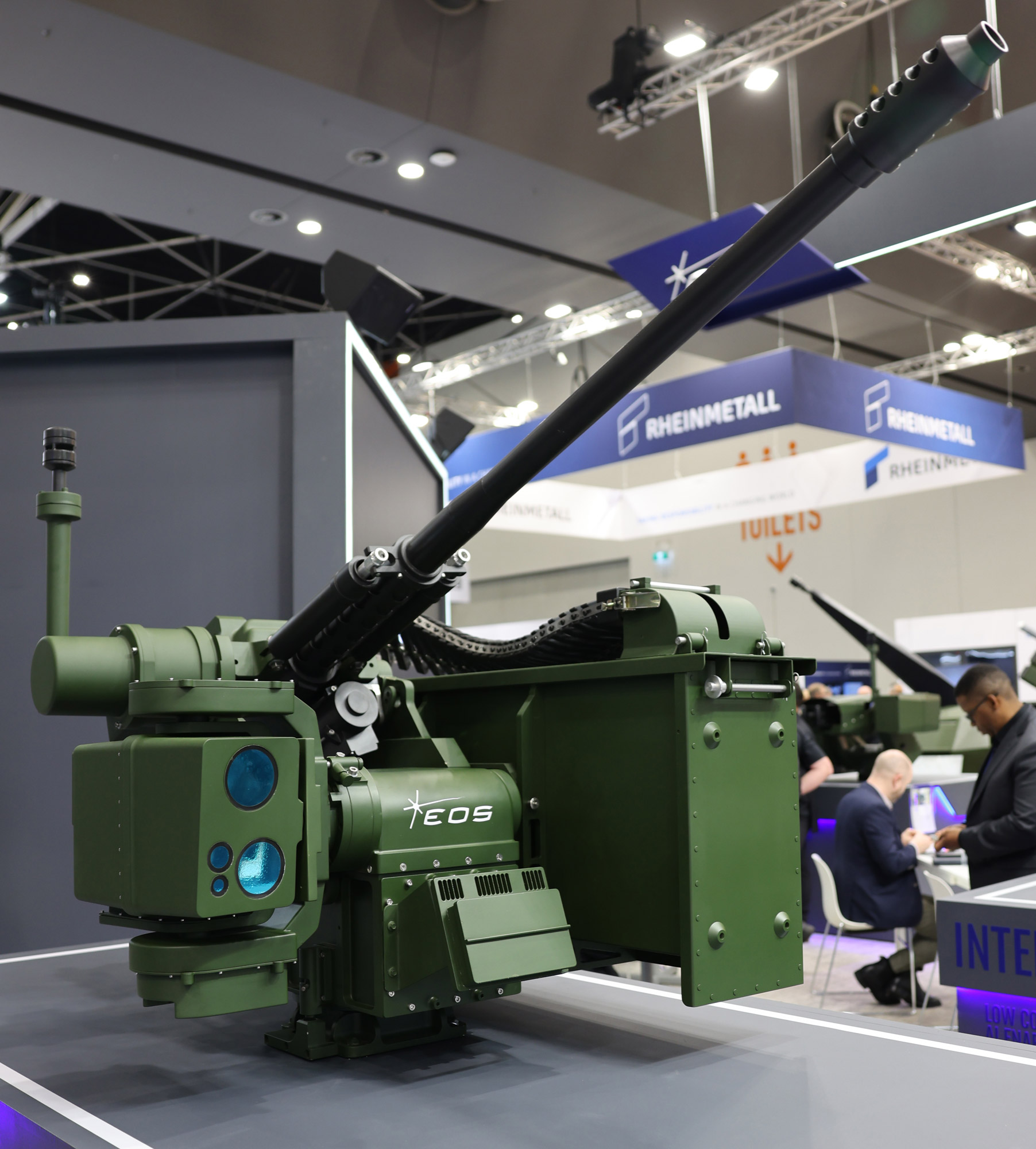
EOS has supplied small numbers of R400 Slinger remote weapon stations to the army for Land 156 trials; these being mounted on Hawkei vehicles. Credit: Gordon Arthur
“Where zero-emission options aren’t yet practical, efficient combustion engines – running on renewable fuels and hybrids – help customers reduce emissions while the transition progresses.”
Mats Bredborg, segment leader for Volvo CE
Thales Australia said its UGV, whose autonomy stack will come from Deakin University, “is engineered to outperform all existing and planned counterparts in payload capacity and operational flexibility”. The BladeHaul is aimed at the Australian Army as well as export markets.
Thales Australia also debuted a Bushmaster Mulga dual-cab variant with a rear cargo deck. It was seen fitted with a RapidStriker counter-unmanned aerial system (C-UAS) suite featuring an EOS R400 remote weapon station (RWS) armed with Thales 70mm rockets, a Robin 3D Iris radar and a Thales electro-optical/infrared sensor.
At the exhibition, Thales also signed a memorandum of understanding with German firm Stark to integrate the latter’s new 100km-range Cascade loitering munition.
Such a Bushmaster variant would be capable of defeating drones as well as launching precision strike munitions. This reflects Thales Australia’s intention to evolve the Bushmaster from a mere troop transport vehicle into a sensor and effector platform better suited to modern warfare. Of interest, Australia’s order of 268 new vehicles announced in April 2026 may yet include such Bushmaster dual-cab variants.
Counter-drone gathers pace
Initiated in February 2025, Project Land 156 is rolling out C-UAS suites for dismounted soldiers, combat formations and fixed installations. Leidos Australia was appointed prime systems integration partner last year for this ongoing, multiyear effort.
The Australian Government said in August 2025 that it had set aside A$1.3bn for counter-drone capabilities over the coming decade. However, divided by ten, this averages just A$130m annually, and many companies are vying for a slice of the pie.
Some local and overseas companies to receive contracts so far, with many exhibiting at Land Forces 2026, include: Acacia Systems, AIM Defence, Anduril, Department 13, DroneShield, DZYNE, Echodyne, EOS, Genesis Arms, L3Harris, MyDefence, OpenWorks Engineering, Silentium Defence and Sypaq.
Canberra claimed that, as of early 2026, it had awarded Land 156 contracts worth a cumulative A$41.4m to 21 companies.
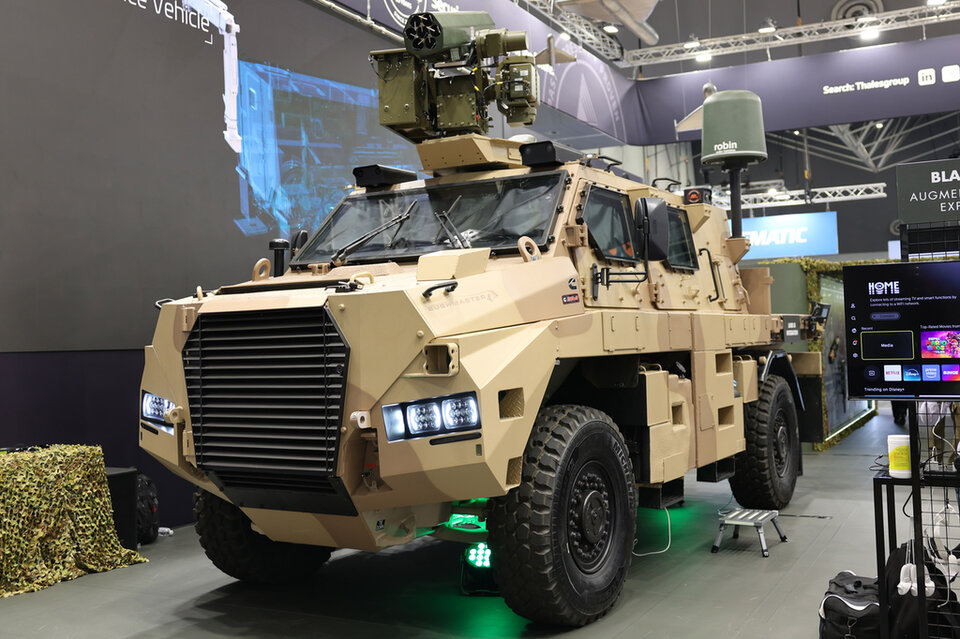
This is the first time Thales Australia has shown a dual-cab version of its Bushmaster. This one is outfitted with the RapidStriker counter-drone suite. Credit: Gordon Arthur
Australia’s fledgling C-UAS system underwent an Integrated C-UAS Acquisition, Refresh and Upgrade Schedule (ICARUS) demonstration late last year, with another scheduled for the end of 2026. The main elements the Department of Defence seems to have settled on so far are Acacia Systems’ Cortex C2 system, EOS’ Slinger RWS, Department 13’s DART radio frequency detection system, Echodyne’s EchoGuard short-range radar and L3Harris’ VAMPIRE laser-guided rocket system.
Nonetheless, with Land 156 only being drip-fed small contracts so far and with no mass rollout yet occurring, many counter-drone companies were out promoting their wares at Land Forces 2026.
Drones
Another strong showing at the Perth exhibition came from unmanned aerial vehicle (UAV) companies, with plentiful expertise resident in Australian companies. One example is Sypaq, which completed delivery of Corvo X UAVs to the Australian Army earlier this year. Acquired under the DEF129 programme, the fixed-wing Corvo X weighs 1.8kg.
Under the Mission Syracuse initiative, Sypaq is also developing the Corvo Strike drone interceptor. Sypaq expects to demonstrate it in late 2027, and the complete system should be ready in Q1 of 2028. The Corvo Strike employs a proximity fuse to detonate its warhead within metres of drone targets. Australian company Nioa is supplying the warhead and fuse. Incidentally, Sypaq unveiled its tube-launched Corvo Vipera reconnaissance quadcopter at Land Forces 2026.
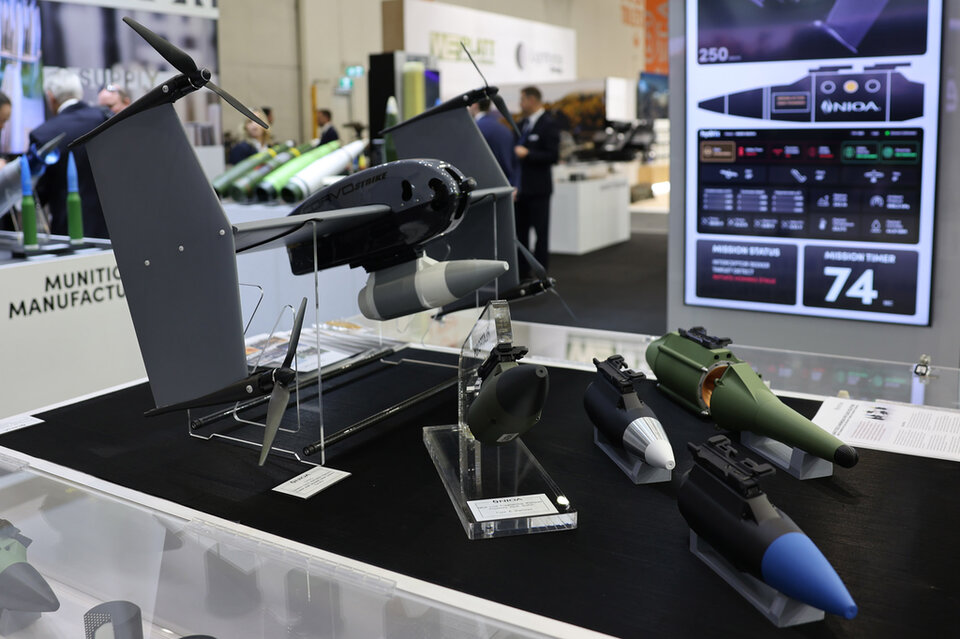
Sypaq’s Corvo Strike drone interceptor UAV is around halfway through its scheduled development phase. Credit: Gordon Arthur
Brigadier James Davis, director general systems and integration, Australian Army, told Global Defence Technology that the Australian Army has a UAV fleet numbering in the low thousands.
“I don’t know the exact number and that probably points to a philosophy, as some of this is decentralised and we allow units to acquire their own systems. And the other thing is, a lot of these systems are what we call attritable, so we don’t expect they’ll have a particularly long life,” Davis said.
The army’s most capable UAV is the Insitu Integrator, but the service is also exploring first-person-view drones and loitering munitions. Medium- and long-range loitering munitions will be appropriated through Project Air 6020, while Project Land 300 will furnish individual soldiers with systems.
The army bought a small number of Aerovironment Switchblade 300s to gain familiarity with loitering munitions, and through Mission Talon Strike it has invested money in Innovaero to develop the OWL-B. This locally developed loitering munition is currently at Technology Readiness Level 8.