
Analyst Comment
Prime position: Türkiye ready for drone innovation
The wars in Ukraine and Iran have underscored the importance of loitering munitions. By Callum Kaye, defence analyst at GlobalData.
Powered by

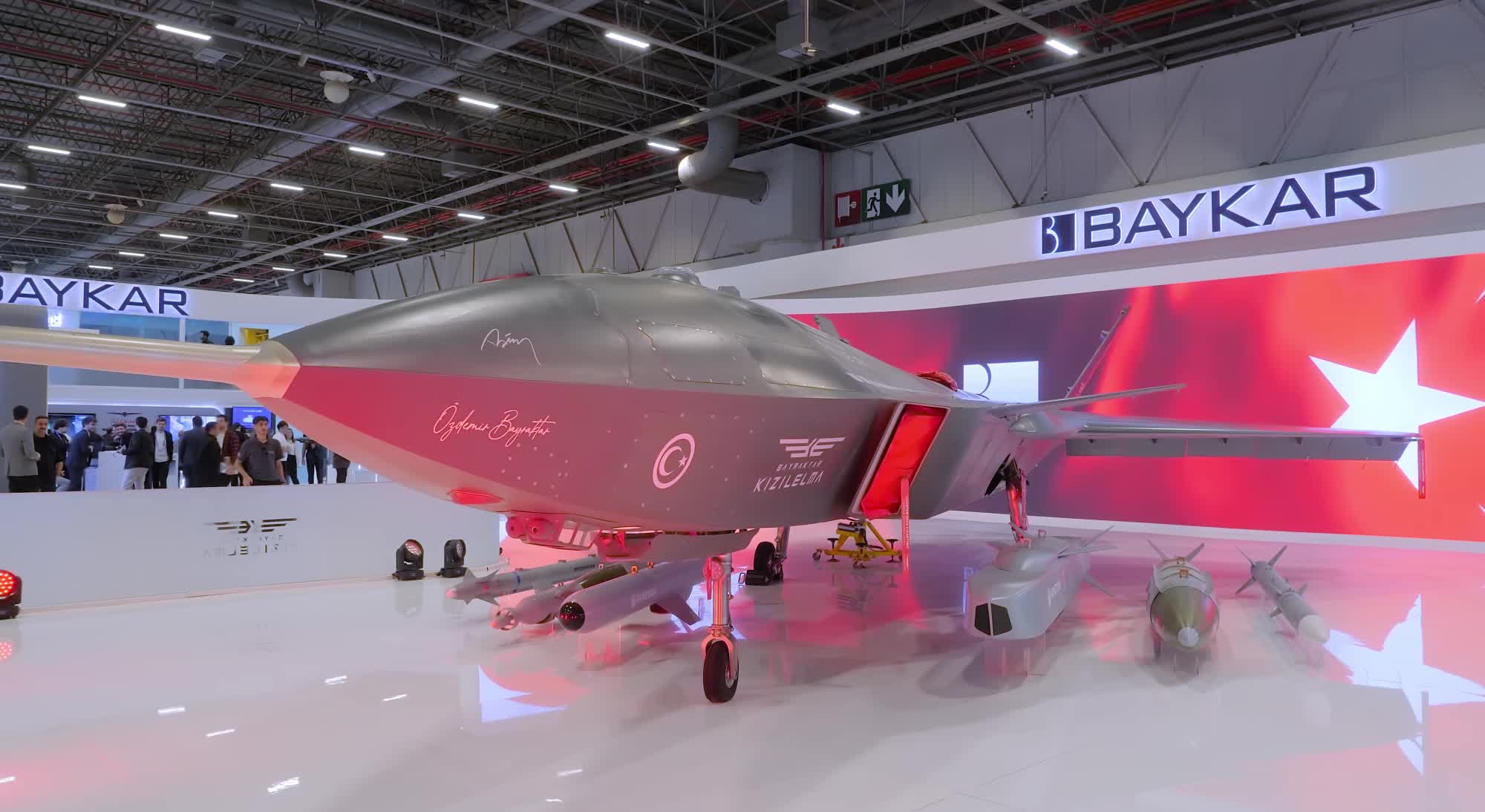
Main video: SAHA EXPO Defence Exhibition. Baykar Kizilelma next-generation combat UAV displayed with missiles - advanced Turkish aerospace technology. Ccredit: Zyabich family/Shutterstock.com
See GlobalData’s recently published report on loitering munitions and the Türkiye Defense Market 2026-2031 report for more information.
The Ukraine war and the 2026 Iran war have underscored the pivotal role of loitering munitions (LMs) on the modern battlefield. The Russian Federation Armed Forces have exponentially increased their LM usage as the five-year conflict continues.
In the entire year of 2024, Russian forces launched more than 6,000 Shahed/Geran at Ukraine. This increased markedly in 2025, with approximately 32,000 Shahed/Geran launched out of a total of nearly 55,000 launches of uncrewed aerial vehicles (UAVs) of all types.
By March 2026, the Ukrainian Ministry of Foreign Affairs claimed that Russia had launched more than 57,000 Shahed/Geran since the start of the invasion in 2022.
Meanwhile, the Iranian Revolutionary Guard Corps’ (IRGC) use of the Shahed series, the Shahed-136 and Shahed-238 in particular, has formed the backbone of Iran’s offensive military capability during the 2026 war.
Despite the conventional forces of both the IRGC and Artesh being largely destroyed since the commencement of US and Israeli strikes in April, LMs and one-way attack drones have proven to be a survivable asset capable of bypassing air defences and causing damage to military sites and key infrastructure, causing long-term disruption in the process.
Türkiye’s primes, Baykar in particular and others, are highly likely to play a key role. Credit: Karolis Kavolelis/Shutterstock.com
This, in turn, has been an important enabler for Iran’s asymmetric warfare strategy to carry out persistent strikes despite the superiority of US and Israeli forces, and demonstrates how LMs and one-way attack drones are narrowing the gap in modern asymmetric warfare.
In the early stages of the conflict, Shahed-type drones were capable of penetrating the air defences of the Gulf States, inflicting substantial destruction and damage. This has included the destruction of a US Air Force E-3 Sentry on the ground at Prince Sultan Air Base, Saudi Arabia and strikes on QatarEnergy liquefied natural gas (LNG), removing 17% of Qatar’s LNG exports, with repairs estimated to further remove 12.8 million tons of LNG annually for the next three to five years.
Even by June 2026, the IRGC was able to continue using its Shaheds to devastating effect, with a strike on Terminal 1 of Kuwait International Airport on 3 June rendering the terminal building inoperable just two days after Kuwait opened its airspace.
Drones as LM relay
With their importance clearly illustrated, major military powers are accelerating the procurement of LMs, and Türkiye’s major primes, Baykar in particular and others, including STM, are highly likely to play an important role in facilitating this.
Baykar, already established in the wider UAV market with its TB2 and TB3 drones, unveiled its three LMs—the K2, the Mizrak and the Sivirisinek—for the first time at the 2026 Saha Expo.
The K2 is the largest of Baykar’s LMs and has a payload of 200kg. It has an endurance of 13 hours and a range of 2,000km, with the propeller engine allowing for a cruise speed of 70 knots. Line-of-sight (LOS) communications range is approximately 100km, which can be extended with a beyond line of sight (BLOS) channel.
The Mizrak comes in two variants, one that uses the full 40kg payload for the warhead, and one that is armed with a 20kg warhead in addition to a radar seeker used in the terminal attack phase. The Mizrak has an operational ceiling of 4,000ft and its propeller engine provides a cruising speed of 80 knots, with an endurance of seven hours and an operational range exceeding 1,000km.
The Sivrisinek is co-developed by Baykar and the Pakistan Air Force’s National Aerospace Science and Technology Park (NASTP). The design of the LM utilises the body of an OMTAS anti-tank missile, with a wing, tail, and propeller engine attached. There are two variants of the LM, the Sivrisinek-UM and the Sivrisinek-UMX. According to Baykar’s technical specifications, both have an identical operational altitude of 4000ft and cruise speed of 55 knots.

The Iranian-origin Shahed has become synonymous for drone warfare. Credit: Mr Changezi/Shutterstock.com
The UMX is fitted with an AI-assisted electro-optic camera. As such, the UM, with a reduced weight, has an extended endurance of approximately nine hours in comparison to the eight hours of the UMX, in addition to a superior range of 1,000km in comparison to the UMX’s 900km.
During an April 2026 demonstration at Baykar’s Test Center, Baykar showcased a coordinated strike utilising the K2 and Sivrisinek LMs in combination with the TB2, TB3 and Akinci UAVs. In addition to featuring AI to allow for autonomous strike capability, Baykar intends for all three of its LMs to utilise its TB2, TB3 and AKINCI UAVs as command-and-control relays.
The utilisation of drones as relays is set to become a key requirement for militaries seeking to acquire an LM strike capability. First and foremost, using a relay such as a UAV substantially increases the range of the LM beyond the curvature of the Earth. In that vein, a relay additionally allows radio signals to bypass buildings and mountainous terrain, better enabling the LM to fly at a lower attitude and thereby evade detection, in addition to better concealing the operator.
As well as this, relays maintain the strength of the radio signals between the LM and the operator, resulting in a clearer video image with which the operator can identify targets. Moreover, although it cannot remove the threat of persistent jamming entirely, a strong radio signal can bypass an adversary’s electronic warfare noise.
Can rivals disrupt Turkish lead?
Given the dominance that Turkish companies, including Baykar, have in several regional UAV markets, they are well placed to replicate this dominance in the loitering munition segment, with the ability to offer LMs that can integrate into UAVs to enable relays being a strong driver in consolidating their market presence.
To be able to compete, other suppliers are highly likely to offer LMs and UAVs with integrated relaying capability. This also has the potential to include the ability to relay with LMs and UAVs from multiple manufacturers.